

What if the years you've spent on Australian worksites were worth more than just a weekly paycheck? You've already mastered the skills and handled the pressure, yet without a formal certificate, you might feel stuck behind a glass ceiling when it comes to pay rises or trade licensing. It's frustrating to think about spending months in a classroom learning things you could teach the instructor, especially when you have a career to maintain and a family to support. We agree that the path to professional validation often feels buried under mountains of bureaucracy and confusing regulations, which is why rpl offers such a vital alternative for experienced professionals.
This guide is designed to simplify that journey by explaining how Recognition of Prior Learning works in 2026. You'll learn exactly how to map your existing competence to national standards to obtain a qualification quickly and efficiently. We'll preview the latest 2026 assessment requirements, break down the typical evidence needed, and show you how a facilitation service can help you navigate the process without the usual stress or complexity.
Key Takeaways
- Discover how to transform your years of on-the-job experience into a nationally recognised qualification using current Australian standards.
- Learn how the rpl process maps your daily tasks to specific units of competency, saving you from redundant study in a classroom.
- Compare the efficiency and cost-effectiveness of skills recognition against traditional TAFE pathways to make an informed career decision.
- Identify the essential primary and secondary evidence required to build a professional portfolio that meets strict regulatory standards.
- Understand how a facilitation service can navigate the bureaucratic hurdles and streamline your journey toward a trade or professional certificate.
Recognition of Prior Learning (RPL) in 2026: Why Experience is Your Greatest Asset
If you've spent years on the tools, in the office, or managing complex projects, you've already done the hard work. In the current 2026 Australian job market, employers are increasingly prioritising proven competency over theoretical knowledge. This is where Recognition of Prior Learning becomes your most valuable tool. It is a formal assessment process that acknowledges the skills you've gained through work and life experience, allowing you to convert that history into a formal qualification.
There is a critical distinction between simply having "experience" and possessing "nationally recognised competency." While you might know how to lead a crew or manage a site, a regulator or a new employer needs to see that your skills align with specific Australian standards. By using rpl, you bridge the gap between what you do every day and the formal benchmarks required for higher pay grades or trade licensing. This pathway is ideal for seasoned tradies who need to formalise their status, as well as professionals in the mining, construction, and healthcare sectors who want to move into management roles without spending years back in a classroom.
Many professionals in these sectors also enjoy applying their practical expertise to the great outdoors during their downtime. If you're an enthusiast for remote travel and camping, you can discover Adventurerz to connect with a community of like-minded explorers.
The Role of the Australian Qualifications Framework (AQF)
Every qualification obtained through skills recognition sits within the Australian Qualifications Framework (AQF). This means a certificate earned through the rpl process carries exactly the same weight and legal standing as one earned through full-time classroom study. These qualifications are built from "Units of Competency," which are specific descriptions of skills and knowledge required to perform a job. In 2026, with the Australian Skills Quality Authority (ASQA) implementing stricter standards for Registered Training Organisations (RTOs), having a well-prepared evidence portfolio is more important than ever. Right Pathway acts as a facilitation service to help you navigate these standards, ensuring your experience is correctly mapped to the current versions of qualifications found on training.gov.au.
RPL for Skilled Migrants: Bridging the Australian Gap
For the 2026-2027 period, the Australian government has allocated 185,000 places in the permanent Migration Program, with a heavy focus on skilled workers. If you are a skilled migrant, your international experience is a powerhouse of potential, but it often requires "translation" into the Australian context. Local certification is frequently the missing link that secures employment or meets the requirements for a skills assessment. Obtaining an Australian qualification through a facilitation service helps you demonstrate that your global expertise meets local safety, regulatory, and technical standards. For those in civil infrastructure, you can learn more about ML Traffic Engineers Australia to see how these standards are applied in a professional traffic engineering context. It's a practical way to ensure you aren't starting from the bottom when your skills are already at the top.
Right Pathway is a facilitation service. We are not a Registered Training Organisation (RTO) and do not issue qualifications directly. We support you in preparing your evidence and navigating the pathway toward an RTO assessment.
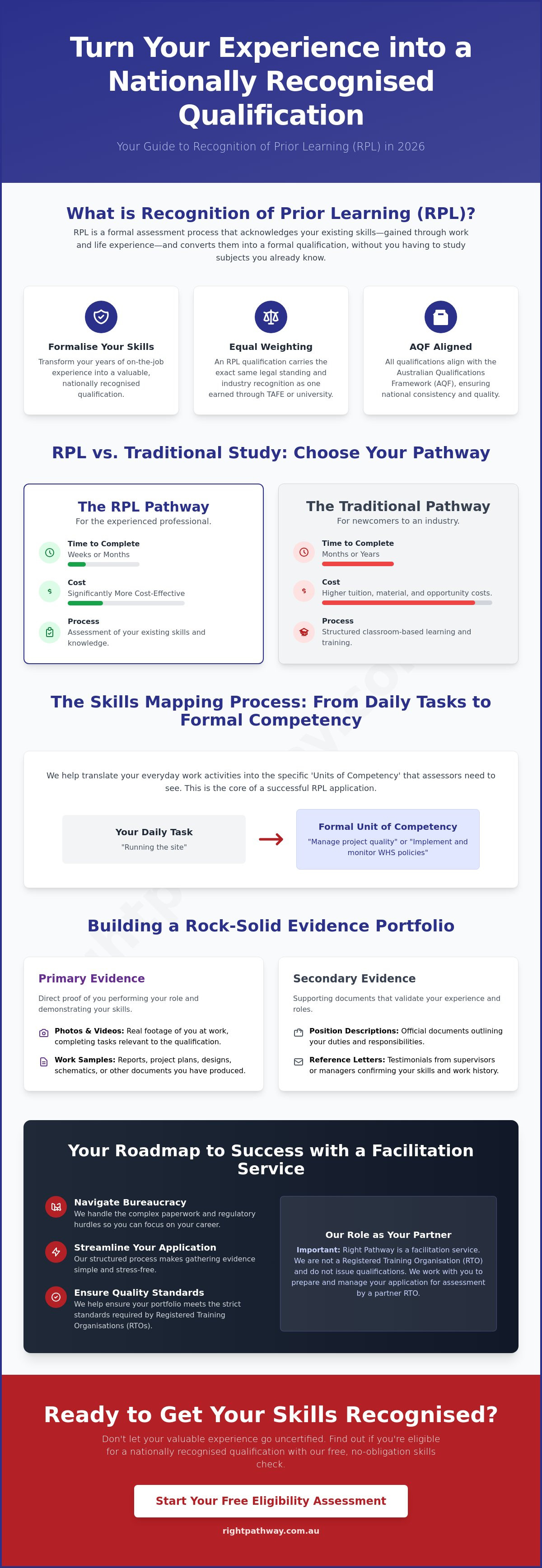
The Skills Mapping Process: Converting Daily Tasks into Units of Competency
You perform complex tasks every day without a second thought. Whether you're managing a crew, troubleshooting a technical fault, or ensuring a site meets safety standards, you're demonstrating high-level skills. However, an assessor cannot simply take your word for it. The rpl process requires a technical translation of your daily actions into the specific language of the Australian Qualifications Framework (AQF). This is known as skills mapping, where we help you identify the "hidden skills" you've developed over years of practice.
Our "Knowledgeable Navigator" approach focuses on breaking down your workday into formal Evidence Points. We look past the job title to see the underlying competency. For example, you might think of your role as "running the site," but we see it as "implementing a quality assurance plan" or "managing project risk." We bridge the gap between "knowing how" to do the job and providing the "proof of how" required by national standards. Understanding the rpl process is the first step in ensuring your hard work is documented correctly.
Identifying Transferable Skills Across Industries
Many professionals possess skills that are highly valuable across different sectors, yet they remain uncertified. We specialise in mapping leadership experience in the mining sector directly to units in the BSB50420 Diploma of Leadership and Management. Similarly, we can translate years of on-site construction safety experience into formal qualifications like the BSB41419 Certificate IV in Work Health and Safety. We also focus on "soft skills" such as conflict resolution, stakeholder management, and resource allocation. These are often the hardest to quantify but are essential building blocks for your formal certificate.
The Facilitator vs. The Assessor: Understanding the Ecosystem
It is important to understand how the skills recognition ecosystem functions in 2026. Right Pathway acts as a facilitation service; we are your expert guides who help you gather, organise, and refine your evidence portfolio. We are not a Registered Training Organisation (RTO) and do not issue qualifications directly. Instead, we partner with reputable RTOs who perform the final assessment and issue the certificate.
This distinction is vital because it allows us to focus entirely on your advocacy. By providing expert evidence preparation guidance, we help prevent the common "evidence gaps" that often lead to RTO rejections. With ASQA's 2026 "Real Skills Deserve Real Recognition" campaign increasing scrutiny on assessment quality, having a professionally prepared portfolio is no longer just a benefit, it's a necessity for success.
Right Pathway is a facilitation service. We are not a Registered Training Organisation (RTO) and do not issue qualifications directly. We support you in preparing your evidence and navigating the pathway toward an RTO assessment.
RPL vs. Traditional Study: Choosing the Right Pathway for Your Career
Deciding whether to return to a classroom or pursue rpl is a significant crossroads in your professional life. For many experienced workers, the thought of sitting through introductory lectures on topics they have already mastered is more than just a nuisance; it's a poor use of valuable time. Traditional study through a TAFE or university is designed to teach you new skills from the ground up. In contrast, skills recognition is designed to validate the expertise you already possess. If you have years of "runs on the board," the traditional pathway may be redundant.
A straight-talking analysis of the timeline reveals a stark difference. A standard Certificate IV or Diploma might require one to two years of part-time study, involving weekly classes, assignments, and exams. Through a facilitation service, the same qualification can often be achieved in a matter of weeks by compiling evidence of your existing work. This isn't about taking a shortcut; it's about choosing the most efficient way to document your current level of competence. Before committing to a long-term course, it is wise to consider the financial investment of each path, weighing tuition fees and student amenities against the cost of professional assessment facilitation.
Time and Cost Analysis for Experienced Professionals
The true cost of traditional study isn't just the tuition fee; it's the "opportunity cost" of the time you spend away from the job. If you have to take time off work or reduce your hours to attend classes, you are losing income while simultaneously paying for a course. By choosing skills recognition, you continue to earn while your portfolio is being prepared. This immediate path to certification often leads to a faster return on investment through quicker promotions or meeting licensing requirements for your trade. Using a free eligibility assessment is a practical way to reduce risk, as it helps you determine if you have enough evidence before you spend a cent.
Learning Styles: Classroom Theory vs. Workplace Competency
Many people in trade and technical roles are kinaesthetic learners, meaning they learn best by doing rather than by reading textbooks. For these professionals, the rpl process is often a much more natural fit. It skips the "boredom barrier" of introductory theory and focuses on the practical application of your skills in real-world scenarios. There is also a significant psychological benefit to this approach. Having a professional assessor validate your years of hard work provides a sense of official recognition that a standard classroom environment cannot match.
However, it's important to be honest about when skills recognition is not the answer. If you are looking to move into a completely new industry where you have no prior experience, or if there are specific high-level technical gaps in your knowledge, traditional training is the correct choice. A facilitation service like Right Pathway can help you identify these gaps early, ensuring you don't start an assessment process that you aren't yet ready to complete.
Right Pathway is a facilitation service. We are not a Registered Training Organisation (RTO) and do not issue qualifications directly. Our role is to guide you through the evidence preparation process to ensure your application is as strong as possible before it reaches a partner RTO.
Building a Rock-Solid Evidence Portfolio: What Assessors Actually Look For
The most common hurdle in the rpl journey isn't a lack of skill; it's the challenge of proving those skills on paper. An assessor from a Registered Training Organisation (RTO) cannot simply take your word for it. They require a structured portfolio that demonstrates your competence across every unit of the qualification. Think of your portfolio as a legal case where you are the star witness, and your documentation is the evidence that proves your expertise beyond doubt. We help you move from a collection of loose papers to a professional, audit-ready submission that clearly tells the story of your career.
Organising this information is where many people feel overwhelmed. A messy pile of documents makes the assessor's job difficult and can lead to delays or requests for more information. We focus on creating a logical flow that maps each piece of evidence to a specific requirement. If you are worried about employer confidentiality, remember that you can often redact sensitive business names or financial data while still showing the technical process you followed. This allows you to prove your "know-how" without compromising your professional integrity or violating company policies.
Primary Evidence: The 'Hard Proof' of Your Daily Work
Primary evidence is the most powerful tool in your portfolio because it shows you in action. Assessors love to see photos or short videos of you performing tasks on-site, provided they follow all safety protocols and show you wearing correct PPE. Authoritative documents you have created yourself are also highly valued. These might include project plans, site reports, or safety logs that feature your name or signature. If you have existing licences or even expired certifications from previous roles, include them. They serve as a historical record of your formal training and help establish a clear timeline of your professional development within the Australian industry.
Secondary Evidence: Supporting Your Claims
Secondary evidence helps fill the gaps and provides context to your primary documents. Detailed employer references are essential, particularly when they describe your specific responsibilities rather than just your job title. Performance appraisals and professional development logs also add weight to your application. If you have older experience where records are hard to find, a Statutory Declaration can be a useful tool to verify your claims. These legal documents, combined with third-party testimonials from supervisors or clients, create a comprehensive picture of your career. Testimonials are particularly effective when they come from a licensed professional who has directly observed your work over a long period. To ensure you are collecting the right documents from the start, we recommend seeking evidence preparation guidance to streamline the process.
Right Pathway is a facilitation service. We are not a Registered Training Organisation (RTO) and do not issue qualifications directly. We specialise in helping you prepare a professional portfolio that meets the high standards required for an RTO assessment.
Your Roadmap to Success: Navigating the RPL Process with Right Pathway
Understanding the path forward is the best way to reduce the anxiety often associated with formal certification. The rpl journey is a structured progression that moves you from your current role into a qualified professional status. We've refined this process into five clear steps to ensure you always know where you stand and what is required next. This methodical approach ensures that your existing expertise is captured accurately and presented professionally to the assessing body.
- Step 1: The Free Eligibility Assessment. We begin by determining if you have enough "runs on the board" to succeed. This initial check saves you time and ensures you only pursue a pathway that is realistic for your experience level.
- Step 2: Skills Mapping. Our experts take your work history and align it with the exact units of competency found in current qualifications on training.gov.au. This ensures every year of your career is accounted for.
- Step 3: Evidence Collection. We provide guided support as you build your professional portfolio. This stage transforms your daily tasks into the "hard proof" that assessors require.
- Step 4: RTO Submission. Once your portfolio is ready, we facilitate the formal review with our partner Registered Training Organisations. We act as your advocate, ensuring your submission is clear and complete.
- Step 5: Certification. After the RTO completes its assessment, you receive your nationally recognised Australian qualification, opening doors to higher pay and better job titles.
Why Facilitation is the Key to a Stress-Free Application
The "bureaucracy burden" is a real hurdle for busy professionals who are already working long hours. Trying to navigate the complex world of vocational education on your own often leads to frustration and abandoned applications. By choosing a facilitation service, you ensure your evidence is "audit-ready" from the first submission. We have supported over 2,000 applicants across 18 different industries, from mining and construction to healthcare and management. This experience means we've seen almost every scenario and know exactly how to handle the paperwork that often stops others in their tracks. Our role is to bridge the gap between your on-site experience and the high standards of the rpl assessment process.
Ready to Get Started? Your Professional Validation Awaits
Your years of hard work deserve formal recognition. We provide straight-talking honesty about your chances of success from the very first consultation. If we don't believe you have the required evidence for a specific qualification, we'll tell you clearly and suggest a more suitable pathway. This transparent approach has built trust with thousands of workers across Australia. It's time to stop wondering if your skills are enough and start the process of proving it. Take the first step with a Free Eligibility Assessment at Right Pathway today and secure the qualification you've already earned.
Right Pathway is a facilitation service. We are not a Registered Training Organisation (RTO) and do not issue qualifications directly. We work alongside RTOs to help you achieve your career goals through expert guidance and support.
Secure the Professional Recognition You've Already Earned
You've already put in the hard work on the ground, and now it's time to make that experience count toward your future. This guide has shown that rpl is not just a faster alternative to traditional study; it's a rigorous validation of the skills you use every day. By mapping your history to national standards and building a professional evidence portfolio, you can unlock higher pay and better job titles without setting foot in a classroom.
Right Pathway has proudly supported over 2,000 successful applicants across 18 major Australian industries. We provide the expert guidance required to meet high ASQA-regulated standards, acting as your essential navigator through the complex paperwork. Our facilitation service ensures you aren't alone in this process, providing a clear path toward the qualification you've already earned. We focus on the details of the evidence so you can focus on your career.
Don't let your expertise remain unofficial. Take the first step toward your professional goals by confirming your status today. Your career progression is within reach, and we're here to help you secure the recognition you deserve.
Book your Free RPL Eligibility Assessment with Right Pathway
Frequently Asked Questions
Is an RPL certificate the same as a regular qualification?
Yes, a certificate obtained through skills recognition is identical to one earned through classroom study. It is issued by a Registered Training Organisation (RTO) under the Australian Qualifications Framework (AQF) and carries the same legal weight. Employers and regulators cannot distinguish between the two pathways because the assessment benchmarks are the same. This ensures your qualification is fully recognised for job applications, pay rises, and licensing requirements across Australia.
How much does an RPL certificate cost in Australia?
The cost of obtaining a qualification varies depending on the level of the certificate and the specific Registered Training Organisation (RTO) involved. Factors such as the complexity of your evidence and the amount of facilitation support you require also influence the final price. While prices differ across the industry, investing in professional facilitation can often save you money by preventing costly re-submissions or the need for redundant training units you already know.
How much work experience do I need to be eligible for RPL?
Most applicants require at least three to five years of relevant, recent experience to be successful in the rpl process. However, the specific requirements depend entirely on the qualification you are seeking. Some Certificate III trades might require more hands-on time, while a Diploma might focus more on high-level management experience. We recommend starting with a free eligibility assessment to determine if your specific work history meets the current national standards.
What happens if I don't have enough evidence for a full qualification?
If your evidence doesn't cover every unit of competency, you may be eligible for a partial assessment or a Statement of Attainment. In this scenario, you only need to complete gap training for the specific units where you lack sufficient proof. This is still significantly faster than doing a full course from scratch. Our facilitation service helps you identify these gaps early so you can choose the most efficient way to finish your qualification.
Can I use RPL for trade licensing requirements?
Yes, obtaining a nationally recognised qualification is a primary step in meeting the requirements for various Australian trade licences. Whether you are in plumbing, gas fitting, or construction, a certificate issued by an RTO through the skills recognition pathway is accepted by state licensing bodies. It provides the formal proof of competence needed to apply for your trade card or contractor licence in your respective state or territory.
How long does the entire RPL process take from start to finish?
The entire rpl process typically takes between four and eight weeks, depending on how quickly you can gather your evidence. This is a massive time saving compared to the one or two years often required for traditional classroom study. Once your portfolio is professionally prepared and submitted to an RTO, the formal assessment phase is usually quite efficient. Your speed in providing documentation is the main factor in the final timeline.
Is RPL available for skilled migrants with overseas experience?
Yes, skilled migrants can certainly use their international experience to obtain an Australian qualification. This is a common pathway for those looking to meet visa requirements or secure employment in the local market. Your overseas history is mapped against Australian standards to ensure your skills are equivalent to local benchmarks. It's a practical way to bridge the gap between your global expertise and the specific regulatory environment found in Australia.
Do I need to do any exams or tests during the RPL assessment?
You generally don't need to sit formal written exams during the rpl process. Instead, the assessment focuses on your portfolio of evidence, such as work samples, photos, and references. In some cases, an RTO assessor might conduct a competency conversation or a practical observation to clarify your skills. These are designed to let you demonstrate what you already know in a practical, workplace-focused manner rather than through stressful theory tests.
Article by
Right Pathway Team
Right Pathway supports experienced workers, tradespeople and skilled migrants with preliminary RPL eligibility guidance, evidence preparation and qualification pathway navigation.
Right Pathway is not a Registered Training Organisation and does not conduct formal competency assessments or issue qualifications. Formal enrolment, competency assessment and qualification issuance are completed by the responsible Registered Training Organisation.
Start with a free initial RPL eligibility assessment at https://www.rightpathway.com.au/eligibility-check
Disclaimer
Right Pathway is a facilitation and support service only. We are not a Registered Training Organisation (RTO), do not conduct formal RPL assessments and do not issue qualifications. All formal RPL assessments and certifications are completed by partner RTOs regulated by ASQA. Eligibility and qualification outcomes depend on each applicant’s evidence, experience and the RTO’s assessment decision.


