

What if the only thing standing between you and a significant career promotion isn't a lack of skill, but a lack of formal recognition for the work you're already doing? It's a common frustration for seasoned professionals across Australia who find themselves sidelined because they haven't had the chance to recognise prior learning and translate their on-site mastery into official documentation. You know your industry inside out, but without the right papers, you're often locked out of higher-tier licensing and senior roles.
We understand that the path to a formal qualification can feel overwhelming, especially with the current regulatory crackdown on fraudulent providers. You need a transparent way to certify your career that respects your time and validates your genuine expertise. This article provides a clear roadmap to help you navigate the process with confidence. We'll explore the five critical pillars of RPL in 2026, showing you how to map your evidence effectively for assessment by a partner Registered Training Organisation (RTO). By the end, you'll have a practical strategy to turn your professional history into the formal recognition you've earned.
Key Takeaways
- Understand how your existing skills are measured against national standards set by the Australian Skills Quality Authority (ASQA).
- Discover how to effectively recognise prior learning by identifying the high-quality evidence required to satisfy Registered Training Organisation (RTO) requirements.
- Learn the five essential pillars of evidence that form the foundation of a successful professional recognition application.
- Follow a structured pathway from a free initial eligibility assessment to comprehensive skills mapping for your specific industry.
- See how a professional facilitator navigates complex paperwork to bridge the gap between your experience and a formal qualification.
What Does it Mean to Recognise Prior Learning in Australia?
To recognise prior learning is to formally validate the professional expertise you've built outside a traditional classroom. In the Australian Vocational Education and Training (VET) sector, this process ensures that if you already have the skills, you don't need to spend time relearning them. It's a pragmatic approach that values current competency over how many hours you've sat at a desk. Whether you've gained your knowledge through decades of work, life experience, or non-accredited training, this pathway allows your skills to be mapped against official benchmarks.
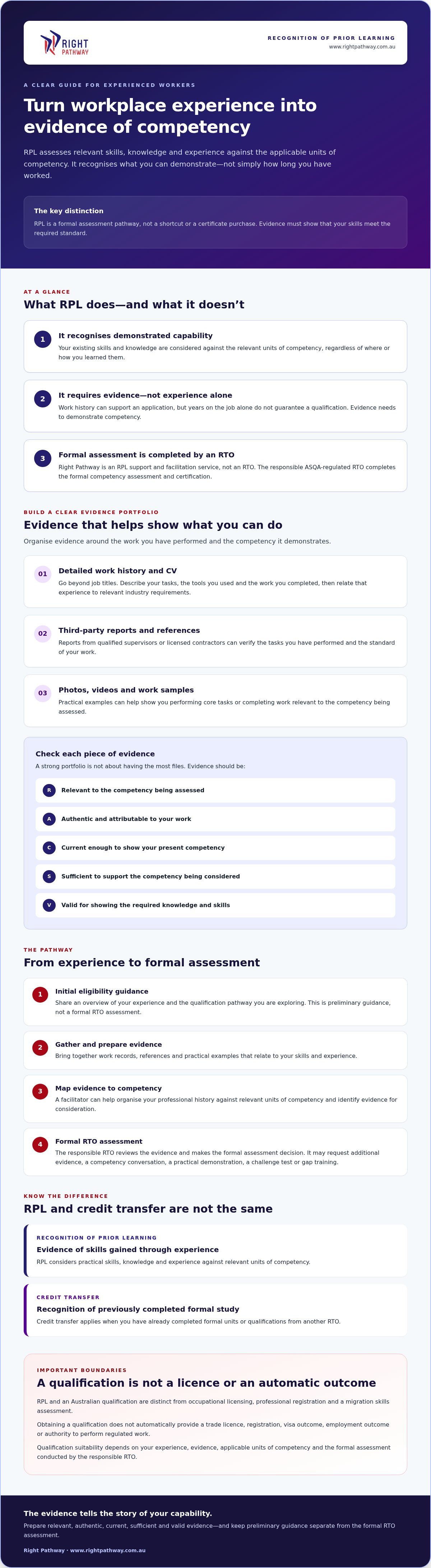
The process measures your existing knowledge against national standards regulated by the Australian Skills Quality Authority (ASQA). It's a rigorous assessment pathway, not a way to "purchase" a certificate or bypass requirements. You must provide high-quality evidence that proves you can perform tasks to the required industry standard. Qualification suitability depends on the quality of your evidence and the final assessment by a partner Registered Training Organisation (RTO). Right Pathway supports you in preparing this evidence, while the formal assessment is completed by our partner RTOs.
Why Experience Matters More Than Classroom Hours
Australia's training system has shifted toward competency-based outcomes. This is excellent for experienced professionals and tradies who have spent years on-site. For instance, a veteran builder might seek a Certificate III in Carpentry (CPC30220) within the CPC Construction, Plumbing and Services Training Package. Instead of forcing you through redundant modules, the ability to recognise prior learning identifies what you already know. It respects your time and acknowledges that a site foreman often possesses deeper practical knowledge than a fresh graduate.
The Difference Between RPL and Credit Transfer
Many people confuse RPL with Credit Transfer. They serve different purposes. Credit Transfer applies when you've already completed formal units or qualifications from another RTO. In contrast, RPL focuses on practical application and "on-the-job" skills. If you have the hands-on ability but lack the formal papers, RPL is the specific bridge you need to move forward. It focuses on what you can do today, regardless of where or how you learned to do it.
The 5 Pillars of Evidence for a Successful RPL Assessment
In the Australian vocational sector, evidence is king. To successfully recognise prior learning, you need more than just a list of previous employers; you need a robust portfolio that proves your current competency. High-quality, well-organised evidence leads to faster outcomes when your application is reviewed by a partner Registered Training Organisation (RTO). While Right Pathway is not an RTO and does not issue certificates, we act as your navigator by mapping your professional history to specific units of competency. For a comprehensive look at how these standards are applied this year, refer to the RPL Australia 2026 pillar guide.
The strength of your application depends on how well your evidence speaks to the assessor. It's not about the quantity of files, but the relevance and quality of the documentation provided. Partner RTOs require proof that is valid, sufficient, and authentic. By focusing on these pillars, you ensure that your years of hard work are presented in a way that meets strict regulatory requirements.
1. Work History and Detailed CVs
A standard resume is rarely enough for a formal assessment. Your CV must be a technical document that maps your daily tasks to national industry standards. For example, if you're seeking a Certificate III in Carpentry (CPC30220), your history needs to detail the specific tools used and the complexity of the structures you've built. It's about proving you meet the exact requirements of the CPC Construction, Plumbing and Services Training Package through your past roles.
2. Third-Party Reports and References
Validation from qualified supervisors or licensed contractors is essential. These reports act as professional character witnesses for your technical abilities. They confirm that you've performed specific tasks to an acceptable industry standard under real-world conditions. This external verification gives partner RTO assessors the confidence to validate your skills without requiring you to step back into a classroom.
3. Photos, Videos, and Work Samples
Practical evidence is often the most persuasive part of an application. This includes photos or videos of you performing core tasks, such as a site manager overseeing a major pour or a tradesperson installing complex components. All visual samples must clearly show you adhering to current Australian safety and compliance standards. If you're wondering if your current documentation is sufficient, a free initial eligibility assessment can provide the clarity you need to move forward.
Navigating the RPL Process: Steps to Professional Recognition
The journey to formal recognition follows a logical, multi-stage funnel. It begins with a free initial eligibility assessment to determine if your current experience aligns with the requirements of a specific training package, such as the CPC Construction, Plumbing and Services Training Package for those seeking a Certificate III in Carpentry (CPC30220). Once your suitability is confirmed, you enter a dedicated skills mapping phase. This involves translating your daily site activities into the technical language used by assessors. If you're a supervisor in the mining or construction sector, this means documenting exactly how you manage safety protocols and team workflows according to national benchmarks.
After your evidence portfolio is prepared, it's submitted to an ASQA-regulated partner RTO for formal review. It's vital to remember that Right Pathway facilitates this preparation; we don't issue the certificate ourselves. The RTO assessor may request a competency conversation or a practical demonstration to verify your skills. This isn't a traditional exam, but rather a chance to prove you've mastered the required units. Qualification suitability depends on the quality of your evidence and the final assessment by the partner RTO.
Avoiding the 'Instant Certificate' Trap
The Australian Skills Quality Authority (ASQA) has significantly increased oversight, cancelling over 43,000 qualifications as of March 2026. This crackdown targeted fraudulent providers who promised "instant" or "guaranteed" outcomes. Legitimate RPL is a rigorous assessment of your genuine ability. If a provider suggests you can skip the evidence phase or receive a certificate in 24 hours, it's a major red flag. Such "short-cuts" often lead to qualifications being invalidated during regulatory audits, potentially damaging your career and licensing status.
Bridging the Gap: What Happens if Evidence is Missing?
Sometimes, an applicant might possess 80% of the required skills but lack experience in a specific niche area. In these cases, "gap training" provides a targeted way to complete your qualification without starting from scratch. We identify these shortages early in the mapping process. This prevents you from wasting money on a full course when you only need to complete a few specific units of competency to meet the national standard. It's a pragmatic solution that keeps your career progression on track while ensuring you meet every requirement of the training package.
Why Partner with an RPL Facilitator Like Right Pathway?
Deciding to recognise prior learning is a significant step toward professional validation, but the administrative requirements of Registered Training Organisations (RTOs) can be complex. Right Pathway acts as your Knowledgeable Navigator throughout this journey. It's essential to understand that we are not an RTO; we don't issue certificates or conduct formal assessments. Instead, we provide the facilitation and evidence preparation support needed to bridge the gap between your practical experience and formal academic standards. Our team simplifies the RPL process by managing the heavy lifting of documentation that often stalls individual applications.
Since 2019, we've supported over 2,000 applicants across 18 diverse industries. Whether you're working in the mining sector, healthcare, or community services, we understand the specific benchmarks your industry requires. By partnering with a facilitator, you gain an advocate who ensures your submission is robust and technically accurate before it ever reaches an assessor's desk. This methodical approach reduces the anxiety often associated with bureaucratic processes and presents a clear, manageable path toward your career goals.
Expert Skills Mapping and Evidence Review
Every industry has its own technical terminology and regulatory standards. Your daily tasks must be translated into the specific units of competency found in national training packages. We specialise in this mapping, ensuring your evidence portfolio is presented in the precise format that partner RTOs require. A professional review of your documents before submission ensures that your evidence is sufficient and authentic; this significantly reduces the likelihood of an assessor requesting additional files or clarification later in the process.
Taking the Next Step Toward Your Qualification
Validating your years of hard work is about more than just a piece of paper; it's about unlocking career progression and licensing eligibility. Stop letting a lack of formal papers hold you back from the senior roles you've already earned the right to hold. Right Pathway is here to support your evidence preparation, while the final assessment and issuance of any qualification are completed by our partner RTOs. Please note that qualification suitability always depends on the quality of your evidence and the final assessment outcome from the partner RTO.
Securing Your Professional Future in 2026
The decision to recognise prior learning is a strategic investment in your career longevity. By focusing on the five pillars of evidence and following a structured mapping process, you can transform your years of practical experience into a formal qualification. We've supported over 2,000 successful applicants across more than 18 industry sectors, providing the expert facilitation needed to meet the high standards of our partner RTOs.
Right Pathway remains your dedicated navigator in evidence preparation, ensuring your portfolio is robust before it reaches an ASQA-regulated assessor. It's important to remember that qualification suitability depends on the quality of your evidence and the final assessment by the partner RTO. Validating your existing expertise is the most pragmatic way to unlock new licensing opportunities and senior roles without redundant study.
Your years of hard work have already built the foundation; we're simply here to help you get the credit you deserve. Take the first step toward certifying your career and move forward with quiet confidence.
Frequently Asked Questions
Is recognition of prior learning the same as a qualification?
No, to recognise prior learning is to undergo an assessment process that leads to a qualification, but the term refers to the pathway rather than the certificate itself. It's a formal method of proving you already meet the standards of a national training package, such as the CPC Construction, Plumbing and Services Training Package. If the partner RTO determines your evidence is sufficient, you'll receive the same formal qualification as a student who completed a traditional classroom programme.
How much does a recognise prior learning assessment cost in Australia?
The cost to recognise prior learning varies significantly based on the level of the qualification and the specific industry requirements. Factors such as the volume of evidence required and the number of units of competency being assessed will influence the final investment. Generally, this pathway is more cost-effective than traditional study because you aren't paying for classroom hours or redundant training for skills you've already mastered on the job.
Can I get an RPL certificate if I gained my experience overseas?
Yes, overseas work experience is a valid form of evidence for an RPL application in Australia. Partner RTOs frequently assess international history to determine if the skills gained abroad align with current Australian industry standards. You'll need to provide high-quality documentation, such as translated references or technical work samples, to prove your competency meets local benchmarks. This is a common pathway for skilled migrants looking to validate their professional expertise for local licensing.
How long does the RPL process take from start to finish?
The timeline for the process typically ranges from a few weeks to several months. This duration depends on how quickly you can gather your evidence portfolio and the current assessment timeframes of the partner RTO. While the process is designed for efficiency, it's a rigorous assessment that requires a thorough review of your skills. Qualification suitability depends on the quality of evidence provided and the final assessment by the partner RTO.
What happens if the RTO decides my evidence isn't sufficient?
If an assessor finds that your evidence doesn't fully meet the requirements, you'll usually be asked to provide more documentation or undertake gap training. Gap training is a pragmatic solution that allows you to complete only the specific units of competency you're missing. Right Pathway identifies these gaps during our initial mapping phase, which helps you avoid unnecessary costs and ensures you have a clear path to completing your qualification.

Article by
Right Pathway Team
Right Pathway supports experienced workers, tradespeople and skilled migrants with preliminary RPL eligibility guidance, evidence preparation and qualification pathway navigation.
Right Pathway is not a Registered Training Organisation and does not conduct formal competency assessments or issue qualifications. Formal enrolment, competency assessment and qualification issuance are completed by the responsible Registered Training Organisation.
Start with a free initial RPL eligibility assessment at https://www.rightpathway.com.au/eligibility-check
Disclaimer
Right Pathway is a facilitation and support service only. We are not a Registered Training Organisation (RTO), do not conduct formal RPL assessments and do not issue qualifications. All formal RPL assessments and certifications are completed by partner RTOs regulated by ASQA. Eligibility and qualification outcomes depend on each applicant’s evidence, experience and the RTO’s assessment decision.


