

Why spend hundreds of hours in a classroom learning skills you already apply every day on the front lines? If you're currently working in community support but feel your career has hit a ceiling due to a lack of formal "paper," the frustration is real. It's a common hurdle for many experienced workers who find the prospect of a lengthy course for a cert iv in mental health redundant when they're already performing the role's core duties.
Your years of practical experience are a classroom in themselves. You can fast-track your CHC43315 Certificate IV in Mental Health by leveraging your existing workplace evidence through the Recognition of Prior Learning (RPL) process. This guide explains how to navigate current national standards and map your expertise against the required units. We'll show you how to secure the professional validation needed to step into senior support or caseworker roles without the need for unnecessary study, ensuring your hard-earned skills are finally recognised.
Key Takeaways
- Understand why the CHC43315 Certificate IV in Mental Health is the current national standard for recovery-oriented and trauma-informed support work.
- Learn how to bypass redundant classroom study by using your existing field experience to fast-track a cert iv in mental health through the RPL process.
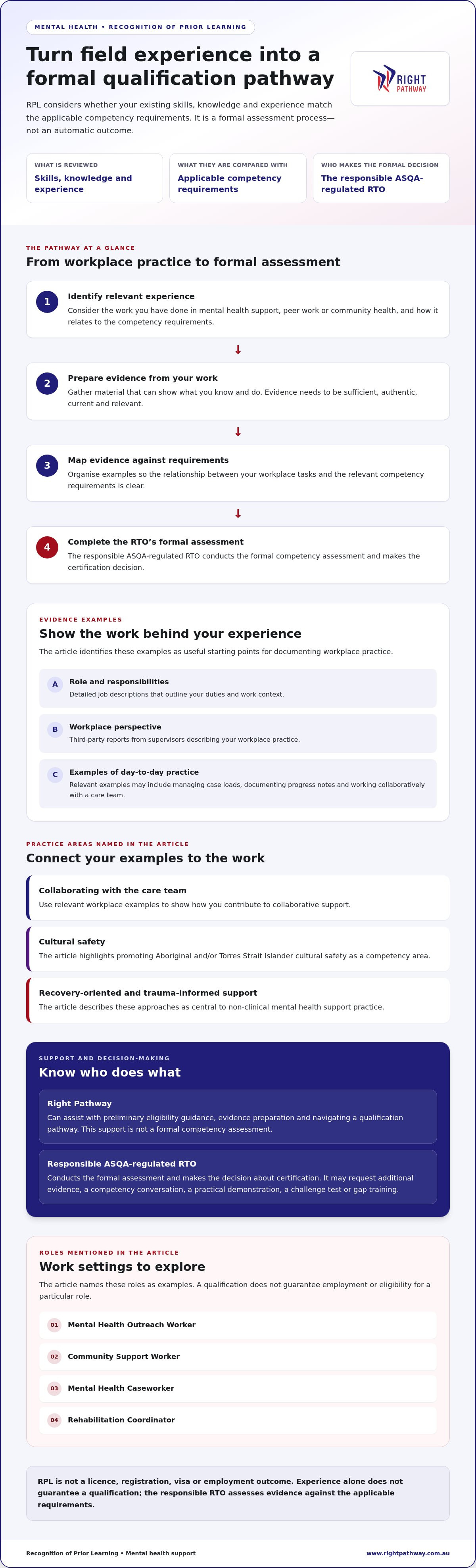
- Identify the specific evidence required for a successful assessment, including detailed job descriptions and third-party reports from your supervisors.
- Discover how professional facilitation can help you map your daily tasks against formal standards before final certification by a partner RTO.
What is the CHC43315 Certificate IV in Mental Health?
The CHC43315 Certificate IV in Mental Health is the current national benchmark for professionals providing non-clinical support to people affected by mental illness and psychiatric disability. It shifts the focus from traditional clinical models to recovery-oriented practice and trauma-informed care. This approach prioritises the individual's journey toward a self-directed life, acknowledging the impact of past experiences on current wellbeing. As the landscape of mental health in Australia continues to evolve, this qualification ensures that the workforce remains equipped to handle complex social and emotional needs with professional rigour.
While many students spend up to 24 months in traditional classrooms, those already working in the field can often bypass redundant study. If you have significant experience, you can formalise your expertise through Recognition of Prior Learning (RPL). Obtaining a cert iv in mental health opens doors to several high-impact roles, including:
- Mental Health Outreach Worker
- Community Support Worker
- Mental Health Caseworker
- Rehabilitation Coordinator
Core Units and Competency Standards
The qualification consists of 15 units designed to meet strict ASQA standards for industry compliance. Critical units include "Work collaboratively with the care team" and "Promote Aboriginal and/or Torres Strait Islander cultural safety." These aren't just theoretical concepts; they represent the daily realities of navigating multi-disciplinary teams and providing inclusive care. If you're already managing case loads or documenting progress notes, you're likely already meeting these national standards in your daily work. For those interested in how connectivity is being improved within the clinical research ecosystem, check out trialport.
The Value of a Nationally Recognised Qualification
Holding a cert iv in mental health is frequently a prerequisite for employment within government-funded programs and NDIS-registered organisations. It serves as a professional seal of approval that validates your skills to employers and funding bodies. Beyond simple compliance, the benefits of RPL include a significant boost to your professional standing and long-term salary potential. It turns your years of field labour into a tangible asset that supports career progression into senior or specialist positions.
Recognition of Prior Learning (RPL): The Fast-Track for Experienced Workers
Traditional study for a cert iv in mental health often involves 12 to 24 months of lectures, assignments, and supervised placement. Recognition of Prior Learning (RPL) flips this model. Instead of learning new concepts, you provide evidence that you already meet the competency standards. It's a formal assessment process that validates the skills you've honed through years of frontline service, converting your daily labour into a nationally recognised qualification. Navigating the requirements for RPL Australia ensures that your workplace experience is treated as a valid classroom, making it the most efficient route for seasoned professionals.
The time-saving benefits are significant. Why spend a year sitting through modules on recovery-oriented practice when you've been implementing those exact frameworks for years? RPL bridges the gap between your current field experience and the formal credentials required for senior roles without forcing you to restart your education from scratch. It's a pragmatic solution for workers who need the "paper" to match their actual performance levels. By focusing on what you already know, you can secure your qualification in a fraction of the time required for classroom-based learning.
Who is Eligible for Mental Health RPL?
Not everyone is a candidate for this pathway, but if you've spent significant time in the sector, you likely have a wealth of untapped evidence. Ideal candidates include mental health support workers, peer workers, and community health assistants who have at least two years of consistent industry experience. If you're unsure where your skills sit, you can complete a free eligibility check to see if your background aligns with the current CHC43315 standards.
The Role of an RPL Facilitator
The biggest barrier to qualification is often the administrative burden. Right Pathway acts as your professional navigator throughout the RPL process. We are not a Registered Training Organisation (RTO); instead, we specialise in evidence preparation and guidance. We help you map your experience to the national standards and ensure your portfolio is robust. Once your evidence is ready, the formal assessment and certification are conducted by one of our partner RTOs. This partnership allows you to focus on your work while we handle the complex coordination and paperwork required for your cert iv in mental health.
Mapping Your Field Experience: What Counts as Evidence?
Evidence is the currency of a successful RPL assessment. It proves you have already mastered the competencies required for a cert iv in mental health by showing what you do on the job rather than what you read in a textbook. Unlike traditional study pathways, where you complete assignments to show potential, RPL requires you to demonstrate actual performance in a real-world setting. To be successful, your evidence must be current, usually within the last two to three years, authentic, and sufficient to cover all units of the CHC43315 qualification.
As highlighted in Victoria University's Certificate IV in Mental Health overview, the sector prioritises recovery-oriented practice. The following table illustrates how common daily tasks align with the national standards required for certification.
| Daily Workplace Task | Potential CHC43315 Competency Area |
|---|---|
| Developing individualised recovery plans | Recovery-oriented practice |
| Collaborating with NDIS providers or GPs | Working within a care team |
| Documenting client progress in CRM systems | Information management and reporting |
| Applying safety protocols during crises | Trauma-informed care and safety |
Turning Daily Tasks into Qualification Units
Mapping daily tasks to specific units is where the facilitation process adds the most value. For example, conducting a client intake isn't just an administrative task; it maps directly to units involving communication and initial assessment. Similarly, if you've spent time facilitating a support group, you've already demonstrated the group work competencies that classroom students spend weeks studying in theory. We help you bridge this gap by identifying which parts of your routine work meet the national standards.
The Importance of Trauma-Informed Practice Evidence
High-quality evidence often focuses on how you manage psychosocial risks and provide trauma-informed care. Documenting your approach to client safety and empowerment serves as powerful proof of your competency. Providing this level of detail can be daunting, but evidence preparation guidance is a core part of the support and facilitation offered by Right Pathway. We help you identify the "gold" in your daily files and package it for review by a partner RTO, ensuring your cert iv in mental health reflects your true expertise.
Ready to see how your current work history maps to national standards? Check your eligibility for an evidence-based assessment today.
Navigating Your Qualification Pathway with Right Pathway
Securing a cert iv in mental health through experience requires a precise alignment with national standards. It's vital to understand the distinction between your support team and the assessing body. Right Pathway acts as your professional navigator, specialising in evidence preparation and qualification pathway guidance. While we facilitate the entire process of mapping your skills, the formal assessment and issuance of your CHC43315 certificate are performed by our partner Registered Training Organisations (RTOs). This clear division ensures that your application meets the high benchmarks set by ASQA while giving you a dedicated advocate to handle the administrative complexities.
One of the primary concerns for workers is the financial investment. We maintain full transparency regarding RPL costs in Australia, which typically represent a significant saving compared to full-fee tuition for a 12 to 24-month course. By choosing the RPL pathway, you aren't just saving time; you're making a pragmatic financial decision that avoids paying for redundant training in skills you've already mastered on the job.
The Facilitation Process: From Evidence to Certificate
- Step 1: Free eligibility assessment. We conduct an initial review to map your current skills against the CHC43315 units, ensuring you're a strong candidate for RPL before you commit.
- Step 2: Expert evidence review. Our team works with you to refine your portfolio, ensuring your de-identified case notes and supervisor reports meet strict RTO standards.
- Step 3: Partner RTO submission. Once your evidence is robust, we manage the submission to a partner RTO for final assessment and certification.
Why Choose a Professional Facilitator?
There are many reasons to choose Right Pathway, including our track record with over 2,000 successful applicants. We provide nationwide support, assisting mental health workers in every state to bridge the gap between their daily labour and formal recognition. Navigating ASQA requirements alone can be a "paperwork headache," but our expert guidance makes the process manageable. We ensure your cert iv in mental health application is handled with the professional rigour it deserves, allowing you to focus on what matters most: supporting your clients in their recovery.
Take the Next Step in Your Mental Health Career
Securing your cert iv in mental health doesn't have to mean returning to a classroom for years of redundant study. By choosing the RPL pathway, you're choosing to value your existing skills and the thousands of hours you've spent supporting your community. This process transforms your daily labour into a nationally recognised credential that unlocks senior roles and higher salary potential without the need for unnecessary coursework.
Right Pathway has supported over 2,000 successful applicants across 18 different industries, providing the nationwide expertise needed to navigate complex regulatory standards. We remove the administrative burden by helping you prepare a robust evidence portfolio for assessment by a partner RTO. It's a pragmatic and efficient way to bridge the gap between your field experience and professional validation.
Don't let a lack of formal documentation hold you back from the career progression you've already earned. Check your eligibility for a Cert IV in Mental Health RPL assessment today through our free initial eligibility assessment. We're here to help you get the recognition you deserve and move your career forward with confidence.
Frequently Asked Questions
Can I get a Cert IV in Mental Health through RPL if I've worked in the sector for years?
Yes, you can certainly obtain a cert iv in mental health through the Recognition of Prior Learning (RPL) pathway if you have documented industry experience. The process requires you to demonstrate that your daily workplace tasks align with the 15 units of competency in the current CHC43315 qualification. You'll need to provide a portfolio of evidence, such as de-identified case notes and supervisor reports, to prove your competency in recovery-oriented and trauma-informed care.
How much does an RPL assessment for the Cert IV in Mental Health cost?
The cost for an RPL assessment varies depending on the specific requirements of the partner RTO and the volume of evidence being mapped. Generally, this pathway is a more cost-effective alternative to traditional study because you aren't paying for classroom tuition or learning materials for skills you already possess. It allows you to invest in the validation of your existing expertise rather than paying for a 12 to 24-month course from scratch.
Is Right Pathway a Registered Training Organisation (RTO)?
No, Right Pathway is not an RTO and does not issue qualifications or conduct formal assessments. We act as professional facilitators and navigators who specialise in evidence preparation and qualification pathway guidance. Our role is to help you compile a robust portfolio that meets national standards, while the formal assessment and issuance of your CHC43315 certificate are performed by our accredited partner RTOs.
What kind of jobs can I get with a CHC43315 Certificate IV in Mental Health?
Holding a cert iv in mental health qualifies you for several essential roles in the Australian community services sector. Graduates often work as Mental Health Outreach Workers, Community Support Workers, or Mental Health Caseworkers in both government and non-government organisations. This qualification is frequently a mandatory requirement for senior support positions, especially in programs funded by the NDIS or state health departments.
How long does the RPL process take compared to traditional study?
The RPL process is significantly faster than classroom-based learning, often taking only a few weeks or months to complete once your evidence is compiled. Traditional study for this qualification typically requires a commitment of 12 to 24 months of lectures and placements. Because you're proving existing skills rather than learning new ones, the timeline is largely determined by how quickly you can gather your workplace documentation with our support.

Article by
Right Pathway Team
Right Pathway supports experienced workers, tradespeople and skilled migrants with preliminary RPL eligibility guidance, evidence preparation and qualification pathway navigation.
Right Pathway is not a Registered Training Organisation and does not conduct formal competency assessments or issue qualifications. Formal enrolment, competency assessment and qualification issuance are completed by the responsible Registered Training Organisation.
Start with a free initial RPL eligibility assessment at https://www.rightpathway.com.au/eligibility-check
Disclaimer
Right Pathway is a facilitation and support service only. We are not a Registered Training Organisation (RTO), do not conduct formal RPL assessments and do not issue qualifications. All formal RPL assessments and certifications are completed by partner RTOs regulated by ASQA. Eligibility and qualification outcomes depend on each applicant’s evidence, experience and the RTO’s assessment decision.


