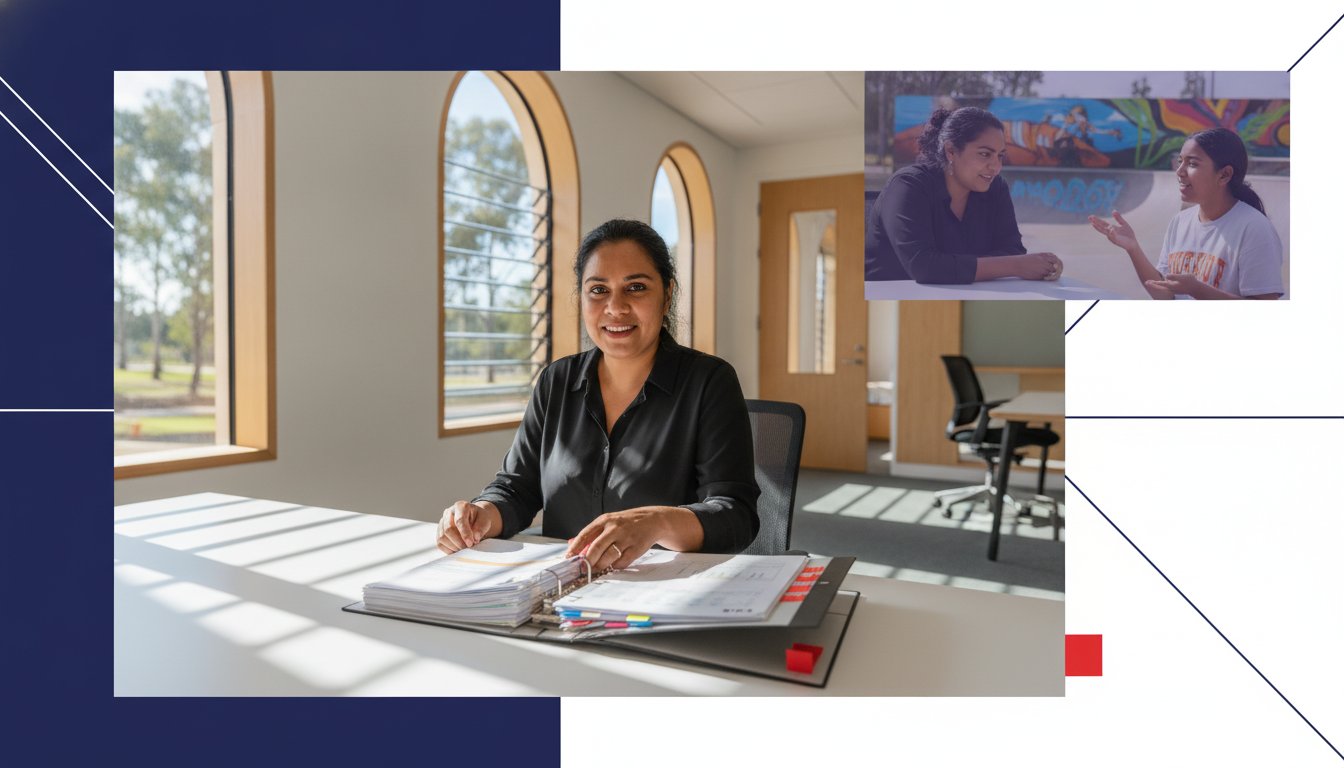
You’ve spent years on the front lines, supporting young people through some of the most challenging moments of their lives. You’ve de-escalated crises, developed support plans, and advocated for those without a voice. You don’t just have a job; you have a vocation. But in today’s highly regulated community services sector, practical experience alone is often not enough to secure senior roles or meet organisational compliance requirements.
The official benchmark for professional practice is the Diploma of Youth Work. For many experienced workers, the thought of returning to a classroom for 12 to 18 months feels redundant and impractical. You’re already applying the principles of trauma-informed care and ethical practice every day. Why should you have to study what you already know?
This is where Recognition of Prior Learning (RPL) offers a direct and efficient pathway. RPL is a formal assessment process that validates your existing skills and knowledge, allowing you to convert your on-the-job experience into a nationally recognised qualification. It’s not a shortcut; it’s a smart-cut for professionals who have already done the hard work.
This guide explains how you can achieve your Diploma of Youth Work via RPL in 2026, bypassing the need for classroom study and getting the formal recognition your career deserves.
The Value of a Diploma of Youth Work in Australia’s Community Sector
In Australia, the community services sector is experiencing a growing demand for highly skilled and formally qualified youth workers. As government funding and organisational standards become more stringent, holding a formal qualification is no longer just an advantage—it's often a necessity. The Diploma of Youth work is the industry standard that signals your competence in managing complex cases and leading youth-focused programmes.
- Growing Demand: The need for qualified professionals to support young people with complex needs, including mental health, housing instability, and justice system involvement, is on the rise.
- Industry Benchmark: The CHC50425 Diploma of Youth Work is the current, nationally recognised qualification that employers and funding bodies look for to ensure compliance and best practice.
- Career Advancement: A Diploma opens doors to leadership positions and higher salary bands that are often inaccessible without formal credentials, regardless of your years of experience.
- Professional Validation: Perhaps most importantly, it provides official recognition for the skills you’ve honed over years of dedicated service, validating your expertise and boosting your professional confidence.
Meeting National Standards in Youth Support
For organisations that receive government funding or operate under strict regulatory oversight, having a formally qualified workforce is non-negotiable. Qualifications regulated by the Australian Skills Quality Authority (ASQA) are the gold standard, ensuring that staff meet national benchmarks for safety, ethics, and competence.
- Compliance for Funding: Many government-funded youth programmes mandate that team leaders and case managers hold a Diploma-level qualification to meet contractual and audit requirements.
- Transitioning from a Certificate IV: While a Certificate IV in Youth Work is an excellent starting point, the Diploma is designed for workers who are ready to take on greater responsibility. If you are already managing complex cases, developing programmes, or informally mentoring junior staff, it is the right time to formalise your advanced skills.
- Organisational Audits: A qualified team strengthens an organisation's position during audits, demonstrating a commitment to professional development and high standards of care.
Career Progression Beyond Entry-Level Roles
While passion and experience get you into the field, a formal qualification is often the key to moving up. The Diploma of Youth Work is your gateway to more influential and rewarding roles where you can make an even greater impact.
- Leadership Opportunities: The qualification is often a prerequisite for positions such as Youth Work Coordinator, Case Manager, Team Leader, and Programme Manager.
- Specialised Fields: For those working in demanding environments like residential care, child protection, or juvenile justice, the Diploma provides the recognised skills needed to manage high-stakes situations effectively.
- Long-Term Job Security: In a competitive and evolving sector, a formal qualification provides a level of job security that experience alone cannot guarantee. It makes you a more valuable and versatile asset to any community organisation.
Understanding the CHC50425 Diploma of Youth Work
The CHC50425 Diploma of Youth Work is a high-level qualification designed for professionals who develop and deliver programmes and services to young people. It moves beyond foundational skills to focus on complex case management, advocacy, and leadership within a social justice framework.
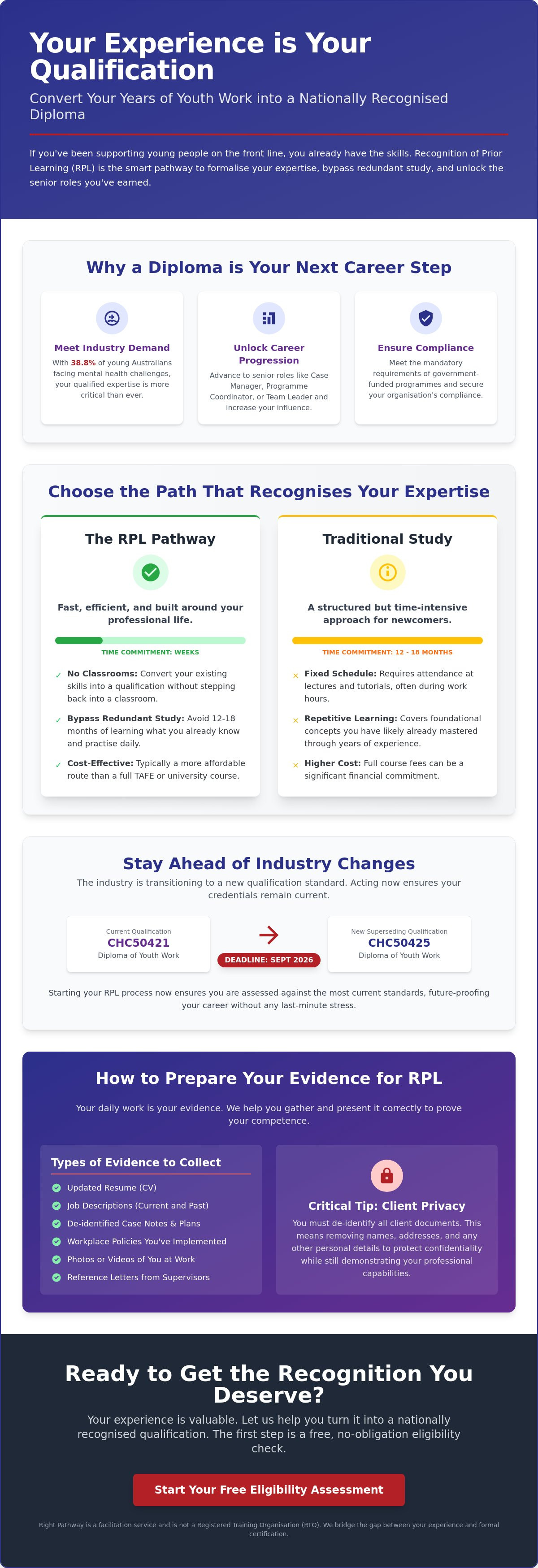
This qualification is part of the nationally endorsed Community Services (CHC) Training Package. It is crucial to ensure you are pursuing the most current version. As of 2026, the CHC50425 has superseded the older CHC50421 and CHC50413 codes. While your experience may align with the skills from older versions, your qualification must be issued under the current CHC50425 code to be recognised by employers and industry bodies.
- Definition: It is an advanced qualification focusing on the skills required to support young people with complex needs, manage legal and ethical compliance, and lead community-based programmes.
- Core Units: The qualification includes a set of core units covering essential competencies such as applying trauma-informed care, responding to critical situations, and working with diverse communities.
- The Diploma vs. Certificates: Unlike a Certificate III or IV, which focus on direct support delivery, the Diploma equips you to design interventions, manage teams, and operate with a high degree of autonomy.
Core Competencies and Learning Outcomes
The CHC50425 Diploma of Youth Work is built around a set of core competencies that reflect the real-world demands of senior youth work roles. When pursuing this qualification via Recognition of Prior Learning (RPL), you will need to demonstrate your existing ability in these areas. The "learning outcomes" for a student are, for you, a checklist of skills you already possess.
- Programme Development and Facilitation: You must show how you develop, implement, and evaluate youth programmes that are inclusive, empowering, and promote principles of social justice.
- Complex Case Management: This involves demonstrating your skills in managing challenging situations related to mental health, substance abuse, homelessness, and other complex needs.
- Leadership and Compliance: You need to prove your ability to lead ethical practice, manage workplace health and safety (WHS), and ensure legal compliance in a community services setting.
Electives: Tailoring the Qualification to Your Experience
In addition to the core units, the Diploma includes a range of elective units. This allows the qualification to be tailored to your specific area of expertise. For an RPL candidate, this is a crucial step where you align the qualification with your day-to-day work.
- Choosing Relevant Electives: Select electives that directly reflect your niche. If you work primarily with Indigenous youth, in disability support, or in a school setting, your choice of units should mirror this.
- Aligning with Workplace Responsibilities: The strongest RPL applications use evidence drawn directly from current job roles. Choose electives that correspond to tasks you perform regularly.
- Skills Mapping as the First Step: Before you begin gathering evidence, a thorough skills mapping exercise is essential. This process, often guided by an RPL facilitator, identifies which core and elective units your experience already covers, creating a clear roadmap for your application.
RPL vs. Traditional Study: The Efficient Path for Professionals
For an experienced youth worker, the traditional TAFE or university pathway often feels disconnected from reality. The idea of sitting in a classroom to learn theories you already put into practice daily is not just inefficient—it’s a poor use of your valuable time and expertise. RPL acknowledges that the most important learning often happens on the job, not in a lecture hall.
- The Time Commitment: A traditional Diploma course can take 12 to 18 months of part-time or full-time study. The RPL process, for a well-prepared candidate, can be completed in a matter of weeks.
- The "Study Myth": You do not need to be taught what you are already doing successfully. RPL is not a learning process; it is a rigorous assessment process designed to validate your existing competence.
- Cost-Benefit Analysis: While there is a fee for RPL assessment and facilitation, it is typically a fraction of the cost of full tuition fees for a lengthy course. When you factor in the lost income from taking time off work for study, RPL is by far the more financially sound option.
The Problem with Traditional Work Placements
One of the biggest hurdles for experienced professionals undertaking traditional study is the mandatory work placement. For someone already working full-time in the industry, this requirement is often impractical and unnecessary.
- RPL Uses Your Current Job: With RPL, your current workplace is your evidence. You don’t need an unpaid "student" placement because you are already a functioning professional in the field.
- Avoiding the "Student" Label: It can be demoralising to be treated as a student in a professional environment where you are already a respected and experienced team member. RPL allows you to maintain your professional standing throughout the process.
- Employer Preference: Employers often prefer and support RPL for their staff because it doesn't require them to grant extended time off for classes or placements. It’s a way to upskill their workforce with minimal disruption to operations.
Is an RPL Qualification the Same as a TAFE Diploma?
This is one of the most common questions, and the answer is an unequivocal yes. A qualification achieved through RPL holds the exact same weight and national recognition as one earned through traditional study.
- Identical Qualification: The final Diploma of Youth Work issued by a Registered Training Organisation (RTO) is identical, regardless of the pathway taken to achieve it. The certificate does not state "achieved via RPL."
- Nationally Recognised: All qualifications are issued by ASQA-regulated RTOs, ensuring they are part of the Australian Qualifications Framework (AQF) and are recognised by employers and industry bodies across the country.
- A Rigorous Assessment, Not a Shortcut: The misconception that RPL is an "easy way out" is false. It is a comprehensive and demanding assessment that requires you to prove your competence against the same national standards as a student. The only difference is that your evidence comes from years of experience, not from classroom assignments.
How to Prepare Your Evidence for a Youth Work RPL Assessment
A successful RPL application depends on a portfolio of high-quality evidence that clearly demonstrates your skills and knowledge. The goal is not to submit hundreds of documents, but to select targeted evidence that directly maps to the units of competency in the CHC50425 Diploma of Youth Work.
- Quality Over Quantity: An assessor would rather see five strong pieces of evidence for a unit than 20 irrelevant ones. Each document should have a clear purpose.
- De-identifying Information: Protecting client confidentiality is paramount. You must remove all names, contact details, and other identifying information from any evidence you submit. This demonstrates your understanding of professional ethics.
- Third-Party Testimonials: A letter or report from a current or former supervisor, a senior colleague, or an industry peer can be powerful evidence. This report should detail your responsibilities and attest to your skills in specific areas.
- Mapping Tasks to Units: The most critical step is to connect your daily tasks to the specific requirements of the qualification. For example, a case note you wrote could demonstrate your skills in "assessing and responding to client needs."
A Checklist of Common Evidence Types
Your portfolio of evidence should be a snapshot of your professional practice. Think about the documents you create and the tasks you perform every week. Common examples include:
- Client and Programme Documents: De-identified case notes, individual support plans, risk assessments, and programme outlines or evaluation reports.
- Workplace Communication: Meeting minutes where you led a discussion or advocated for a client, emails to stakeholders, or professional presentations you have delivered.
- Media Evidence: Photographs or videos of you facilitating a youth group or activity (with signed permission from all participants).
- Employment Documents: Your current and past position descriptions, your resume, and letters of employment confirming your roles and responsibilities.
The Professional Conversation: Proving Your Knowledge
Evidence is not just about paperwork. A key part of the RPL assessment is the "Professional Conversation" or competency interview. This is a structured discussion with a qualified assessor where you articulate your knowledge and explain how you apply it in practice.
- Prepare to Articulate Your Skills: Be ready to discuss your experience using clear, professional language. The assessor will ask you questions designed to probe your understanding of the theories and principles behind your actions.
- Demonstrate Ethical Understanding: You will likely be asked to discuss how you apply the National Youth Work Code of Ethics in your practice, particularly in complex or ambiguous situations.
- Explain Your Frameworks: Be prepared to explain how you use specific frameworks, such as trauma-informed care or strengths-based practice, when responding to critical incidents or developing support plans. This conversation is your chance to fill any gaps your documentary evidence might have.
How Right Pathway Facilitates Your Diploma Journey
Navigating the RPL process alone can be confusing and time-consuming. The language used by training packages can be dense, and knowing exactly what evidence an RTO assessor is looking for can be difficult. This is where a specialist RPL facilitation service like Right Pathway becomes your most valuable asset.
It is important to understand that Right Pathway is not an RTO and does not issue qualifications. Our role is to act as your "Knowledgeable Navigator." We are experts in the RPL process who bridge the gap between your on-the-job experience and the formal requirements of the national training standards.
- Expert Guidance: We translate the complex requirements of the CHC50425 Diploma into practical, easy-to-understand steps.
- Streamlined Process: We manage the administrative burden, helping you collect, organise, and present your evidence in a professional portfolio that meets RTO standards.
- Stress Reduction: With our support, you can focus on what you do best—your job—while we handle the complexities of the RPL application on your behalf.
Step 1: Your Free Eligibility Assessment
The first step is a no-obligation conversation with one of our senior consultants. We will review your experience to determine if RPL is the right pathway for you.
- Determining Your Suitability: We will assess your work history and responsibilities against the requirements of the Diploma of Youth Work.
- Honest and Transparent Advice: If we believe you need more experience or that another qualification is a better fit, we will tell you. Our goal is to set you up for success.
- Identifying Your Pathway: We confirm that the CHC50425 is the correct qualification to help you achieve your career goals.
Step 2: Expert Evidence Mapping and Support
Once your eligibility is confirmed, we work with you to build a powerful portfolio of evidence.
- Professional Portfolio Development: Our consultants guide you in selecting the strongest possible evidence and organising it against the specific units of the Diploma.
- Translating Your Experience: We help you articulate your "on-the-job" language and skills into the formal "competency-based" language that RTO assessors require.
- Liaison with Partner RTOs: We work with our network of trusted, ASQA-regulated partner RTOs to ensure your portfolio is submitted correctly, streamlining the final assessment and certification process.
Your years of hard work have earned you the right to be formally recognised. Let us help you take the final step.
Book your free RPL eligibility assessment with Right Pathway today and turn your experience into a nationally recognised Diploma of Youth Work.
Frequently Asked Questions (FAQs)
Can I get a Diploma of Youth Work based on my experience without studying?
Yes. Recognition of Prior Learning (RPL) is a formal assessment pathway that allows you to use your existing work experience, skills, and knowledge to gain a full qualification without undertaking any new study. If you can provide sufficient evidence that you are already performing at the level of the CHC50425 Diploma, you can be awarded the qualification.
How long does the RPL process take for a Diploma of Youth Work?
The timeline varies depending on how quickly you can gather your evidence. For a well-prepared candidate with readily available documentation, the entire process from initial assessment to receiving your certificate can take between 4 and 12 weeks. This is significantly faster than the 12-18 months required for traditional study.
What is the difference between the older codes and the current CHC50425?
Training packages are periodically updated to reflect current industry standards and practices. The CHC50425 Diploma of Youth Work is the most recent version, superseding the older CHC50421 and CHC50413 codes. The updates typically involve changes to core and elective units to better align with contemporary youth work, such as a greater emphasis on trauma-informed practice and mental health support. For your qualification to be current, it must be issued with the CHC50425 code.
Do I need to do a work placement if I am doing RPL?
No. A major advantage of the RPL pathway is that it eliminates the need for a separate work placement. Your current or past job serves as the environment where you have already demonstrated your skills. The evidence you provide from your workplace is used in place of a student placement.
Is an RPL qualification recognised by the Australian Community Workers Association (ACWA)?
Yes. A qualification awarded through RPL by a nationally recognised RTO is just as valid as one obtained through classroom study. ACWA and other professional bodies recognise qualifications from the Australian Qualifications Framework (AQF), regardless of the assessment method used to achieve them.
How much does it cost to get a Diploma of Youth Work via RPL?
The cost of RPL is significantly less than standard course tuition fees. The final price can vary depending on the level of support you require and the RTO's assessment fees. It is best to get a customised quote based on your individual circumstances. You can learn more about the general costs on our RPL cost information page.
What happens if I have gaps in my evidence for certain units?
If your portfolio shows that you have gaps in a few specific areas, it doesn’t necessarily mean you cannot get qualified. The assessor may ask you more targeted questions during the Professional Conversation, or you may be required to complete a small amount of "gap training" for only the units where you lack evidence. This is still much faster and cheaper than completing the entire course.
Can skilled migrants use overseas experience for a Diploma of Youth Work RPL?
Absolutely. The RPL assessment process considers all relevant experience, regardless of where it was obtained. As long as you can provide verifiable evidence that your overseas experience is equivalent to Australian standards and you can demonstrate your skills against the CHC50425 units of competency, your international experience is highly valuable in an RPL application.
Article by
Right Pathway Team
Right Pathway supports experienced workers, tradespeople and skilled migrants with preliminary RPL eligibility guidance, evidence preparation and qualification pathway navigation.
Right Pathway is not a Registered Training Organisation and does not conduct formal competency assessments or issue qualifications. Formal enrolment, competency assessment and qualification issuance are completed by the responsible Registered Training Organisation.
Start with a free initial RPL eligibility assessment at https://www.rightpathway.com.au/eligibility-check
Disclaimer
Right Pathway is a facilitation and support service only. We are not a Registered Training Organisation (RTO), do not conduct formal RPL assessments and do not issue qualifications. All formal RPL assessments and certifications are completed by partner RTOs regulated by ASQA. Eligibility and qualification outcomes depend on each applicant’s evidence, experience and the RTO’s assessment decision.


