

If you have been working in an Australian hospital or healthcare facility, you already know the vital role you play in patient care. Every day, you are on the front lines, providing essential support, comfort, and assistance. But without a formal qualification, your hard-earned experience can feel unrecognised, limiting your job security and career progression.
You may feel stuck, believing the only path forward is to enrol in a lengthy TAFE course, studying topics you already master daily. There is a more efficient, respectful, and practical way.
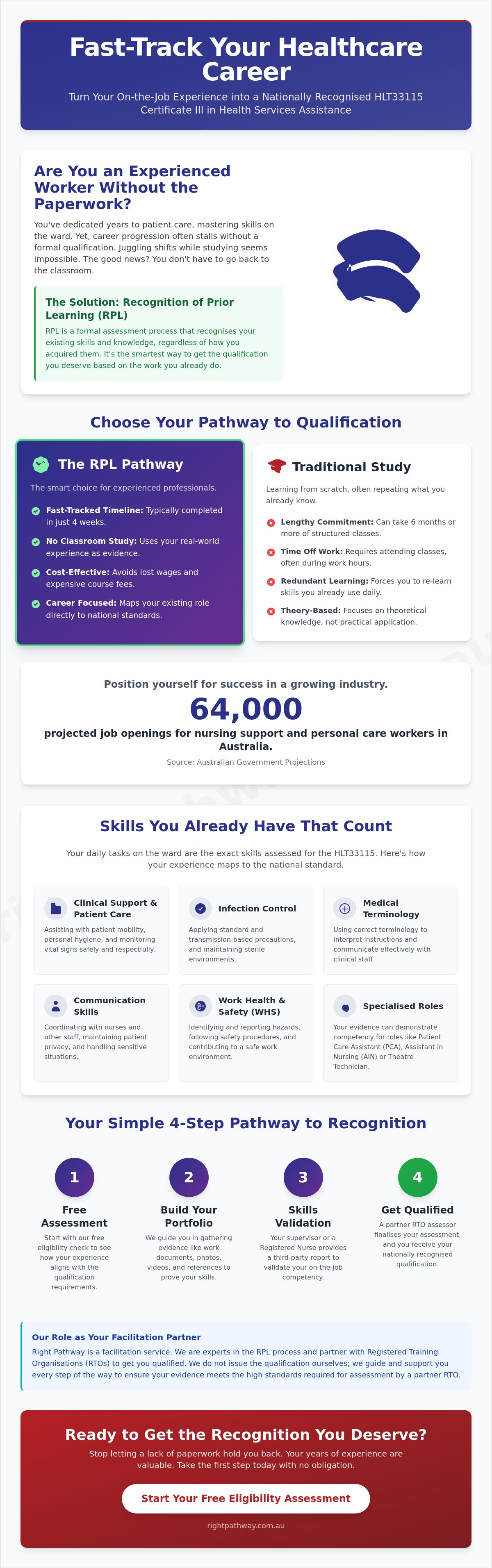
Recognition of Prior Learning (RPL) is a formal assessment process designed for experienced professionals like you. It allows you to convert your existing skills, knowledge, and on-the-job experience directly into a nationally recognised Certificate III in Health Services Assistance (HLT33115). This is your opportunity to have years of dedicated work formally validated, without having to start from scratch in a classroom.
##Table of Contents
- Understanding the Certificate III in Health Services Assistance (HLT33115)
- Core Competencies: What Skills Do You Already Have?
- Study vs. RPL: Why Experienced Workers Shouldn’t Start from Scratch
- Building Your Evidence Portfolio: The Practical Path to Certification
- How Right Pathway Facilitates Your Health Services Career
##Understanding the Certificate III in Health Services Assistance (HLT33115)
The Certificate III in Health Services Assistance, with the national code HLT33115, is the industry-standard qualification for support roles within Australian hospitals and clinical environments. It serves as the benchmark for non-clinical patient support, ensuring a consistent level of care and safety across the country.
For many experienced workers searching online, a common typo is "Cert III health services assistant". If this is how you found us, you are in the right place. While the correct term is 'Certificate III' (or Cert III), we understand the search query and are here to provide clear information on the official HLT33115 qualification.
A Health Services Assistant (HSA) is a crucial member of the modern Australian healthcare team. You work under the supervision of nursing and medical staff to provide direct patient care, maintain a safe and clean environment, and support the overall functioning of a clinical unit. This qualification is often mandatory for roles in acute care hospitals, private clinics, day surgery centres, and rehabilitation facilities.
Key Roles and Career Outcomes
Holding an HLT33115 qualification opens the door to a range of essential and in-demand roles. It formalises your skills for positions you may already be performing, giving you the security and recognition you deserve. Key career outcomes include:
- Patient Care Assistant (PCA): Assisting patients with mobility, personal hygiene, and daily living activities.
- Assistant in Nursing (AIN): Working under the direct supervision of a Registered Nurse to provide a range of patient care tasks.
- Ward Assistant or Wardsperson: Transporting patients, equipment, and supplies within the hospital.
- Theatre Technician/Orderly: Preparing and maintaining the operating theatre environment, assisting with patient positioning, and managing sterile supplies.
This certificate often acts as a prerequisite for working in specialised hospital departments, from emergency to maternity. As Australia's healthcare needs continue to grow into 2026 and beyond, the demand for qualified and experienced HSAs is stronger than ever. Securing your formal qualification is the best way to ensure your place in this vital industry. For those interested in expanding their career into the disability sector, you can learn more about Accessible Care, a registered NDIS provider offering specialised support services.
The HLT33115 National Code
The national code, HLT33115, is your guarantee of quality and portability. It signifies that your qualification is part of the Australian Qualifications Framework (AQF) and will be recognised by employers in every state and territory. This is crucial for career mobility, ensuring you don't have to requalify if you move interstate.
The qualification is comprised of core and elective units of competency. Core units, which are mandatory for everyone, cover fundamental skills such as:
- Complying with infection prevention and control policies and procedures
- Interpreting and applying medical terminology appropriately
- Communicating and working effectively in health or community services
- Working with diverse people
In short, HLT33115 is the benchmark for non-clinical patient support, validating the skills you use on every shift.
##Core Competencies: What Skills Do You Already Have?
When you look at the formal units of a qualification, it can be easy to feel disconnected from your day-to-day reality. The key to a successful RPL application is understanding how your daily tasks translate directly into these 'competency units'. You are likely demonstrating the required skills every time you clock on for a shift.
The gap is not in your ability, but in the formal language used to describe it. It's the difference between 'doing the job' and 'knowing the theory' behind the national standards. RPL bridges this gap by assessing what you do, not what you've studied.
Let's break down some of the skills you probably already have:
- Technical Skills: Safely transporting patients via beds and wheelchairs, maintaining and cleaning medical equipment, minimising infection risks through proper hand hygiene and waste disposal, and assisting with basic patient observations.
- Soft Skills: Communicating effectively and with empathy in a clinical setting, respecting patient privacy and dignity, and working collaboratively with nurses and other healthcare professionals.
Clinical Support and Patient Care
Think about your last shift. Did you assist a patient with moving from their bed to a chair? That's evidence of your skills in manual handling and patient mobility. Did you help a patient with their meal or provide them with a drink? That demonstrates your competency in assisting with personal care needs.
Your ability to recognise and respond to a patient's needs, communicate effectively with nursing staff about any changes in a patient's condition, and provide basic first aid in an emergency are all high-value skills. In an RPL assessment, you are not learning these things for the first time; you are providing proof that you perform them competently and regularly.
Workplace Health and Safety (WHS) in Healthcare
Hospitals are highly regulated environments with strict WHS protocols. Your adherence to these rules is not just part of your job—it's a core competency for your qualification. Every time you follow hospital safety procedures, you are generating evidence for your RPL portfolio.
This includes everything from correctly using manual handling equipment like hoists and slide sheets to the proper disposal of sharps and contaminated waste. Recognising and reporting potential hazards, participating in safety drills, and understanding infection control measures are all practical examples of your WHS expertise. Your daily adherence to WHS legislation forms the very basis of your RPL evidence, proving you can work safely and responsibly in a complex healthcare setting.
##Study vs. RPL: Why Experienced Workers Shouldn’t Start from Scratch
For too long, the default option for gaining a qualification has been traditional study. But for someone already working in the field, this pathway is often impractical and inefficient. It forces you to take time away from work, lose income, and sit through lessons on topics you mastered years ago.
RPL offers a smarter, faster, and more respectful alternative. It acknowledges that the most valuable learning often happens on the job, not in a classroom. The result is the exact same, nationally recognised HLT33115 Certificate III in Health Services Assistance that you would receive from a TAFE, but the journey is tailored to your professional experience.
Consider the difference:
- Time Commitment: A traditional course can take 6-12 months to complete. The RPL facilitation process with Right Pathway is typically completed in just 4 to 6 weeks, once you have gathered your evidence.
- Cost-Benefit Analysis: Studying often means course fees plus the significant cost of lost wages from taking time off to attend classes. RPL is a single, streamlined assessment process that allows you to continue working and earning. You can learn more about the investment by reading about how much RPL costs in Australia.
- Emotional Benefit: Perhaps most importantly, RPL provides the profound satisfaction of having your years of hard work and dedication formally validated. It's not just a piece of paper; it's recognition of your professional identity.
Is Recognition of Prior Learning Right for You?
RPL is designed for those with substantial, relevant, and recent experience. To be a strong candidate for the Certificate III in Health Services Assistance, you generally need at least two years of recent experience working in a relevant role. This ensures your skills are current and align with today's industry standards.
Use this checklist to self-assess your eligibility:
- Do you currently work as an AIN, PCA, or in a similar hospital support role?
- Can you confidently assist with patient mobility, personal care, and other daily activities?
- Do you regularly follow infection control and WHS procedures in a clinical setting?
- Can you communicate effectively with patients and colleagues, including using basic medical terminology?
- Can you provide evidence of your work, such as a position description, resume, and a reference from a supervisor?
If you answered "yes" to these questions, you are very likely a strong candidate for RPL. The key is distinguishing between 'knowing' how to do a task and having 'evidence' to prove it. This is where our expertise becomes invaluable.
The Myth of "The Easy Way Out"
Some people mistakenly believe that RPL is a shortcut or a way to get a qualification without earning it. This could not be further from the truth. RPL is a rigorous assessment process governed by the same national standards body, the Australian Skills Quality Authority (ASQA), that oversees TAFEs and universities.
It is not easier; it is simply different. Instead of assessing your ability to learn new information, it assesses the skills and knowledge you already possess. The assessment is conducted by a qualified and accredited assessor from a Registered Training Organisation (RTO). Right Pathway partners with high-quality, compliant RTOs to ensure the integrity and validity of every qualification issued. You can be confident that your RPL-issued certificate holds the same weight and commands the same respect as one earned through traditional study.
##Building Your Evidence Portfolio: The Practical Path to Certification
The heart of the RPL process is your Portfolio of Evidence. This is the collection of documents, photos, and statements that proves your competency to an assessor. It is the bridge between your hands-on experience and your formal certification. While this may sound daunting, our role at Right Pathway is to simplify it for you.
We guide you through a straightforward, 5-step process of evidence collection:
- Initial Assessment: A free consultation to confirm your eligibility and map out your specific pathway.
- Evidence Checklist: We provide you with a detailed, personalised checklist of the exact documents you need.
- Portfolio Development: You gather your evidence with our ongoing support and guidance.
- Skills Conversation: You will have a conversation with the RTO assessor to discuss your experience and answer questions about your work.
- RTO Assessment: The partner RTO assessor reviews your complete portfolio and issues your nationally recognised qualification.
A crucial piece of evidence is the 'third-party report'. This is a signed witness statement from a supervisor, such as a Registered Nurse or unit manager, who has observed you at work and can vouch for your skills. We provide the templates and guidance to make this a simple and professional request.
When using workplace documents, it is essential to handle patient privacy and confidentiality with the utmost care. Any evidence you provide must be de-identified, meaning all patient names, medical record numbers, and other personal details are blacked out.
What Documents Count as Evidence?
Your portfolio will be a mix of different documents that, together, paint a complete picture of your capabilities. Specific items can include:
- A detailed and up-to-date resume or CV.
- Formal position descriptions and duty statements.
- Certificates from any previous non-accredited training, such as in-service workshops on manual handling or basic life support.
- De-identified workplace documents, like checklists you have completed or contributions to patient care plans.
- Photos or short videos of you performing tasks (e.g., setting up equipment, demonstrating cleaning procedures), ensuring no patients or their data are visible.
- Letters of reference or your signed third-party report.
The Role of Skills Mapping
This is where Right Pathway's expertise truly shines. We take your resume and work history and meticulously map your specific tasks to the official HLT33115 units of competency. For example, when you state that you "assist with patient hygiene," we map that directly to the unit CHCCCS002 Assist with movement and CHCCCS026 Transport individuals.
This skills mapping process is vital. It organises your experience into the formal language assessors require, making their job easier and your application stronger. It also allows us to proactively identify any potential 'gaps' in your experience. If a gap is found, we can advise on the best way to address it, which may involve a simple practical demonstration or a short piece of gap training, saving you from having to enrol in the full course.
##How Right Pathway Facilitates Your Health Services Career
For busy healthcare professionals, navigating the complexities of the national training system can be overwhelming. Right Pathway acts as your knowledgeable navigator. We are not a Registered Training Organisation (RTO) and we do not issue qualifications. Our specific role is to act as your expert guide and advocate, taking the paperwork headache and bureaucratic stress off your shoulders.
We begin with a free, no-obligation initial eligibility assessment. This allows you to find out if you qualify for RPL before you commit to anything. We believe in transparency and want to ensure you are on the right path from the very beginning. By coordinating with our network of fully-compliant partner RTOs, we manage the process for you, allowing you to focus on your important work.
Our RPL Facilitation Process
Our proven process has supported over 2,000 successful applicants across more than 18 industries. From your first phone call with us to the moment you receive your certificate from our partner RTO, we are with you every step of the way. Our consultative approach is designed to reduce the stress and uncertainty often associated with formal assessment. We translate the jargon, organise the paperwork, and ensure your application is presented in the most professional and compelling way possible. The entire RPL process is streamlined for your convenience.
Take the Next Step in Your Healthcare Journey
Your experience is valuable, and it deserves to be recognised. It is time to stop 'just working' and start 'being qualified'. A formal qualification provides job security, opens doors to promotion, and gives you the professional standing you have earned. We also provide dedicated support for skilled migrants who have extensive overseas experience and need to have it validated for work in Australia.
Don't let another year go by without getting the credit you deserve. The next step is simple and risk-free.
Book your free RPL eligibility assessment with Right Pathway today and let's turn your experience into a nationally recognised qualification.
##Frequently Asked Questions (FAQs)
What is the difference between Cert III Health Services Assistance and Aged Care?
While both qualifications involve caring for people, they are designed for different environments. The Certificate III in Health Services Assistance (HLT33115) is specifically tailored for roles within hospitals and acute care settings. It focuses on skills relevant to a clinical environment, such as medical terminology, assisting with clinical procedures, and working in operating theatres. In contrast, a Certificate III in Individual Support (Ageing) is designed for roles in residential aged care facilities or community care, with a greater focus on supporting independence, dementia care, and palliative care in a non-clinical setting.
Can I get a Cert III in Health Services Assistance via RPL if I am a migrant?
Yes, absolutely. RPL is an excellent pathway for skilled migrants who have relevant work experience from their home country. The assessment will verify that your skills and knowledge meet Australian industry standards. You will need to provide evidence of your overseas experience, which could include translated position descriptions, references from former employers, and any qualifications you hold. Right Pathway has extensive experience assisting skilled migrants in getting their expertise recognised in Australia.
How much does an RPL assessment for HLT33115 cost in Australia?
The cost of an RPL assessment can vary depending on the complexity of your application and the specific RTO conducting the formal assessment. However, it is almost always significantly more affordable than paying for a full 6-12 month course, especially when you factor in the lost income from not being able to work. We provide a clear and transparent quote after your free initial assessment.
Do I need to attend any classes if I choose the RPL pathway?
In most cases, no. The purpose of RPL is to gain a qualification based on the skills you already have, eliminating the need for classroom-based learning. If the assessor identifies any small "gaps" in your knowledge or skills, you may be required to complete a small amount of gap training or a practical demonstration, but you will not need to attend the full course.
What happens if I have "gaps" in my experience during the RPL process?
Having a gap is not a roadblock; it's simply an area that needs to be addressed. As your facilitators, we work with you and the partner RTO to identify the most efficient way to fill that gap. This could involve a professional conversation with the assessor, a practical demonstration of the skill, or completing a specific training unit. Our goal is to find the quickest and most practical solution without requiring you to enrol in the entire qualification.
Is the certificate I receive through RPL different from a TAFE certificate?
No. The certificate you receive is identical. It is the same nationally recognised HLT33115 Certificate III in Health Services Assistance, issued by an ASQA-regulated Registered Training Organisation. The qualification holds the same value and is recognised by employers across Australia, regardless of whether it was achieved through RPL or traditional study.
How long does the RPL facilitation process take with Right Pathway?
The timeline largely depends on how quickly you can gather your evidence. Once you have submitted your complete portfolio, the facilitation and assessment process typically takes between 4 and 6 weeks. Our role is to streamline this process, providing clear guidance to help you gather your documents efficiently.
Can I work as an AIN with a Certificate III in Health Services Assistance?
Yes. The HLT33115 qualification is widely accepted for Assistant in Nursing (AIN) roles, particularly in hospital settings. It provides the foundational skills and knowledge required to work safely and effectively under the supervision of a Registered Nurse. Many healthcare facilities list this certificate as a mandatory requirement for their AIN positions.
Article by
Right Pathway Team
Right Pathway supports experienced workers, tradespeople and skilled migrants with preliminary RPL eligibility guidance, evidence preparation and qualification pathway navigation.
Right Pathway is not a Registered Training Organisation and does not conduct formal competency assessments or issue qualifications. Formal enrolment, competency assessment and qualification issuance are completed by the responsible Registered Training Organisation.
Start with a free initial RPL eligibility assessment at https://www.rightpathway.com.au/eligibility-check
Disclaimer
Right Pathway is a facilitation and support service only. We are not a Registered Training Organisation (RTO), do not conduct formal RPL assessments and do not issue qualifications. All formal RPL assessments and certifications are completed by partner RTOs regulated by ASQA. Eligibility and qualification outcomes depend on each applicant’s evidence, experience and the RTO’s assessment decision.


