

What if the years you've spent delivering daily personal care could directly earn you a formal qualification without forcing you to sit through beginner lectures? For experienced care workers exploring aged care rpl australia, recognition of prior learning offers a legitimate method to validate genuine competency against national standards. You already manage complex client routines and strict reporting protocols every shift, yet confusing evidence requirements often make the path to formal recognition feel overwhelming.
This guide explains how to convert your practical workplace skills into formal qualifications through an independent assessment conducted by an ASQA-regulated Registered Training Organisation (RTO). We examine the exact documentation needed for qualifications like the CHC33021 Certificate III in Individual Support, outline how evidence is verified, and preview the transparent steps required to gain formal recognition for your hard work.
Key Takeaways
- Learn how everyday caregiving duties translate directly into units of competency for current qualifications like the CHC33021 Certificate III in Individual Support.
- Discover how aged care rpl australia operates through structured assessment stages conducted by ASQA-regulated Registered Training Organisations.
- Master the four core ASQA evidence rules to assemble an authentic, compliant portfolio while safeguarding resident confidentiality under Australian privacy laws.
- Find out how practical evidence mapping guidance helps busy care workers organise their documentation efficiently prior to formal RTO assessment.
Understanding Aged Care RPL in Australia: Qualifications and Standards
Under the Australian Qualifications Framework (AQF), Recognition of Prior Learning (RPL) evaluates your existing work experience against current vocational standards. Rather than sitting through repetitive modules, aged care rpl australia allows experienced staff to translate hands-on personal care duties directly into formal units of competency. With residential facilities required to meet strengthened Aged Care Quality Standards, providers prioritise verified workers who hold accredited credentials.
Skills recognition is not an automatic shortcut or mere paperwork check; it demands verifiable workplace competence that satisfies rigorous ASQA benchmarks.
To see how vocational recognition functions in Australian care environments, watch this practical overview:
Key Qualifications: CHC33021 and CHC43015 Frameworks
Key Qualifications: CHC33021 and CHC43015 Frameworks
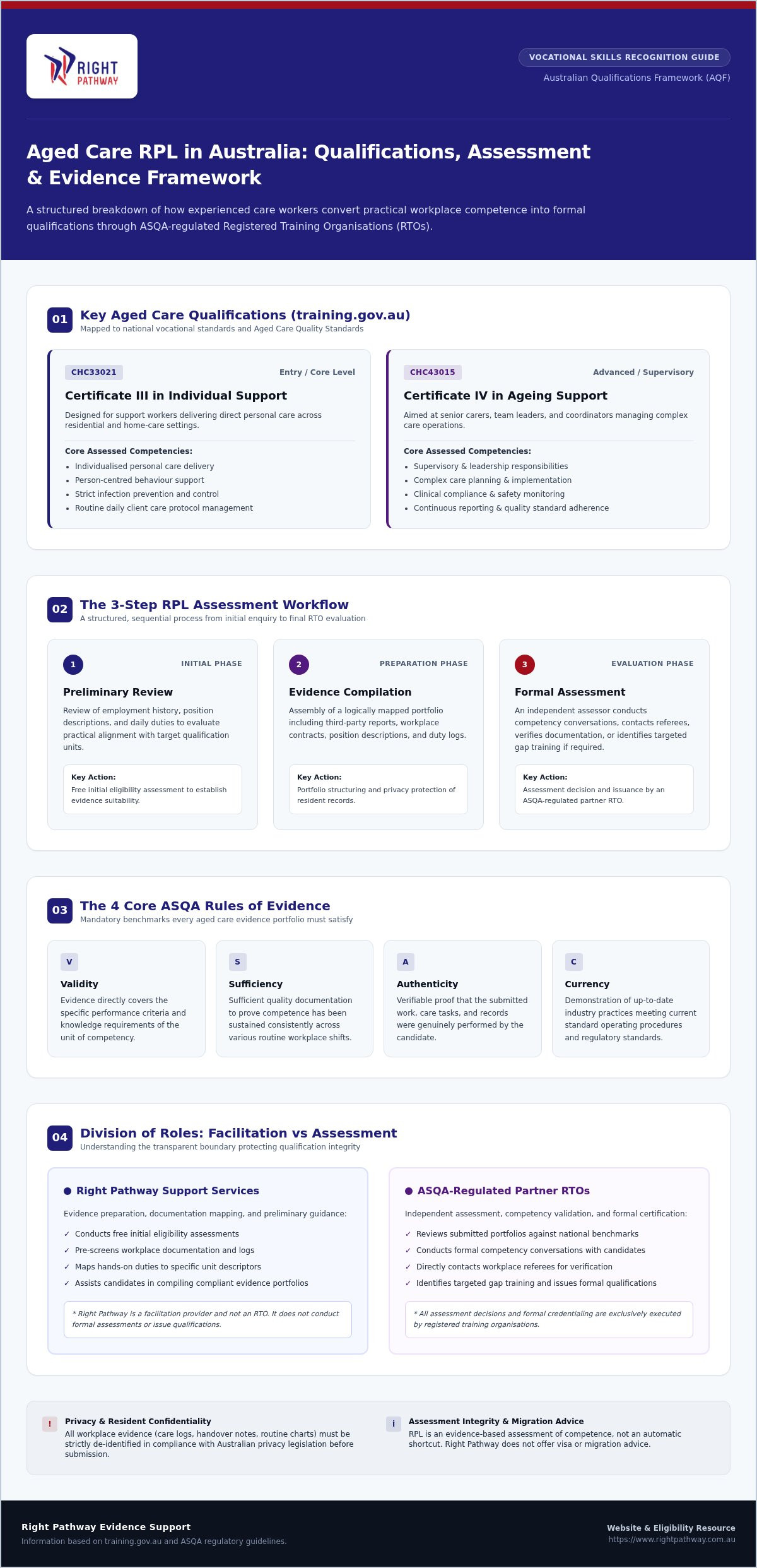
National benchmarks listed on training.gov.au define two primary pathways. The CHC33021 Certificate III in Individual Support covers core individualised care, person-centred behaviour support, and infection control. Alongside practical care skills, support workers must maintain current first aid and resuscitation competencies; accredited organisations such as Coolangatta First Aid & CPR Training deliver these essential compliance units. For senior carers, the CHC43015 Certificate IV in Ageing Support assesses supervisory skills, complex care planning, and clinical compliance. Final suitability depends strictly on your evidence portfolio and assessment by a partner RTO.
Eligibility Criteria for Working Carers and Migrants
Candidates need substantial, verifiable paid experience in residential aged care or community home-care environments. Migrant workers with nursing or clinical backgrounds often use this pathway to map overseas healthcare experience to Australian standards. Understanding the broader benefits of RPL helps you decide if converting your routine workplace competence into a formal qualification aligns with your career goals.
How the Aged Care RPL Assessment Process Operates
Navigating aged care rpl australia involves a structured, evidence-based pathway rather than a simple tick-and-flick exercise. Independent assessors evaluate your portfolio directly against national performance criteria aligned with the Aged Care Quality Standards. If your portfolio reveals minor shortfalls in specific competencies, your assessing organisation identifies targeted gap training rather than making you repeat units you already know. Turnaround times vary based on how quickly you compile documentation and the assessor's verification schedule.
Step-by-Step Pathway from Initial Enquiry to Certification
The journey follows three clear, sequential phases:
- Step 1: Preliminary Review. You undertake an initial review of your employment history, job role descriptions, and daily duties to confirm alignment with qualification units.
- Step 2: Evidence Compilation. You gather third-party reports, workplace contracts, duty logs, and position descriptions into a logically mapped submission.
- Step 3: Formal Assessment. An assessor conducts competency conversations, contacts professional referees, and reviews documentation to verify your hands-on competence.
The Distinct Role of Facilitation Services vs Partner RTOs
Understanding who handles each stage prevents common industry confusion. Facilitation providers assist candidates by pre-screening documents, mapping workplace tasks to unit codes, and organising submissions. They are not Registered Training Organisations and do not issue qualifications. Formal evaluation, assessment decisions, and final credentialing remain strictly the domain of ASQA-regulated partner RTOs. Review our detailed RPL process guide to see how this separation protects qualification integrity, or complete a free initial eligibility assessment to check your evidence readiness today.
Essential Evidence Portfolio for Aged Care Skills Recognition
To succeed with aged care rpl australia, your portfolio must satisfy the four ASQA rules of evidence: validity, sufficiency, authenticity, and currency. Assessors need proof that you performed tasks yourself, met standard operating procedures, and used current techniques within the past two to three years. Strict compliance with the Privacy Act 1988 is non-negotiable; every workplace document containing resident details must be fully de-identified before submission. Submitting comprehensive, well-structured records upfront prevents protracted assessment delays.
Primary Workplace Documents Assessors Require
RTO assessors look for formal proof that confirms your routine technical duties across residential or home-care settings:
- Employment Verification: Signed contracts, official position descriptions, and recent payslips demonstrating ongoing hours.
- De-identified Workplace Logs: Redacted care plans, bowel charts, progress notes, incident forms, and medication administration sheets.
- Third-Party Reports: Testimonials from Registered Nurses or facility managers confirming practical competency across specific units.
Overcoming Common Documentation Gaps and Currency Challenges
Casual and agency carers often struggle with fragmented paperwork across multiple facilities. In these cases, timesheets paired with detailed statutory declarations and supervisor sign-offs bridge the gaps effectively. Overseas nurses seeking recognition in Australia can present certified foreign transcripts alongside proof of their recent Australian aged care work history. Learn more about national portfolio requirements by reading our comprehensive overview of RPL pathways.
Navigating Your Aged Care Pathway with Right Pathway Support
Assembling a compliant evidence portfolio while working demanding shift patterns is a heavy burden. Established in 2019, Right Pathway has guided over 2,000 applicants across 18 vocational sectors nationwide, helping experienced care workers bridge the gap between practical routines and formal benchmarks. We operate strictly as an evidence facilitation and support service. Right Pathway is not an RTO, does not conduct formal assessments, does not issue qualifications, and does not provide migration or visa advice. Instead, we assist with documentation pre-screening and match your completed portfolio directly with ASQA-regulated partner RTOs that perform the independent evaluation.
Professional Evidence Mapping and Regulatory Transparency
Our consultants examine your daily care duties and methodically align your hands-on tasks with specific competency requirements. We reject unethical shortcuts completely. Genuine aged care rpl australia pathways never promise instant certificates, guaranteed outcomes, or bypassed competency conversations. Every outcome depends strictly on your evidence quality and the assessor's decision. To understand the various factors that influence application fees across the vocational sector, consult our practical RPL cost Australia guide.
Take the Next Step in Your Care Career
Securing an accredited credential unlocks opportunities for career advancement into senior personal care, lifestyle coordination, and specialist dementia support roles. During your initial review, our team evaluates your current resume, position descriptions, and employment history to identify potential evidence gaps before formal submission. You receive clear, transparent guidance on whether your background meets RTO entry benchmarks. Take the first step toward validating your hard-earned experience by requesting a free eligibility check today.
Validate Your Care Experience and Advance Your Career
Transforming your hands-on frontline experience into formal qualifications shouldn't require sitting through classroom lectures on skills you deliver every shift. By aligning your daily duties with national vocational standards, aged care rpl australia provides a legitimate pathway to earn formal recognition. With strict regulatory benchmarks governing residential and home-care settings across Australia, proving your practical competency through verifiable workplace records has never been more valuable.
Since 2019, Right Pathway has guided over 2,000 candidates across 18 vocational sectors nationwide. Through structured portfolio mapping and transparent evidence reviews, our experienced consultants help you assemble an authentic documentation package for independent evaluation by ASQA-regulated partner RTOs. We remove the guesswork from skills recognition so you can focus on your vital care duties.
Take charge of your professional future today. With supportive guidance tailored to your shift schedule, you can validate your workplace competence with complete confidence.
Frequently Asked Questions
What is aged care RPL and how does it work in Australia?
Aged care RPL is an assessment pathway where experienced care workers demonstrate vocational competence through practical workplace proof rather than attending routine classes. For aged care rpl australia applicants, this involves mapping everyday tasks, like personal care routines and infection management, against current national units. An independent assessor from an ASQA-regulated Registered Training Organisation then audits your documentation and verifies your competency before awarding formal credit.
Which aged care qualifications can be achieved through recognition of prior learning?
Workers can pursue qualifications based on their verified duties and evidence portfolio. Common qualifications include the CHC33021 Certificate III in Individual Support, which covers direct personal care and person-centred assistance, and the CHC43015 Certificate IV in Ageing Support for supervisory staff and care team leaders. Final eligibility and unit suitability depend strictly on your workplace evidence and independent assessment by an ASQA-regulated partner RTO.
Can I use overseas nursing or care experience for Australian aged care RPL?
Yes, overseas healthcare experience can form a substantial part of your portfolio for aged care rpl australia. International nurses and experienced carers frequently use certified overseas transcripts, hospital reference letters, and employment contracts alongside recent Australian care work. Assessors require proof of current practice within Australian care environments to confirm you understand domestic compliance standards, privacy legislation, and workplace health and safety protocols.
Is an aged care qualification achieved via RPL identical to one earned through classroom study?
Yes, the testamur and statement of attainment issued upon completing RPL are completely identical to those awarded through traditional classroom or online training. Australian Qualifications Framework standards make no distinction on how competency was acquired, whether through study or workplace validation. Your certificate is issued directly by an accredited RTO and holds the exact same validity for industry employment, mandatory minutes compliance, and award wage progression.
Is Right Pathway a Registered Training Organisation (RTO)?
No, Right Pathway is not a Registered Training Organisation and does not issue qualifications or conduct formal assessments. We provide specialised evidence facilitation and document preparation support. Our team helps experienced care workers map their routine frontline duties against competency requirements before connecting them with ASQA-regulated partner RTOs. Those independent partner RTOs evaluate your portfolio, conduct assessor interviews, and issue the final qualification if deemed competent.

Article by
Right Pathway Team
Right Pathway is an Australian Recognition of Prior Learning (RPL) support and facilitation service helping experienced workers, tradespeople and skilled migrants prepare evidence for nationally recognised qualification pathways.
Founded in 2019, Right Pathway has supported over 2,000 applicants across construction, mining, healthcare, aged care, business, community services, hospitality, automotive and the trades.
We work with ASQA-regulated partner Registered Training Organisations (RTOs) to support evidence preparation, skills mapping and qualification pathway guidance. Right Pathway is not an RTO and does not issue qualifications directly.
Start with a free RPL eligibility assessment at rightpathway.com.au.
Disclaimer
Right Pathway is a facilitation and support service only. We are not a Registered Training Organisation (RTO), do not conduct formal RPL assessments and do not issue qualifications. All formal RPL assessments and certifications are completed by partner RTOs regulated by ASQA. Eligibility and qualification outcomes depend on each applicant’s evidence, experience and the RTO’s assessment decision.


