

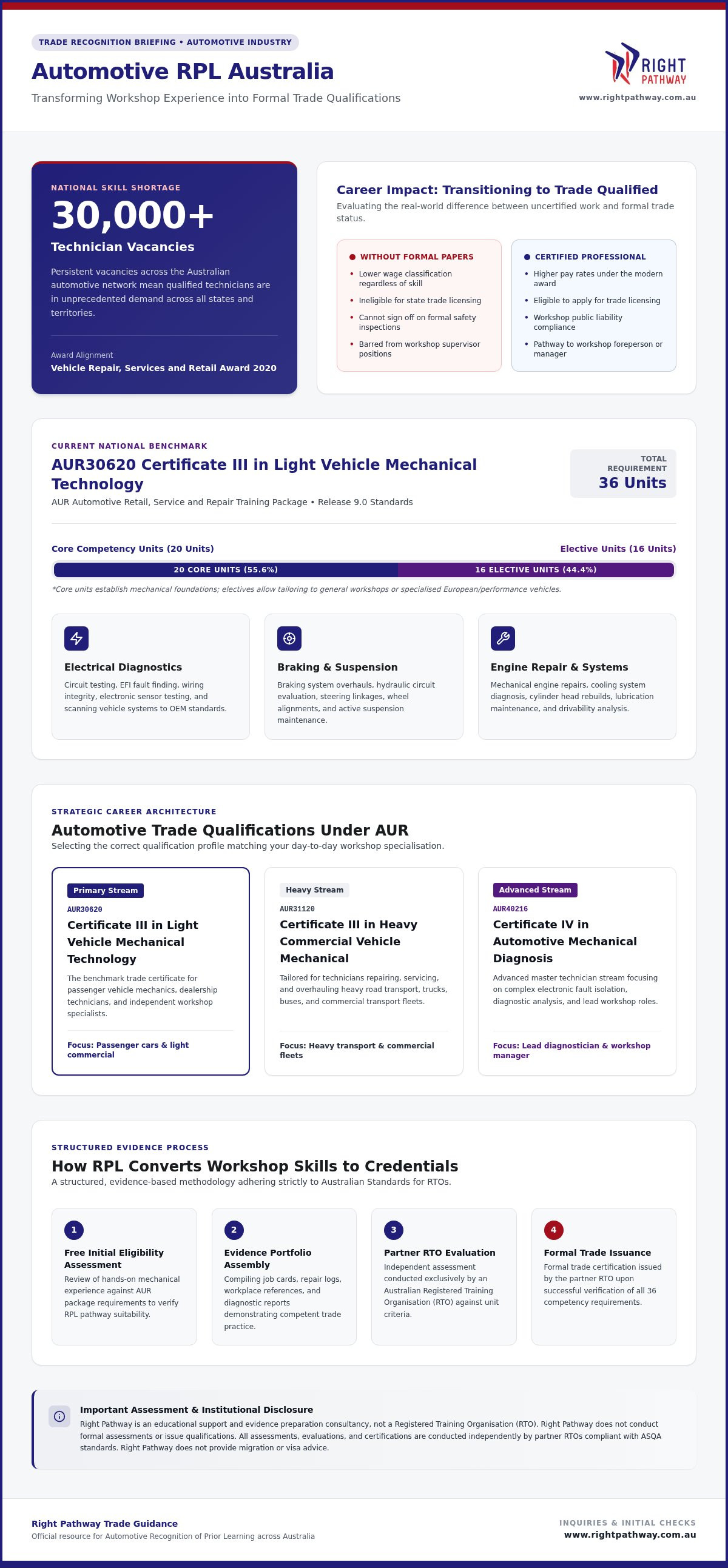
With over 30,000 technician vacancies persisting across the national network, there has never been a more critical time to formalise your expertise. You've likely spent years under the hoist, solving complex EFI faults and rebuilding engines, yet you're still classified at a lower pay rate because you lack formal papers. It's frustrating to be treated as "unqualified" when your hands-on skills match or exceed those of a master technician. If you are exploring automotive rpl australia, you've already taken the first step toward closing that gap.
In this guide, you'll learn how to convert your years of mechanical experience into a formal Australian qualification through a streamlined, evidence-based process. We will walk you through the current AUR30620 requirements, the specific evidence partner RTOs demand, and how to navigate the transition from a veteran worker to a certified professional. Right Pathway acts as your knowledgeable navigator, helping you prepare a robust portfolio for RTO assessment so you can finally secure the trade licensing and pay rates you deserve.
Key Takeaways
- Discover how to convert your extensive workshop experience into a formal trade certificate through a structured evidence-mapping process.
- Learn the specific evidence requirements for automotive rpl australia to ensure your portfolio meets the rigorous standards of partner RTOs.
- Understand the structure of the AUR30620 Certificate III in Light Vehicle Mechanical Technology and its importance for industry licensing and pay rates.
- Find out how Right Pathway facilitates your evidence preparation and provides a free initial eligibility assessment to clarify your certification journey.
Why Automotive RPL Australia is Essential for Experienced Mechanics
Many mechanics have spent years refining their craft without holding formal papers. In the Australian vocational education system, recognition of prior learning (RPL) serves as a formal assessment methodology. It evaluates the skills you've already gained on-the-job against national standards. For those seeking automotive rpl australia, this isn't about learning new tricks; it's about proving you already know them.
To better understand how this pathway works for trade professionals, watch this helpful video:
Australian workshops face strict compliance and insurance requirements. Business owners often prefer certified staff to ensure they meet public liability and professional indemnity standards. Moving from an "unqualified technician" to a certified professional changes your status in the workshop. It validates your expertise and ensures the business remains compliant with national industry regulations and safety benchmarks.
The Benefits of Professional Validation
Holding a formal qualification often leads to better pay rates under the Vehicle Repair, Services and Retail Award 2020. It also opens doors to senior roles such as workshop foreperson or manager. For many, the biggest advantage is eligibility for trade licensing, which is essential for signing off inspections or starting your own business. It's a streamlined alternative to traditional classroom study that leads to a nationally recognised qualification while respecting your time. Such efficiency makes achieving automotive rpl australia a practical reality for busy professionals.
Is Automotive RPL Right for You?
This pathway is designed for veteran mechanics with significant experience across diverse vehicle systems. Partner RTOs typically look for evidence of competency in:
- Electrical diagnostics and circuit testing
- Braking systems and suspension overhauls
- Engine repair and steering maintenance
If you've spent at least a few years in a full-service environment, you likely have the foundation required. You can check your status through a free initial eligibility assessment to see if your experience maps to current standards.
Key Qualifications: AUR30620 and the AUR Training Package
The AUR Automotive Retail, Service and Repair Training Package provides the formal structure for all mechanical trades. While some online resources still cite superseded codes, the industry currently adheres to Release 9.0 standards. For those pursuing automotive rpl australia, the AUR30620 Certificate III in Light Vehicle Mechanical Technology is the primary objective. This is a nationally recognised qualification that requires a candidate to demonstrate competency across 36 units, including 20 core requirements and 16 electives.
Other specialised pathways exist within the package for different trade roles. Mechanics working on trucks and buses often target the AUR31120 Certificate III in Heavy Commercial Vehicle Mechanical Technology. Regardless of the specialisation, your success in automotive rpl australia depends entirely on the quality of your workplace evidence and the formal evaluation conducted by a partner RTO.
Understanding AUR30620 Requirements
The AUR30620 qualification specifications outline core units covering engine systems, steering, suspension, and electrical diagnostics. Elective units allow the qualification to be tailored to your specific workshop environment, whether you specialise in European performance cars or general servicing. Evidence must show you can perform these tasks safely and to manufacturer standards.
Higher Level Pathways: Cert IV and Beyond
Achieving a Certificate III acts as the foundation for your career. Experienced technicians often progress to the AUR40216 Certificate IV in Automotive Mechanical Diagnosis. This higher level focuses on advanced fault-finding and lead technician responsibilities. It's the logical next step for those aiming for workshop management roles. If you aren't sure where your experience sits, a free initial eligibility assessment is the best way to determine your starting point.
The Automotive RPL Evidence Checklist: What You Need
A common misconception about automotive rpl australia is that it involves simply filling out forms. In reality, it is a rigorous assessment of your professional competency. To ensure your application meets national standards, you must provide high-quality evidence that is authentic, valid, and current. Following ASQA guidance on recognition of prior learning, RTO assessors require proof that you have performed specific tasks consistently over time.
Your evidence portfolio should include primary documents such as:
- Employment contracts and detailed job descriptions.
- Recent pay slips or group certificates to verify industry experience.
- Third-party testimonials from licensed workshop supervisors or owners.
- Photographic and video proof of you performing hands-on repairs.
Mapping Your Daily Tasks to Units of Competency
The goal is to translate your workshop routine into formal units. For example, a standard brake service maps directly to the unit "Inspect and service braking systems." You don't need to retrain; you just need to provide the repair orders and diagnostic logs that prove you've done the work. Converting these daily records into a structured portfolio is a key part of the journey. This process ensures your existing skills are recognised without requiring you to step foot in a classroom.
Organising Your Portfolio for Success
When capturing photos or videos, ensure they show your face and the specific mechanical task, such as using a multimeter for circuit testing or machining a rotor. All documents must reflect recent industry standards to be considered valid by an assessor. You can learn about the Right Pathway RPL process to see how we guide you through this collation phase. Suitability for certification depends entirely on the quality of this evidence and the final RTO assessment.
Navigating the Path to Certification with Right Pathway
Securing automotive rpl australia doesn't have to be a solo struggle against bureaucracy. Right Pathway operates as your expert facilitator, bridging the gap between your workshop experience and formal certification. Our process begins with a free initial eligibility assessment to determine if your background aligns with the AUR training package. Once confirmed, we provide expert guidance on mapping your mechanical skills to the required units of competency. Finally, we coordinate with partner Registered Training Organisations (RTOs) who conduct the formal assessment.
Why Use a Facilitation Service?
The primary benefit of using a facilitation service is the reduction of time spent on administrative hurdles and technical jargon. Many mechanics find the training package language confusing; we translate your daily tasks into the specific evidence required for a nationally recognised qualification. By ensuring your portfolio meets high standards before submission, you reduce the risk of delays during the RTO's evaluation. Our role is to handle the complex paperwork so you can stay focused on your trade.
Important Disclaimers and Expectations
Transparency is central to our partnership. It's essential to understand that Right Pathway is not an RTO and does not issue certificates or conduct formal assessments. The final decision on your competency rests entirely with the partner RTO. Additionally, we don't provide migration, visa, or immigration advice. Our expertise is strictly focused on evidence preparation and pathway navigation for trade professionals. If you're ready to see where your skills stand, start your free eligibility check today and take the first step toward formalising your expertise.
Secure Your Mechanical Future Today
Your years of workshop experience represent significant value. It's time to transform that hard work into official recognition. We've explored how the AUR30620 Certificate III in Light Vehicle Mechanical Technology serves as the industry standard. Right Pathway has facilitated over 2,000 successful applications. While we aren't an RTO, we provide specialised support for the AUR training package to help mechanics bridge the gap to certification. Your skills deserve formal validation.
Achieving automotive rpl australia is a methodical process. It rewards your existing expertise without requiring you to repeat training you've already mastered. By leveraging our free initial eligibility assessment, you'll gain immediate clarity on your path forward. This isn't just about a piece of paper. It's about unlocking better pay rates and the career respect you've earned.
Take control of your professional standing and let your hard-earned experience speak for itself.
Frequently Asked Questions
Is automotive RPL easy for experienced mechanics?
Recognition of prior learning is a rigorous assessment of competency rather than an easy or guaranteed shortcut. While it's more efficient than traditional classroom study for veteran mechanics, it requires the collation of high-quality evidence like job cards and repair orders. Partner RTOs must verify your skills against the AUR30620 standards. Right Pathway supports this journey by facilitating your evidence preparation to ensure it meets the necessary benchmarks for a successful outcome.
How much does an automotive RPL certificate cost in Australia?
The total investment for automotive rpl australia varies depending on the specific qualification and the partner RTO conducting the assessment. Fees typically cover the initial evidence review, the formal assessment by a qualified assessor, and the issuance of the certificate. Since every mechanic's experience is unique, we recommend starting with a free initial eligibility assessment. This provides clarity on the requirements before you commit.
Can I get a trade certificate if I trained overseas?
Skilled migrants with international experience can use the RPL process to have their skills validated against Australian standards. Your overseas work history, training documents, and references are valuable pieces of evidence for an RTO assessment. While Right Pathway doesn't provide migration or visa advice, we specialise in helping international professionals map their existing mechanical expertise to current standards to achieve official trade certification through our partner RTOs.
What happens if my evidence is not sufficient for the AUR30620?
If your evidence portfolio doesn't cover all 36 units required for the AUR30620, you may be required to complete gap training. The RTO assessor identifies specific units where competency hasn't been fully demonstrated through your work history. You can then complete these remaining units through targeted training with a Registered Training Organisation. This ensures you still achieve your goal without needing to repeat the areas where you're already an expert.
How long does the automotive RPL process typically take?
The duration of the automotive rpl australia process depends largely on how quickly you can gather your workplace experience and the current assessment timelines of the partner RTO. Many candidates complete their portfolio within a few weeks with our facilitation support. Once submitted, the formal evaluation by the RTO assessor generally takes several more weeks. We focus on streamlining the preparation phase to ensure your evidence is sufficient before it reaches the assessor's desk.

Article by
Right Pathway Team
Right Pathway is an Australian Recognition of Prior Learning (RPL) support and facilitation service helping experienced workers, tradespeople and skilled migrants prepare evidence for nationally recognised qualification pathways.
Founded in 2019, Right Pathway has supported over 2,000 applicants across construction, mining, healthcare, aged care, business, community services, hospitality, automotive and the trades.
We work with ASQA-regulated partner Registered Training Organisations (RTOs) to support evidence preparation, skills mapping and qualification pathway guidance. Right Pathway is not an RTO and does not issue qualifications directly.
Start with a free RPL eligibility assessment at rightpathway.com.au.
Disclaimer
Right Pathway is a facilitation and support service only. We are not a Registered Training Organisation (RTO), do not conduct formal RPL assessments and do not issue qualifications. All formal RPL assessments and certifications are completed by partner RTOs regulated by ASQA. Eligibility and qualification outcomes depend on each applicant’s evidence, experience and the RTO’s assessment decision.


