
What if the frontline casework you coordinate every day already satisfies the standards of a formal qualification? Securing a diploma of community services rpl allows experienced workers to convert years of practical experience into the current CHC52025 Diploma of Community Services without stepping back into a classroom.
Balancing intense rosters while untangling bureaucratic jargon from the CHC Community Services Training Package is tough. You want formal recognition for your senior casework, but you can't afford documentation gaps or privacy breaches when handling confidential client records. It's completely reasonable to feel cautious about how the assessment process actually works.
This guide explains how experienced practitioners navigate workplace evidence requirements to achieve qualification outcomes through partner RTOs. We'll outline acceptable documents, privacy-compliant competency mapping, and the exact steps needed to validate your skills efficiently.
Key Takeaways
- Understand how your frontline casework aligns with the updated CHC52025 Diploma of Community Services standards under the Australian Qualifications Framework.
- Discover which primary workplace records, from care plans to project logs, satisfy RTO evidence requirements while protecting client privacy.
- Follow a structured four-stage pathway for your diploma of community services rpl, using specialised documentation support before partner RTO assessment.
- Learn practical strategies to bridge identified competency gaps through targeted training without having to complete an entire qualification from scratch.
Understanding the CHC52021 Diploma of Community Services RPL
Under the Standards for Registered Training Organisations (RTOs), Recognition of Prior Learning (RPL) is an official assessment pathway that evaluates an individual's existing skills and knowledge against national competencies. While the CHC52021 qualification has been superseded on training.gov.au by the updated CHC52025 Diploma of Community Services within the CHC Community Services Training Package, candidates pursuing a diploma of community services rpl can translate their active casework experience directly into the current framework through partner RTOs.
To see how vocational recognition assists practitioners in gaining credit for frontline casework, watch this case study:
Unlike structured classroom delivery requiring weekly lectures and routine assignments, the practical pathway validates competencies already performed on the job. Right Pathway provides evidence preparation guidance, helping workers compile authentic documentation before independent assessment by partner RTOs. Exploring the benefits of RPL clarifies how converting years of workplace problem-solving into a formal credential saves substantial study hours while proving current industry competence.
Who Qualifies for Community Services Skills Recognition?
Eligibility centres on documented workplace performance rather than job titles alone. This pathway supports:
- Family support officers, social housing coordinators, and case managers managing high-needs caseloads.
- Senior community workers who design, implement, and review complex client intervention plans autonomously.
- Overseas-qualified human services professionals seeking formal Australian alignment through recognised qualifications.
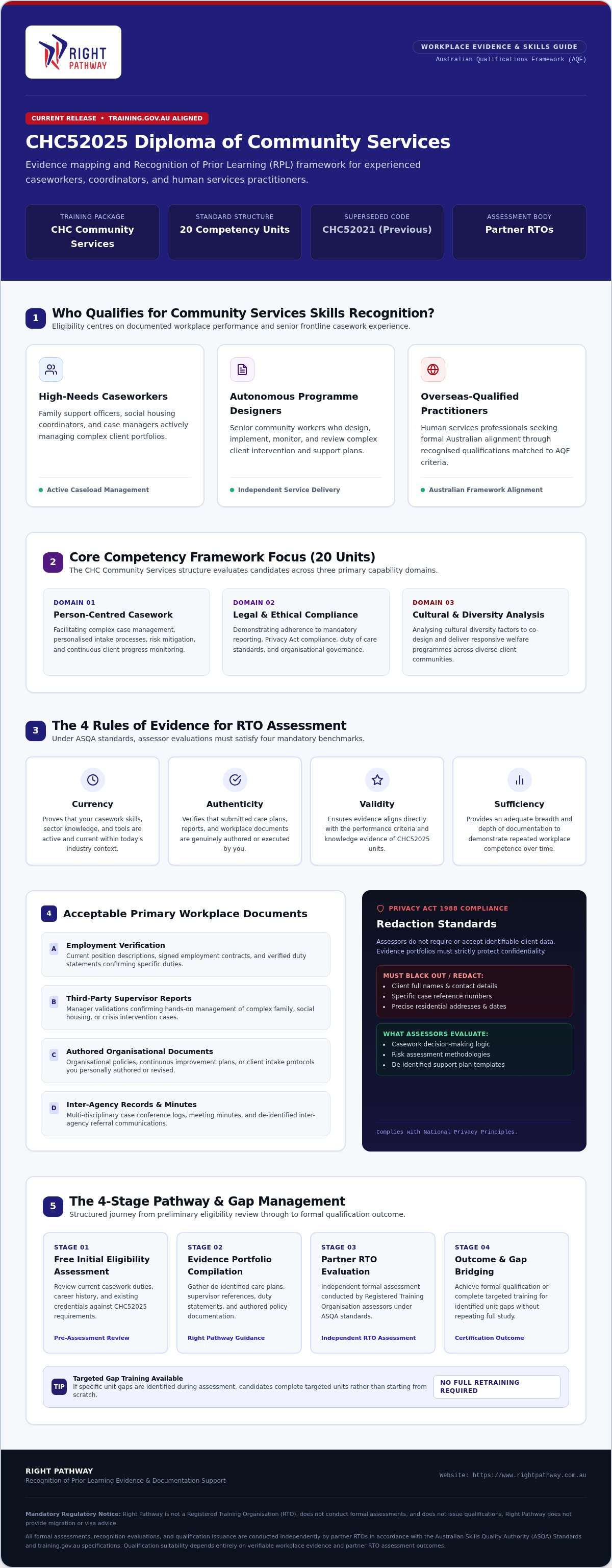
Core Competency Areas Under the CHC Community Services Framework
The standard structure requires candidates to prove practical mastery across 20 units of competency. Core capabilities focus on facilitating person-centred case management, managing legal and ethical compliance within community organisations, and analysing cultural diversity to deliver responsive welfare programmes. Suitability depends entirely on verifiable workplace evidence and partner RTO assessment.
Essential Evidence Checklist for Community Services Recognition
Securing an outcome through RPL is not a simple tick-box administrative exercise. Registered Training Organisation (RTO) assessors operate under ASQA guidelines to evaluate your portfolio against four core rules of evidence: currency, authenticity, validity, and sufficiency. While previous transitions referenced the CHC52021 Diploma of Community Services, current applicants must align their evidence with the active CHC52025 release. Suitability depends entirely on documentation quality, and candidates can review their profile through a free initial eligibility assessment before assembling workplace records.
Primary Workplace Documents You Can Provide
Proving senior casework requires a combination of primary and secondary operational proof. Assessors look for official documentation showing your autonomy and service delivery skills:
- Current position descriptions, signed employment contracts, and verified duty statements confirming relevant responsibilities.
- Third-party supervisor reports verifying hands-on management of complex family, housing, or crisis intervention scenarios.
- Organisational policies, continuous improvement plans, or intake protocols you personally authored or updated.
- Meeting minutes, inter-agency case conference logs, and de-identified correspondence demonstrating multi-disciplinary coordination.
Navigating Privacy and Redaction Standards
Working in community services means managing sensitive personal information daily. Supplying evidence for a diploma of community services rpl must never compromise the Privacy Act 1988 or client confidentiality. Assessors do not need or want identifiable client data. Instead, black out names, contact information, case numbers, and specific dates from progress notes, incident reports, and support plans. Using de-identified templates proves your casework capabilities, risk assessments, and decision-making logic without exposing vulnerable individuals to privacy breaches.
The 4-Step RPL Process from Assessment to Outcome
Achieving vocational recognition requires a methodical journey governed by the Australian Qualifications Framework. To maintain regulatory integrity, Right Pathway acts strictly as a documentation facilitator, supporting portfolio collation and skills mapping. Right Pathway is not an RTO and does not issue qualifications or conduct formal assessments; all formal determinations are delivered independently by partner ASQA-regulated RTOs. Reviewing the complete RPL process provides full visibility over each progression milestone.
Step 1 & 2: Skills Screening and Evidence Mapping
The journey begins with an initial screening to establish your operational history against current qualification standards. Facilitators then assist in cataloguing your casework files, correspondence, and third-party references. Every workplace document is systematically mapped against specific performance criteria across the core units of the CHC Community Services Training Package. This structured preparation ensures your portfolio is logically indexed before submission.
Step 3 & 4: RTO Assessment and Qualification Issuance
Once compiled, your portfolio undergoes formal assessment by an independent partner RTO assessor. This evaluation involves:
- A thorough desk audit evaluating the validity and sufficiency of your submitted workplace evidence.
- A competency conversation where the assessor discusses real-world scenarios to confirm your underpinning legal, ethical, and theoretical casework knowledge.
- Final assessment determination by the RTO, followed by the formal issuance of your qualification testamur.
Completing a diploma of community services rpl hinges entirely on this independent verification of your day-to-day expertise.
Navigating Assessment Challenges and Closing Skills Gaps
Frontline casework is diverse, but daily practice does not always cover every packaging requirement of the CHC Community Services Training Package. If an independent partner RTO assessor identifies that your portfolio lacks sufficient documentation for specific units, your application doesn't simply fail. Legitimate assessment routes provide structured options to address missing performance benchmarks. Discovering the wider benefits of RPL helps experienced professionals realise that partial recognition remains a valuable step forward.
Resolving Unmet Competency Requirements
When documentation gaps arise during a diploma of community services rpl appraisal, partner RTOs offer practical remedies:
- Completing targeted gap training modules focused solely on missing theoretical units or specialised electives.
- Participating in structured workplace simulations to demonstrate uncommon crisis management procedures.
- Submitting supplementary supervisor verifications confirming niche casework duties that lacked immediate paperwork.
- Receiving an official Statement of Attainment for satisfied competencies while completing any remaining units.
Next Steps for Experienced Community Workers
Translating informal workplace learning into formal recognition unlocks senior coordination roles, programme management duties, and specialist casework responsibilities across the community sector. Preparing early reduces administrative delays. Begin by assembling historical duty statements, organisational policies you helped draft, and performance appraisals into an orderly folder. Working alongside documentation facilitators ensures your records match formal unit descriptors accurately. Completing a complimentary preliminary screening confirms your portfolio's alignment before you proceed to formal assessment with partner RTOs.
Take the Next Step Toward Formal Recognition
Proving your frontline expertise doesn't mean repeating units you practise every day. By systematically converting real-world workplace documentation into an audit-ready portfolio, experienced community workers can confidently meet the rigorous assessment standards set by partner RTOs. Since 2019, Right Pathway has supported over 2,000 applicants across 18 vocational industries, delivering specialised skills mapping across complex human services units to ensure every piece of workplace evidence aligns directly with national training requirements.
Pursuing your diploma of community services rpl through an independent partner RTO validates your leadership in client advocacy, complex case coordination, and ethical service delivery. With expert documentation guidance in your corner, you can clear administrative hurdles, protect client privacy, and focus entirely on taking the next step in your community sector career.
Take charge of your vocational pathway today. Your dedicated casework and ongoing community impact deserve formal professional validation.
Frequently Asked Questions
Can I achieve a Diploma of Community Services through RPL without current employment?
Yes, you can qualify if you have substantial, verifiable past industry experience. Assessors require recent documentation, typically from within the last two to three years, to prove currency. You must supply historic contracts, reference letters, and workplace records showing you previously performed the relevant casework functions autonomously.
How long does the evidence preparation and assessment process usually take?
Turnaround timelines vary based on your documentation readiness and partner RTO assessment schedules. Gathering evidence and mapping your portfolio generally takes a few weeks depending on how quickly you locate past records. Once submitted, partner RTO assessors conduct their desk review and competency conversations before issuing a formal assessment decision.
What happens if my workplace evidence does not cover every unit?
If your portfolio shows documentation gaps during your diploma of community services rpl appraisal, you won't automatically fail. The partner RTO assessor identifies the specific unmet competencies. You can satisfy these remaining requirements by completing targeted gap training modules or providing supplementary third-party reports without having to repeat units you already proved.
Is a qualification gained through RPL treated the same as standard study?
Yes, qualifications issued via RPL carry the exact same legal and professional standing as those achieved through conventional classroom study. Your testamur is issued under the Australian Qualifications Framework by an ASQA-regulated RTO. It contains no notation stating you completed the qualification through recognition rather than campus-based coursework.
Does Right Pathway issue my community services diploma directly?
No, Right Pathway is not a Registered Training Organisation and does not issue qualifications or conduct formal assessments. We provide specialised evidence preparation guidance, document mapping, and screening support. All formal evaluations, competency determinations, and certificate issuances are completed exclusively by our ASQA-regulated partner RTOs across Australia.
Article by
Right Pathway Team
Right Pathway is an Australian Recognition of Prior Learning (RPL) support and facilitation service helping experienced workers, tradespeople and skilled migrants prepare evidence for nationally recognised qualification pathways.
Founded in 2019, Right Pathway has supported over 2,000 applicants across construction, mining, healthcare, aged care, business, community services, hospitality, automotive and the trades.
We work with ASQA-regulated partner Registered Training Organisations (RTOs) to support evidence preparation, skills mapping and qualification pathway guidance. Right Pathway is not an RTO and does not issue qualifications directly.
Start with a free RPL eligibility assessment at rightpathway.com.au.
Disclaimer
Right Pathway is a facilitation and support service only. We are not a Registered Training Organisation (RTO), do not conduct formal RPL assessments and do not issue qualifications. All formal RPL assessments and certifications are completed by partner RTOs regulated by ASQA. Eligibility and qualification outcomes depend on each applicant’s evidence, experience and the RTO’s assessment decision.


