

Why does a decade of senior management experience often feel invisible when you look at a formal qualification checklist? You know you've done the work, but the technical process of skills mapping for RPL can feel like learning a foreign language. It's completely normal to feel anxious about the volume of paperwork or uncertain if your daily tasks are 'good enough' to meet the strict benchmarks set by the Australian Skills Quality Authority (ASQA).
We understand that you want a clear path forward without the confusion of 'Units of Competency' getting in the way. This guide explains the exact process of mapping your professional history to current national standards to streamline your journey. By identifying high-quality evidence that aligns with the 2025 Standards for RTOs, you'll gain the confidence that your skills are being correctly measured. While Right Pathway is not a Registered Training Organisation (RTO) and does not provide migration advice or formal assessments, we specialise in the evidence preparation and guidance required for a successful submission. We'll show you how to organise your portfolio so our partner RTOs can efficiently assess your eligibility for a nationally recognised qualification, ensuring you get the credit you deserve for your existing hard work.
Key Takeaways
- Understand how skills mapping for RPL translates your unique career history into the technical language used by Australian RTOs to identify qualification gaps early.
- Learn to navigate 'Performance Criteria' within Units of Competency to ensure your daily tasks meet the specific requirements of qualifications like the BSB50420 Diploma of Leadership and Management.
- Discover a methodical step-by-step approach to selecting the correct qualification level and sourcing official unit outlines from training.gov.au.
- Master the 'Rules of Evidence' including Validity, Sufficiency, Authenticity, and Currency to ensure your portfolio is prepared for a formal RTO assessment.
- Clarify the distinction between evidence facilitation and formal certification to ensure you have the correct support throughout your Recognition of Prior Learning journey.
What is Skills Mapping for RPL and Why Does It Matter?
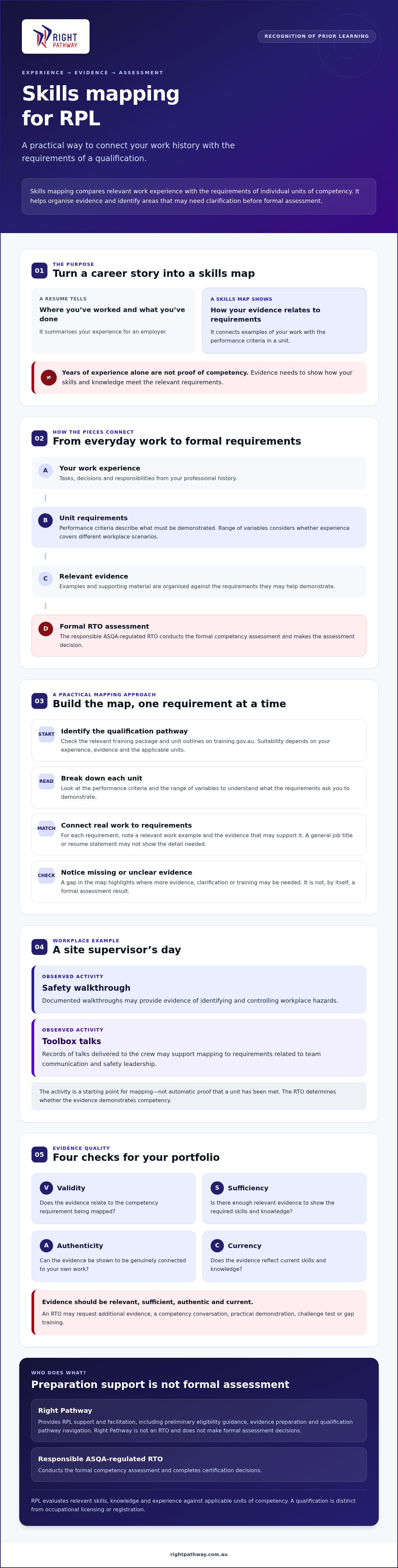
Skills mapping for RPL is the technical process of cross-referencing your professional work history against the specific requirements of a Recognition of Prior Learning assessment. It's the bridge between your real-world experience and the formal standards set by the Australian Qualifications Framework (AQF). Without a precise map, even a highly skilled professional might fail to provide the exact type of evidence an assessor needs to see to verify their competency.
This process is vital because it identifies 'gaps' in your portfolio before you submit a formal application. If you're missing specific evidence for a core unit, a map highlights this early, preventing you from wasting time and resources on an unsuccessful application. It effectively transforms a generic resume into a structured evidence portfolio that aligns with the RPL process used by Registered Training Organisations (RTOs). Effective skills mapping for RPL ensures that your application is robust, reducing the likelihood of being asked for additional documentation later.
The Difference Between a Resume and a Skills Map
A resume tells your career story to a prospective employer, but a skills map proves your competency to an academic assessor. While your resume might state you have "ten years of project management experience," an assessor needs to see evidence that matches the 'Performance Criteria' of a specific unit. Years of experience alone aren't enough; you must prove you can perform every task defined in the national standard. A resume is a summary; a skills map is a detailed blueprint of your capabilities.
The Role of Training Packages in 2026
The Australian vocational education system is built on 'Training Packages' found on the official training.gov.au database. For example, if you're targeting the CPC40120 Certificate IV in Building and Construction (Building), you'll find a list of 'Units of Competency'. These units are the building blocks of your qualification. Mapping involves breaking down your daily responsibilities to see how they satisfy the requirements of these individual units. Right Pathway specialises in this preparation, helping you navigate these complex frameworks before your evidence reaches a partner RTO for formal assessment.
Connecting Work Experience to Units of Competency
The true power of skills mapping for RPL lies in the details. Every Unit of Competency in a national training package contains specific 'Performance Criteria' that define exactly what a person must do to be considered competent. For instance, in the BSB50420 Diploma of Leadership and Management, a unit might require you to demonstrate how you facilitate workplace communication. While you might simply say you "run the weekly team meeting," an assessor needs to see evidence that you've prepared agendas, managed group dynamics, and followed up on action items.
Successful mapping also considers the 'Range of Variables'. This ensures your experience isn't limited to one narrow task but covers different workplace scenarios. Right Pathway acts as your technical translator in this process. We help convert your daily "tradie talk" or "corporate speak" into the precise terminology that RTO assessors require. This bridge ensures your experience is recognised in its full professional context. If you aren't sure where your current role fits, a free initial eligibility assessment can provide immediate clarity.
Case Study: Mapping a Site Supervisor's Day
A site supervisor's daily safety walkthrough directly maps to WHS units by demonstrating the active identification and control of workplace hazards. Beyond the physical inspection, the 'Toolbox Talks' delivered to the crew serve as primary evidence for units focused on team communication and safety leadership. By documenting these routine actions correctly, you build a portfolio that speaks the assessor's language and meets the rigorous standards of partner RTOs.
Addressing the 'Gap' Myth
Finding a 'gap' in your skills map isn't a sign of failure. It's a strategic advantage. It means identifying a specific area where you might need a small amount of gap training before a partner RTO can grant a full qualification. A professional skills assessment identifies these requirements early. This proactive approach saves you from paying for a full assessment only to be told later that your evidence is insufficient. It's about being prepared, not just being experienced.
A Step-by-Step Guide to Mapping Your Professional Skills
Successful skills mapping for RPL requires a methodical approach to ensure every piece of your professional history is accounted for. It isn't just about collecting documents; it's about making sure those documents speak directly to the requirements of the qualification you're targeting. Following a logical sequence reduces the risk of missed details and ensures your portfolio is ready for a formal assessment by a partner RTO.
- Step 1: Select the correct qualification level. Assess whether your daily responsibilities align with a Certificate IV or a Diploma. A Certificate IV generally focuses on operational tasks and team supervision, while a Diploma targets management and strategic decision-making.
- Step 2: Source Unit of Competency outlines. Visit training.gov.au to download the specific unit requirements for your target qualification. These outlines provide the exact benchmarks you must meet.
- Step 3: Collate your evidence. Gather primary evidence such as employment contracts and payslips to prove your history. Then, collect secondary evidence like project reports, emails, site photos, or schedules to prove your actual competency.
- Step 4: Perform the cross-reference. Look at each unit's performance criteria and match it to a specific document in your collection. If a unit requires proof of budget management, you must link it to a financial report or a signed budget approval you've handled.
Organising Your Evidence Portfolio
An RTO assessor needs to find what they're looking for quickly. Categorise your documents by unit title or theme rather than just by date. This structure demonstrates that you understand the standards you're being measured against. Remember the rule of currency; most RTOs require evidence to be from the last 2 to 3 years to ensure your skills reflect current industry practices and safety regulations.
Self-Assessment vs. Professional Facilitation
Many candidates find self-mapping overwhelming due to the complex language used in national training packages. It's easy to overlook critical evidence or misinterpret a technical requirement. Accessing professional RPL support can bridge this gap. A facilitator understands exactly what assessors are looking for and can help you organise your portfolio with precision.
Evidence Requirements and Professional Facilitation
To ensure your skills mapping for RPL meets the rigorous requirements of a partner RTO, your evidence must adhere to the four 'Rules of Evidence'. These are the benchmarks every assessor uses to judge your portfolio. Validity ensures your evidence directly relates to the unit criteria. Sufficiency confirms you've provided enough proof to show consistent performance. Authenticity verifies the work is yours, and Currency proves you still possess these skills today.
A well-mapped portfolio significantly reduces the friction during the RPL process. Right Pathway specialises in this preparation, acting as a bridge between your experience and the RTO's requirements. It's vital to clarify that Right Pathway is a facilitation service, not an RTO. We don't conduct formal assessments, issue qualifications, or provide migration and visa advice. Our expertise lies in guiding you through evidence collection so that when your file reaches a partner RTO, it's structured for a smooth, professional review.
Common Pitfalls in Skills Mapping
Quality always beats quantity. Many candidates make the mistake of providing hundreds of pages of irrelevant 'fluff' instead of a few high-quality, factual documents. Another critical error is mapping against superseded training packages. For example, in the building industry, you must ensure your map aligns with the current CPC40120 Certificate IV in Building and Construction (Building) rather than the older, superseded CPC40110 version. Using outdated codes can lead to your application being rejected immediately.
Finalising Your Path to Certification
Once your skills map is complete and your evidence is organised, the entire portfolio is presented to a partner Registered Training Organisation. At this stage, the RTO conducts an independent, formal assessment of your submission. They may request a competency conversation or a practical observation to verify specific skills. The final decision rests solely with the RTO's assessor. By investing time in professional skills mapping for RPL, you ensure that the evidence they review is clear, compliant, and representative of your true professional standing.
Taking the Next Step Toward Your Qualification
Professional validation shouldn't be a source of constant anxiety. By using a structured approach to skills mapping for RPL; you transform your daily work tasks into a powerful evidence portfolio that meets the strict benchmarks of the Australian vocational education system. This methodical process ensures you only focus on relevant documentation; avoiding the common mistake of providing too much information that doesn't actually prove competency. Identifying any potential gaps early allows you to move forward with a clear roadmap rather than guesswork.
Since 2019; Right Pathway has supported over 2,000 applicants across 18 different industries by providing expert guidance on evidence preparation. We act as your knowledgeable navigator to ensure your experience is presented in the technical language that RTO assessors expect to see. While formal certification is always conducted by our partner Registered Training Organisations; our facilitation ensures your journey remains transparent and efficient. You have already done the hard work in your career; now it is time to ensure those skills are officially recognised.
Take the first step toward your professional future with confidence; knowing you have the right support to document your expertise correctly.
Frequently Asked Questions
What is skills mapping for RPL?
Skills mapping for RPL is the systematic process of aligning your professional history with the specific Units of Competency within a nationally recognised qualification. It involves breaking down your daily tasks to see how they satisfy the individual performance criteria set by Australian training standards. This step is essential because it provides a clear roadmap for your evidence collection; ensuring that every document you provide serves a specific purpose in your assessment.
Can I perform my own skills mapping for an Australian qualification?
You can perform your own mapping by downloading the unit outlines from training.gov.au and cross-referencing them with your resume. However; many professionals find this process challenging due to the technical language and high volume of documentation required by the Standards for Registered Training Organisations (RTOs) 2025. Professional facilitation helps you avoid common errors; such as using superseded codes or providing evidence that doesn't meet the strict 'Rules of Evidence' required for a formal assessment.
How much evidence do I need to provide for a successful skills assessment?
The volume of evidence depends on the qualification level; but the focus should always be on quality rather than quantity. You must provide enough proof to satisfy an RTO assessor that you are competent across all required areas; which typically involves a mix of primary documents like payslips and secondary evidence like project reports. A successful skills mapping for RPL identifies the exact pieces of evidence needed to prove your competency without overwhelming the assessor with irrelevant documentation.
What happens if my skills map shows a gap in my experience?
Identifying a gap is a strategic advantage because it allows you to address specific needs before submitting a formal application. If your map shows you lack evidence for a particular unit; you may need to undertake 'gap training' to gain the missing knowledge. This proactive approach ensures you don't pay for a full assessment only to be told your experience is insufficient; saving you both time and money during your Recognition of Prior Learning journey.
Does Right Pathway issue the final RPL certificate?
Right Pathway is not a Registered Training Organisation (RTO) and does not issue qualifications or conduct formal assessments. We provide expert facilitation and support for evidence preparation to ensure your portfolio meets the high standards required by our partner RTOs. The final assessment and the issuance of any formal qualification are completed independently by a partner RTO after they have reviewed your evidence and confirmed your competency.
Article by
Right Pathway Team
Right Pathway supports experienced workers, tradespeople and skilled migrants with preliminary RPL eligibility guidance, evidence preparation and qualification pathway navigation.
Right Pathway is not a Registered Training Organisation and does not conduct formal competency assessments or issue qualifications. Formal enrolment, competency assessment and qualification issuance are completed by the responsible Registered Training Organisation.
Start with a free initial RPL eligibility assessment at https://www.rightpathway.com.au/eligibility-check
Disclaimer
Right Pathway is a facilitation and support service only. We are not a Registered Training Organisation (RTO), do not conduct formal RPL assessments and do not issue qualifications. All formal RPL assessments and certifications are completed by partner RTOs regulated by ASQA. Eligibility and qualification outcomes depend on each applicant’s evidence, experience and the RTO’s assessment decision.


