

A successful RPL portfolio is a curated narrative of your professional competency, not just a random collection of old workplace documents. It's understandable to feel overwhelmed by the sheer volume of evidence required to meet the Australian Qualifications Framework (AQF) standards. Most professionals find it difficult to determine what qualifies as "sufficient" evidence while trying to balance a full-time career. By looking at specific rpl evidence portfolio examples, you can transform years of hands-on experience into a structured application that Registered Training Organisation (RTO) assessors can easily validate.
We promise to help you master the art of building a high-quality submission through industry-specific templates and professional mapping tips. This guide provides a clear roadmap for evidence collection to give you confidence that your portfolio meets the necessary benchmarks. You'll learn how to categorise your work history effectively, ensuring a smoother path toward a nationally recognised qualification. While Right Pathway is not an RTO and does not conduct formal assessments, we act as your knowledgeable navigator to simplify the preparation process and accelerate your career progression.
Key Takeaways
- Understand why quality beats quantity by focusing on probative proof that demonstrates your actual skill level to RTO assessors.
- Review sector-specific rpl evidence portfolio examples for qualifications such as the CPC40120 Certificate IV in Building and Construction (Building).
- Learn to implement a digital-first folder structure that maps your work history directly to the core and elective units of your chosen qualification.
- Discover how to avoid common pitfalls like over-collecting irrelevant documents or using superseded qualification codes from outdated training packages.
What is an RPL Evidence Portfolio and Why Does Quality Matter?
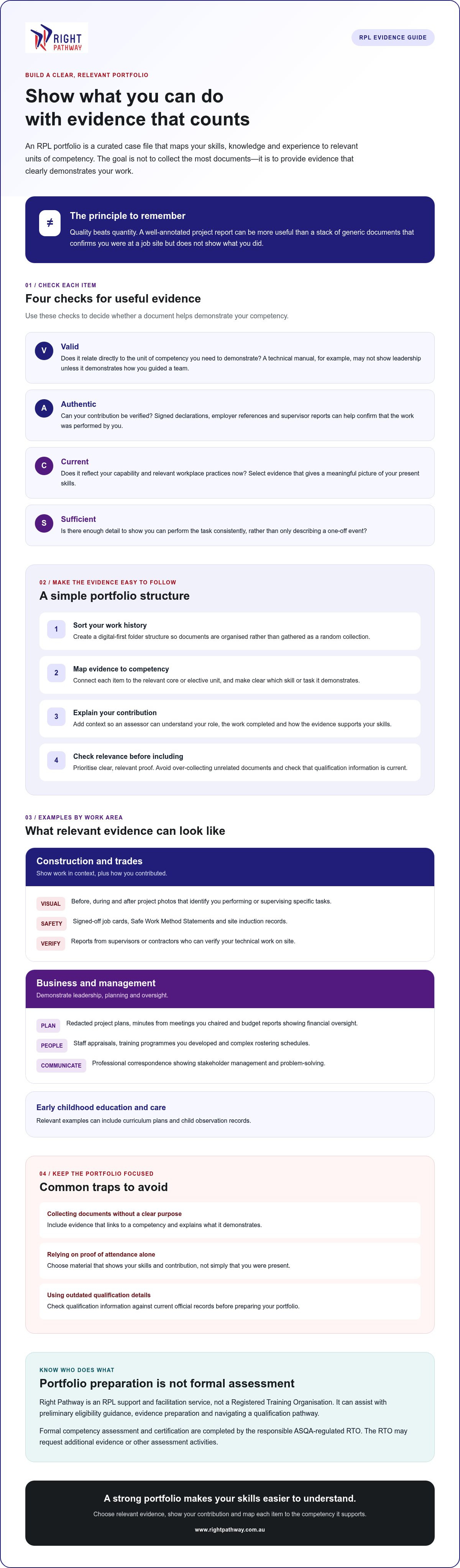
An RPL evidence portfolio is a structured body of proof meticulously mapped to specific units of competency within a training package. Rather than a random assortment of old documents, it serves as a professional case file that demonstrates your mastery of specific skills. In the context of Recognition of Prior Learning (RPL), your portfolio must speak the language of the Australian Qualifications Framework (AQF) to be successful.
Quality consistently outweighs quantity in the eyes of an assessor. Registered Training Organisations (RTOs) look for "probative" evidence, which refers to documents that actually prove your skills rather than just confirming your attendance at a job site. Reviewing high-quality rpl evidence portfolio examples shows that a single, well-annotated project report is often more valuable than twenty generic payslips. While Right Pathway guides your RPL process by helping you identify and organise these documents, the final formal assessment and issuance of any qualification are always performed by a partner RTO.
The Four Pillars of Successful RPL Evidence
To ensure your submission meets national standards, every piece of evidence should align with the VACS principle. This framework is the gold standard for Australian vocational assessments and helps you select the best rpl evidence portfolio examples from your own career:
- Valid: The evidence must directly relate to the specific unit of competency being assessed. If you're proving leadership, a technical manual you wrote might not be valid unless it demonstrates team guidance.
- Authentic: You must prove the work was performed by you. Signed statutory declarations, employer references, or third-party reports from supervisors are essential to verify your contribution.
- Current and Sufficient: Evidence should ideally be from the last 2-3 years to reflect modern industry practices. It must also provide enough detail to show you can perform the task consistently over time, not just as a one-off event.
RPL Evidence Portfolio Examples for Key Australian Industries
Understanding how to map your daily tasks to a qualification is often the most challenging part of the process. Effective rpl evidence portfolio examples bridge the gap between simply doing the job and proving your skill to a professional assessor. Whether you're targeting a trade or a corporate role, your evidence must demonstrate that you consistently meet the training package requirements.
Construction and Trade Evidence Examples
For a qualification like the CPC40120 Certificate IV in Building and Construction (Building), visual proof is paramount. Assessors need to see the application of theory in a real-world setting. High-quality portfolios in this sector typically include:
- Visual proof: Before, during, and after photos of site projects that clearly identify you performing or supervising specific tasks.
- Compliance documents: Signed-off job cards, Safe Work Method Statements (SWMS), and site induction records that demonstrate a commitment to safety.
- Third-party reports: Professional testimonials from licensed supervisors or contractors who can verify your technical proficiency on-site.
Business and Management Evidence Examples
When pursuing the BSB50420 Diploma of Leadership and Management, your evidence shifts toward strategic oversight and administrative authority. These rpl evidence portfolio examples focus on your ability to lead teams and manage resources:
- Strategic documents: Redacted project plans, minutes from meetings you chaired, and organisational budget reports showing financial oversight.
- Performance management: Evidence of staff appraisals, training programmes you developed, or complex rostering schedules.
- Communication: Professional correspondence or emails that highlight your ability to manage stakeholders and solve complex organisational problems.
Similar principles apply to healthcare roles, such as the CHC50121 Diploma of Early Childhood Education and Care, where you might provide curriculum plans or child observation records. It's vital to remember that suitability for any rpl certificate australia depends entirely on the final RTO assessment. If you're unsure where your experience fits, you can start with a free initial eligibility assessment to identify your strongest evidence pathways.
How to Organise Your Portfolio for Maximum Assessment Impact
A disorganised submission is the primary reason for assessment delays. Choosing a digital-first approach ensures easy sharing and robust version control between you, your facilitator, and the RTO. In 2026, physical folders are a thing of the past; digital storage allows for instant updates and clear categorisation of your work history. This method reduces the friction of the review process and keeps your evidence secure and accessible.
Create a logical folder structure based on the qualification's core and elective units. For instance, when organising rpl evidence portfolio examples, your top-level folders should be labelled with the unit codes found on training.gov.au. Within these, use a strict naming convention for every file, such as 'UnitCode_DocumentType_Date_YourName'. This level of detail demonstrates professional rigour and ensures that your facilitator can review your progress quickly. It also allows you to move through the benefits of rpl without getting bogged down in administrative confusion.
The Mapping Document: Your Portfolio's Index
The mapping guide is the most critical component of your submission because it tells the assessor exactly which document proves which skill. A cross-referenced index can significantly reduce RTO 'Request for Further Information' (RFI) delays by eliminating the need for assessors to hunt through your files. Instead of providing a generic stack of documents, you are providing a guided tour of your competencies. To add further clarity, use digital annotations or highlights within your PDF documents to point directly to specific clauses, signatures, or data points that serve as evidence. This proactive approach shows you understand the competency standards and are ready for formal validation.
Common Portfolio Mistakes and How an Expert Facilitator Helps
One of the most frequent errors applicants make is "over-collecting" irrelevant documents. While it's tempting to include every payslip or generic certificate from the last decade, a cluttered portfolio obscures your actual competencies. RTO assessors don't want to sift through noise; they want to see high-quality rpl evidence portfolio examples that prove you can perform the required tasks today. Focus on clarity and relevance to ensure your submission stands out for the right reasons.
Another critical pitfall is preparing evidence for superseded qualification codes. Training packages in Australia are updated regularly to reflect modern industry standards and safety regulations. You should always refer to training.gov.au to ensure you're working toward the current version of a qualification. Preparing for an outdated code can lead to significant rework or even rejection by an RTO, wasting both your time and effort.
It's essential to clarify that Right Pathway is not a Registered Training Organisation (RTO). We don't conduct formal assessments or issue qualifications, and we don't provide migration or visa advice. Instead, we act as your expert facilitator. We support you in evidence preparation and mapping, while our partner RTOs handle the formal certification and assessment process.
Why Use an RPL Facilitation Service?
Professional facilitation bridges the gap between your workplace experience and the formal standards of the AQF. We provide expert skills mapping, converting your daily tasks into the technical language required for a successful application. Our team conducts a thorough evidence review, using industry-specific rpl evidence portfolio examples to help you identify which documents are "sufficient" and which need to be bolstered.
By coordinating directly with partner RTOs, we help ensure your rpl certificate cost represents a strategic investment in your career. Starting with a free initial eligibility assessment allows you to identify gaps early, saving you countless hours of unguided document collection and providing a clear path toward professional validation.
Translate Your Experience into Formal Qualifications
Building a high-quality portfolio is the most critical step in securing the professional recognition you've earned through years of hard work. We've explored how probative evidence and digital mapping transform your work history into a compliant submission that RTO assessors can easily validate. By reviewing industry-specific rpl evidence portfolio examples, you can avoid the common mistake of over-collecting irrelevant documents while ensuring your files align with the latest training package standards.
Our team has supported over 2,000 successful applicants across 18 industries nationwide, providing the expert guidance needed to navigate complex AQF requirements. We focus on precise mapping and thorough evidence review to ensure your experience is recognised accurately and efficiently. While Right Pathway isn't an RTO, we act as your dedicated facilitator to streamline the journey toward a nationally recognised qualification.
Your skills are valuable; now is the time to give them the official status they deserve. Let's work together to bridge the gap between your existing experience and the certification you need for your next career move.
Frequently Asked Questions
What are some specific examples of RPL evidence for a carpenter?
Evidence for a carpenter typically includes detailed project plans, site safety records, and technical drawings you've worked from. You should also include signed third-party reports from licensed builders that verify your framing, roofing, or finishing skills. These rpl evidence portfolio examples demonstrate your ability to meet the specific requirements of the CPC30220 Certificate III in Carpentry. Site inductions and Safe Work Method Statements (SWMS) are also essential for proving safety compliance.
How many years of work experience do I need for an RPL portfolio?
You generally need at least three to five years of relevant, recent experience to build a successful portfolio. While there's no fixed legal minimum, RTO assessors look for evidence of consistent performance over time. This ensures your skills are current and meet the standards of the modern Australian workforce. If your experience is older than five years, you may need to provide additional proof to show your knowledge remains up to date.
Can I use photos and videos as evidence in my RPL portfolio?
Yes, visual evidence like photos and videos is highly encouraged for trade-based qualifications. Capturing yourself performing specific tasks on-site provides authentic proof that you possess the required technical skills. Ensure all footage is clear and shows you wearing appropriate PPE to meet safety standards. When using rpl evidence portfolio examples involving video, it's best to include a brief commentary explaining the task and the specific competency unit it addresses.
Is a statutory declaration enough to prove my work experience?
A statutory declaration is a supporting document but is rarely sufficient on its own to prove competency. RTO assessors require a diverse range of evidence to satisfy the sufficiency rule of the VACS principle. You must back up any personal claims with primary evidence such as project logs, payslips, or employer references. Think of a statutory declaration as a way to verify your involvement in a project rather than the sole proof of your skill.
What happens if I don't have all the documents required for an RPL assessment?
If you lack specific documents, a facilitator can help you identify alternative evidence that meets the same competency standards. This might involve collecting more detailed third-party testimonials or using current project work to fill the gaps. In some cases, the RTO may suggest a gap training unit or a practical observation to assess the skills you cannot prove through paperwork alone. This ensures you still meet the nationally recognised qualification requirements.

Article by
Right Pathway Team
Right Pathway supports experienced workers, tradespeople and skilled migrants with preliminary RPL eligibility guidance, evidence preparation and qualification pathway navigation.
Right Pathway is not a Registered Training Organisation and does not conduct formal competency assessments or issue qualifications. Formal enrolment, competency assessment and qualification issuance are completed by the responsible Registered Training Organisation.
Start with a free initial RPL eligibility assessment at https://www.rightpathway.com.au/eligibility-check
Disclaimer
Right Pathway is a facilitation and support service only. We are not a Registered Training Organisation (RTO), do not conduct formal RPL assessments and do not issue qualifications. All formal RPL assessments and certifications are completed by partner RTOs regulated by ASQA. Eligibility and qualification outcomes depend on each applicant’s evidence, experience and the RTO’s assessment decision.


