

You've already done the hard work; you just don't have the piece of paper to prove it yet. It's incredibly frustrating to be overlooked for promotions or leadership roles because you lack a formal certificate, especially when you have more hands-on experience than those with the credentials. Many professionals feel stuck between the need for validation and the dread of wasting years on redundant study. You shouldn't have to repeat what you've already mastered just to satisfy a training requirement.
A professional rpl assessment offers a pragmatic solution by mapping your years of industry experience directly against national standards. This guide will show you how to convert your existing skills into a formal qualification through a rigorous, evidence-based process. We'll explore the types of documentation required by Registered Training Organisations (RTOs) and how to navigate the complex government frameworks with confidence. By the end, you'll understand the pathway to achieving the recognition you've earned while ensuring your career progression remains on track. Please note that qualification suitability depends on the evidence provided and a formal assessment by a partner RTO.
Key Takeaways
- Understand how your professional history is mapped against the Australian Qualifications Framework (AQF) to identify relevant units of competency.
- Learn the "Rules of Evidence" that RTO assessors use to ensure your skills portfolio is valid, sufficient, authentic, and current.
- Discover how a professional rpl assessment bridges the gap between your on-the-job experience and formal certification without redundant study.
- Identify the critical distinction between evidence facilitation services and the formal assessment completed by a partner Registered Training Organisation (RTO).
- Prepare for a free initial eligibility assessment by organising a detailed work history and relevant documentation from the last five to ten years.
What is an RPL Assessment and How Does it Work?
Recognition of Prior Learning (RPL) is a formal assessment process that evaluates the skills and knowledge you've developed through your professional life and work history. A professional rpl assessment acknowledges that learning happens everywhere, from the workshop floor to the boardroom. It allows you to prove you already possess the competencies required for a specific qualification without sitting in a classroom for months. You can find a broader overview of the Recognition of Prior Learning framework to understand its international context.
The process works by measuring your existing competence against specific units of competency defined within the Australian Qualifications Framework (AQF). Every qualification in Australia is built from these units, which act as the national benchmark for professional standards. It's a rigorous evidence-based journey, not an 'instant' or 'guaranteed' outcome. Right Pathway is a facilitation service, not a Registered Training Organisation (RTO). While we provide guidance on evidence preparation, only partner RTOs can issue the final qualification. Ultimately, qualification suitability depends on the evidence provided and the partner RTO assessment.
The Legal Framework: ASQA and Training Packages
The Australian Skills Quality Authority (ASQA) oversees the vocational education sector to maintain high standards. All requirements for qualifications, such as the CPC30220 Certificate III in Carpentry, are documented on training.gov.au. This national register outlines the current CPC Construction, Plumbing and Services Integrated Framework. Staying aligned with these updated standards ensures your qualification remains relevant in the current job market.
Benefits of Professional Skills Recognition
For experienced workers, the primary advantage is the ability to bypass redundant study. If you've spent years on-site, you don't need to be taught the basics. By securing formal recognition, you open doors to higher-level licensing and career progression. This principle of advancing through certified expertise is universal; for example, those interested in professional underwater training can discover Scubadeep and their certification courses in Phuket. You can learn more about the broader benefits of RPL to see how it fits your long-term career goals.
Essential Evidence: What RTO Assessors Look For
A successful rpl assessment requires more than a simple list of previous job titles. While your resume provides a helpful overview, it's merely a set of claims that require verification through tangible proof. RTO assessors look for a comprehensive portfolio of evidence that demonstrates you can perform specific tasks to the national standard. Right Pathway assists you in organising this portfolio to meet the strict requirements of our partner RTOs, ensuring your submission is professional and structured. You should be aware that qualification suitability depends entirely on the evidence provided and the final assessment by a partner RTO.
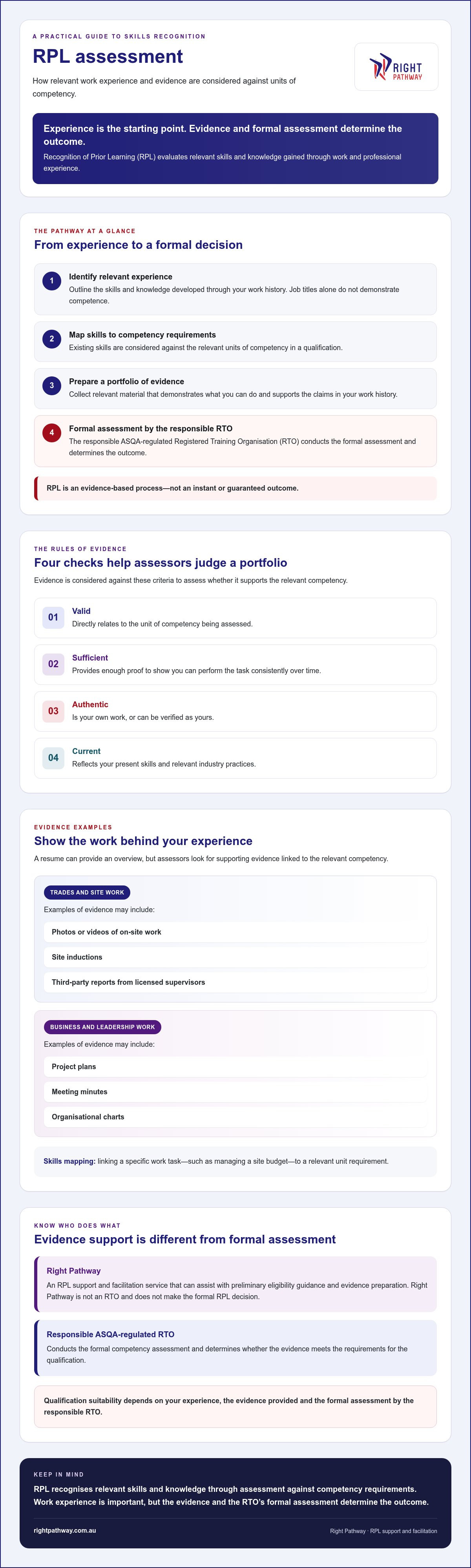
Assessors follow the "Rules of Evidence" to maintain the integrity of the Australian Qualifications Framework (AQF). Your evidence must meet four key criteria:
- Valid: The evidence must directly relate to the unit of competency being assessed.
- Sufficient: You must provide enough proof to show you can perform the task consistently over time.
- Authentic: Every document, photo, or report must be your own work or verified as yours.
- Current: Proof should typically come from within the last five years to reflect modern industry practices.
The core of this process is skills mapping. This involves linking a specific work task, such as managing a site budget, to a specific unit requirement in a training package. If you're unsure if your experience qualifies, you can start with a free initial eligibility assessment to identify your potential pathway.
Common Evidence Types for Trades and Business
For those seeking a CPC30220 Certificate III in Carpentry from the Construction, Plumbing and Services Training Package, evidence often includes photos or videos of on-site work, site inductions, and third-party reports from licensed supervisors. In a corporate context, such as the BSB50420 Diploma of Leadership and Management from the Business Services Training Package, assessors look for project plans, meeting minutes, and organisational charts. Demonstrating an understanding of high-level business functions, such as the financial consultancy provided by Recoup Capital, can further strengthen the evidence of your management capabilities. These documents provide the tangible proof required for a successful rpl assessment outcome.
The Importance of Currency
Assessors prioritise recent experience to ensure your skills align with 2026 industry standards and safety regulations. In the context of ASQA standards, currency means the candidate currently possesses the skills and knowledge required to perform the work at the time of the assessment. Older experience is valuable, but it must be supplemented with proof that you've kept your skills up to date with modern technology and legislation. Right Pathway supports you in identifying which parts of your history best demonstrate this currency to a partner RTO.
Navigating the Process: Facilitation vs. RTO Assessment
Understanding the distinction between evidence facilitation and formal assessment is critical for a smooth journey. Right Pathway is a facilitation service, not a Registered Training Organisation (RTO). We don't issue certificates, nor do we provide migration or visa advice. Instead, we act as your expert facilitator, bridging the gap between your raw work history and the technical requirements of an rpl assessment. While we support you through evidence preparation and skills mapping, the final qualification is always issued by one of our partner RTOs following their independent review. Please remember that qualification suitability depends entirely on the quality of evidence provided and the final partner RTO assessment.
Engaging a facilitator reduces the administrative burden that often leads to frustration or abandoned applications. We understand the specific benchmarks of the Australian Qualifications Framework (AQF) and help you present your experience in a language that assessors recognise. This expertise often results in a faster evidence collection phase and significantly reduces the risk of rejection due to insufficient documentation. It's about getting the credit you deserve for your hard work without the stress of navigating complex bureaucracy alone.
The Right Pathway Methodology
Our RPL process begins with a transparent, straight-talking consultation. We evaluate your background against current training packages to determine if a viable pathway exists. If your experience doesn't meet the national standard, we'll tell you directly rather than wasting your time. Once eligibility is confirmed, we guide you through a methodical evidence collection phase before referring your completed portfolio to a partner RTO for formal assessment.
Choosing the Right Pathway for Your Career
Selecting the correct support is vital, especially in high-stakes industries like mining, construction, or healthcare where compliance is non-negotiable. Knowing why choose Right Pathway involves recognising our commitment to high standards and our deep understanding of the vocational education sector. We ensure your rpl assessment portfolio is robust enough to withstand rigorous scrutiny. To take the first step toward formalising your skills, you can complete a free initial eligibility assessment today.
Steps to Prepare for Your Free Initial Eligibility Assessment
Transitioning from years of experience to a formal qualification requires a methodical approach to documentation. Preparing for your rpl assessment doesn't have to be overwhelming if you follow a structured plan. By organising your history now, you'll save time during the facilitation phase and provide a clearer picture to potential assessors. It's important to remember that Right Pathway provides support with evidence preparation, while the final assessment and issuance of any qualification are completed by our partner Registered Training Organisations (RTOs).
- Step 1: Gather your documentation. Collect your current resume along with any old certificates or academic transcripts. Even partially completed courses can sometimes provide credit toward your new goal.
- Step 2: Document your recent work history. Focus on the last five to ten years of relevant experience. This timeframe is critical because it demonstrates the "currency" that RTO assessors require to meet 2026 industry standards.
- Step 3: Identify your primary objective. Determine if you need this qualification for a trade licence, a corporate promotion, or as a university pathway to further your education.
- Step 4: Request a free initial eligibility assessment. This preliminary review determines if your experience aligns with national standards before you commit to the full process.
What Happens During the Initial Eligibility Check?
This stage acts as the "Navigator" phase. It's a non-formal review of your background designed to identify potential gaps in your evidence early on. We look at your daily tasks and map them against units of competency within current training packages. This proactive step ensures you don't waste time pursuing a qualification that doesn't fit your actual skill set. It's a transparent way to see where you stand within the Australian Qualifications Framework (AQF).
Moving Toward Formal Certification
Once your evidence is organised and your eligibility is confirmed, the process moves toward a formal review by a partner RTO. The RPL cost in Australia varies depending on the level of the qualification and the complexity of the evidence required. Whether you're seeking a trade certificate like the CPC30220 Certificate III in Carpentry or a high-level diploma, we ensure your portfolio is robust. Please note that qualification suitability depends entirely on the quality of evidence provided and the final assessment by a partner RTO.
For those looking for a reputable registered training organisation with campuses in Perth and Sydney, you can click here to learn more about Apeiro Institute and their range of vocational programs.
Secure Your Professional Future in 2026
Achieving a formal qualification shouldn't mean starting from scratch. By mapping your work history against national standards, you can secure the recognition you've already earned. We've explored how a rigorous rpl assessment portfolio requires valid and current evidence, and why expert facilitation is the key to navigating this complex journey. Since 2019, we've supported over 2,000 successful applicants across 18 different Australian industries. Our partnerships with ASQA regulated RTOs ensure your evidence is reviewed against the highest benchmarks.
Right Pathway is a facilitation service; formal assessment is completed by partner RTOs, and qualification suitability depends on the quality of evidence provided. Your years of hard work deserve official validation without the need for redundant study. Ready to see if your experience counts? Book your free initial eligibility assessment today. We're here to help you get the credit you deserve and move your career forward with confidence.
Frequently Asked Questions
Is an RPL assessment easier than doing a course?
An rpl assessment isn't necessarily "easier," but it's a more efficient use of time for experienced professionals. Instead of attending classes to learn what you already know, you're required to prove your competence through a rigorous evidence-gathering process. You must still meet the same national standards as any student, which involves significant effort in documenting your skills and work history. It replaces classroom hours with a comprehensive portfolio review, ensuring your time is spent on validation rather than redundant study.
How much does a full RPL assessment cost?
Costs vary depending on the qualification level and the specific fees set by the partner Registered Training Organisation (RTO). Generally, the investment for an RPL pathway is more affordable than the tuition for a full course at a TAFE or private college. For example, the evidence requirements for a trade certificate like the CPC30220 Certificate III in Carpentry differ from those of a business diploma. Right Pathway provides support with evidence preparation, while the final assessment fee is determined by the partner RTO based on the complexity of the review.
Can I get a qualification through RPL if I am a migrant?
Yes, skilled migrants with substantial overseas experience can use this pathway to achieve formal recognition in Australia. It's a pragmatic way to bridge the gap between international work history and Australian national standards. While Right Pathway doesn't provide migration or visa advice, we specialise in helping professionals map their global experience against current training packages. This process helps you gain the credentials needed for career progression or licensing eligibility within the Australian workforce through a partner RTO assessment.
What happens if my evidence is not sufficient for the RTO?
If the RTO assessor identifies gaps in your rpl assessment portfolio, they will provide feedback on what's missing. You might need to provide additional documentation, such as more recent work samples or third-party reports, to satisfy the "Rules of Evidence." In cases where a specific skill can't be proven through past experience, you may be required to complete "gap training" for those specific units. Right Pathway's facilitation role is designed to identify these gaps early, reducing the risk of a non-compliant submission.
How long does the RPL assessment process take from start to finish?
The timeframe typically ranges from two to eight weeks, depending on how quickly you can organise your evidence. This is significantly faster than the months or years required for traditional study. The speed of the process depends on the complexity of the qualification and the quality of the documentation you provide. Once Right Pathway refers your completed portfolio to a partner RTO, their assessors generally complete the formal review and issue the outcome within a few weeks, provided the evidence is sufficient.

Article by
Right Pathway Team
Right Pathway supports experienced workers, tradespeople and skilled migrants with preliminary RPL eligibility guidance, evidence preparation and qualification pathway navigation.
Right Pathway is not a Registered Training Organisation and does not conduct formal competency assessments or issue qualifications. Formal enrolment, competency assessment and qualification issuance are completed by the responsible Registered Training Organisation.
Start with a free initial RPL eligibility assessment at https://www.rightpathway.com.au/eligibility-check
Disclaimer
Right Pathway is a facilitation and support service only. We are not a Registered Training Organisation (RTO), do not conduct formal RPL assessments and do not issue qualifications. All formal RPL assessments and certifications are completed by partner RTOs regulated by ASQA. Eligibility and qualification outcomes depend on each applicant’s evidence, experience and the RTO’s assessment decision.


