
With an estimated 28,000 unfilled skilled technician positions across the country, your years of workshop experience have never been more valuable to the Australian industry. You've likely spent years mastering complex diagnostics and repairs, yet without formal recognition, you might feel stuck behind a glass ceiling regarding pay rises or securing a Motor Vehicle Repairer Licence (MVRL). It's frustrating to know you have the skills but lack the piece of paper that proves it to regulators and employers.
We'll show you how to use automotive rpl australia to convert your existing expertise into a formal qualification, such as the AUR30620 Certificate III in Light Vehicle Mechanical Technology, through a structured evidence-mapping process. This article outlines the 2026 standards for evidence collection and explains how to navigate the transition from mechanic to qualified tradesperson efficiently. Please note that Right Pathway supports evidence preparation while formal assessment is completed by partner RTOs; qualification suitability depends entirely on your unique evidence and partner RTO assessment. We'll preview the documentation required to meet current AUR Training Package standards and how to bridge the gap between your practical experience and official certification.
Key Takeaways
- Understand how your years of workshop experience are mapped against the AUR Automotive Retail, Service and Repair Training Package to identify competency matches.
- Identify the core certifications available in 2026, such as the AUR30620 Certificate III in Light Vehicle Mechanical Technology and the AUR30320 Certificate III in Automotive Electrical Technology.
- Learn the specific types of documentation required to satisfy the VET standards of being valid, sufficient, authentic, and current for a successful evidence portfolio.
- Discover how automotive rpl australia can facilitate the path toward a Motor Vehicle Repairer Licence (MVRL) and increase your professional salary potential.
- Clarify how structured evidence preparation support helps you navigate the formal assessment process managed by partner Registered Training Organisations (RTOs).
Understanding Recognition of Prior Learning (RPL) for the Australian Automotive Industry
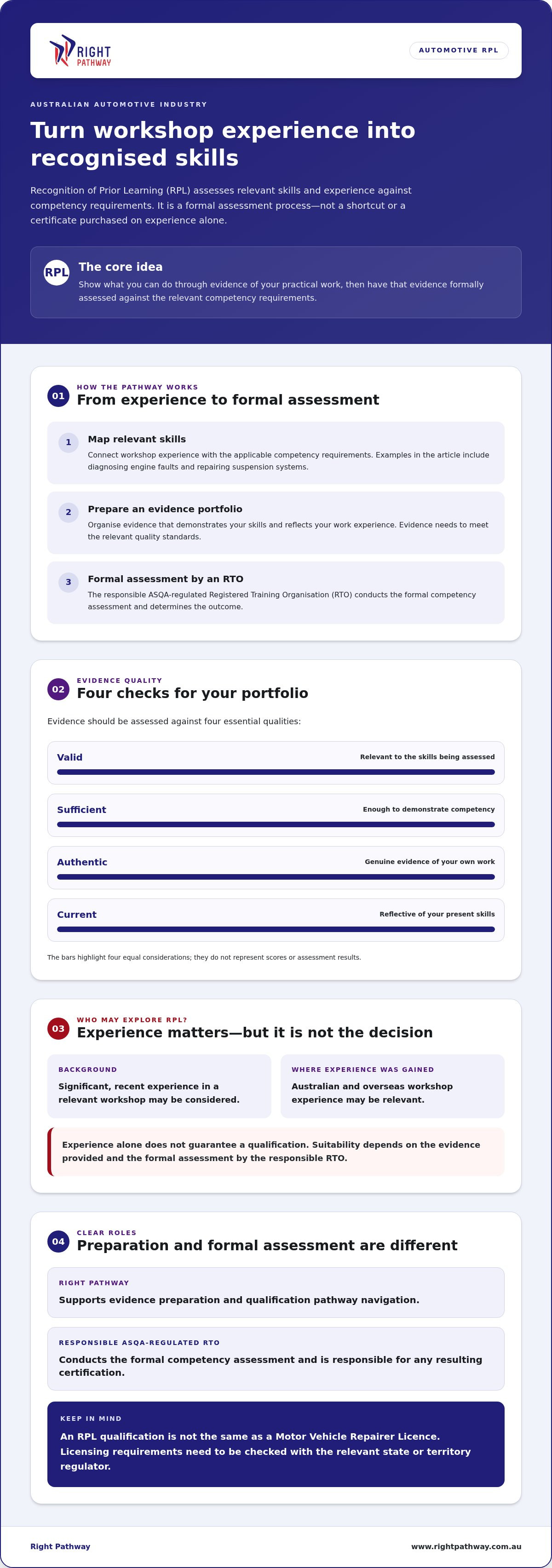
Recognition of Prior Learning is a formal assessment process within the Australian Vocational Education and Training (VET) system. It isn't a shortcut or a short course; rather, it's a method to validate the skills you've already acquired through years of practical work. For those looking into automotive rpl australia, this means your ability to diagnose engine faults or repair suspension systems is measured against national benchmarks to see if you meet the requirements for a formal trade qualification. This pathway acknowledges that learning happens in workshops, not just in classrooms.
The process involves a detailed mapping of your existing skills against the current AUR Automotive Retail, Service and Repair Training Package. This ensures that every technician meets the same high standards as someone who completed a traditional four-year apprenticeship. Recognition of Prior Learning Australia provides a pathway for experienced workers to gain official status without repeating training for skills they already possess. It’s a rigorous evaluation of competency. You don't purchase a certificate; you earn it by proving your professional capabilities through high-quality evidence.
Who is Eligible for an Automotive RPL Assessment?
To be eligible for this pathway, you generally need significant and recent industry experience. Most partner RTOs look for a minimum of three years of full-time work in a relevant workshop environment. This can include both local Australian history and overseas workshop experience, which is particularly beneficial for skilled migrants looking to have their international expertise recognised in the local market. The key is being able to demonstrate that your skills are current and align with Australian industry standards.
Since every technician's background is unique, the first step is always to determine if your specific evidence meets the necessary standards. We recommend starting with a free initial eligibility assessment to identify which qualification best matches your career history. Please note that qualification suitability depends on your evidence and partner RTO assessment. Right Pathway supports you through the evidence preparation phase, while the formal assessment and issuance of any qualification are completed by a partner Registered Training Organisation (RTO).
Core Automotive Qualifications Available via RPL in 2026
The Australian automotive landscape is evolving rapidly, with the Federal Chamber of Automotive Industries (FCAI) highlighting a significant shift towards more sophisticated vehicle technologies and electric drivetrains. To keep pace, technicians must ensure their credentials reflect the current standards of the AUR Automotive Retail, Service and Repair Training Package. Through automotive rpl australia, experienced professionals can target specific qualifications that align with their daily workshop activities. It's essential to understand that qualification suitability depends on evidence and partner RTO assessment. Right Pathway supports evidence preparation while formal assessment is completed by partner RTOs.
Mechanical and Electrical Trade Certifications
For most mechanics, the goal is to achieve a trade-level qualification that mirrors the outcomes of a traditional apprenticeship. The following certifications are currently the most sought-after for those seeking formal validation of their skills:
- AUR30620 Certificate III in Light Vehicle Mechanical Technology: This is the industry benchmark for general automotive mechanics working on passenger and light commercial vehicles.
- AUR31120 Certificate III in Heavy Commercial Vehicle Mechanical Technology: This qualification is specifically designed for specialists working with diesel engines, trucks, and heavy machinery.
- AUR30320 Certificate III in Automotive Electrical Technology: A critical certification for technicians focusing on complex wiring, electronic control systems, and modern vehicle diagnostics.
Advanced Pathways and Specialist Roles
Technicians looking to move into supervisory or master technician roles often pursue the AUR40216 Certificate IV in Automotive Mechanical Diagnosis. This qualification focuses on high-level diagnostic procedures and technical leadership within the workshop. Beyond career progression, these certifications are vital for regulatory compliance. In many Australian states, holding a relevant Certificate III is a prerequisite for obtaining a Motor Vehicle Repairer Licence (MVRL), which is legally required to perform or supervise certain repair work. Achieving this licence is a major step toward professional independence and higher salary potential.
If you're unsure which level matches your current skill set, you can explore the RPL process to see how your history is evaluated. Taking a free initial eligibility assessment is a practical way to start mapping your career toward these formal benchmarks.
The Evidence Portfolio: Proving Your Skills to an Assessor
Success in automotive rpl australia hinges on the quality of your evidence portfolio rather than the length of your resume. Assessors from partner RTOs require proof that satisfies the four VET standards. Evidence must be valid, sufficient, authentic, and current. This means you must demonstrate you can perform tasks safely and correctly according to 2026 industry standards. Qualification suitability depends on your evidence and partner RTO assessment. Right Pathway supports evidence preparation while formal assessment is completed by partner RTOs.
Types of Evidence Required for AUR Qualifications
Technicians should gather a diverse range of documentation to build a robust case. High-quality evidence includes:
- Workplace documents: Job cards, service logs, and repair orders showing the breadth of vehicles you've serviced. You should redact sensitive customer details to maintain privacy.
- Visual evidence: Photos or videos of you performing specific tasks, such as engine rebuilds, complex brake assemblies, or using diagnostic scanners for electrical fault-finding.
- Professional references: Technical reports from qualified tradespeople or workshop managers who have supervised your work. These third-party reports are essential because they provide a verified account of your competency in a real-world environment.
Mapping Your Experience to Units of Competency
Every daily task you complete in the workshop corresponds to a specific unit within the AUR training package. For instance, performing a standard cooling system service might map directly to a unit like AURETR022. Skills mapping is the process of aligning workshop tasks with formal training criteria. This systematic approach ensures that your practical experience bridges the gap to a formal qualification without requiring you to repeat training for skills you already use every day. It transforms your years of mechanical work into a structured format that an assessor can easily verify.
Gathering this documentation can feel overwhelming, but a structured checklist makes the process manageable. You can start by taking a free initial eligibility assessment to see which evidence you already have and what you might still need to collect for a successful application.
Navigating Your RPL Journey with Right Pathway
Right Pathway serves as your knowledgeable navigator through the complexities of the Australian vocational education system. We specialise in trade qualification facilitation, helping you translate years of workshop experience into a format that assessors understand. It's vital to recognise our specific role in this ecosystem. Right Pathway is not a Registered Training Organisation (RTO) and does not issue certificates or qualifications. Instead, we provide essential support in evidence preparation while the formal assessment is completed by our partner RTOs. This ensures your automotive rpl australia application is built on a foundation of high-quality documentation that meets rigorous national standards.
The Step-by-Step Facilitation Process
Our methodical approach is designed to reduce the bureaucratic burden on busy mechanics. The journey follows a logical, three-stage sequence:
- Step 1: Free initial eligibility assessment. We review your work history and workshop experience to confirm you have the necessary depth of skills for your target qualification.
- Step 2: Evidence gathering and skills mapping. Our consultants work with you to collect the job cards, photos, and references discussed in previous sections, aligning them with the current AUR training package requirements.
- Step 3: Submission to a partner RTO. Once your portfolio is robust and meets the required standards, we facilitate the submission to a partner Registered Training Organisation (RTO) for formal assessment.
Why Professional Facilitation Matters
The VET landscape is strictly regulated by the Australian Skills Quality Authority (ASQA). Navigating these standards alone often leads to significant stress and administrative errors that can stall your progress. By choosing professional facilitation, you ensure your evidence is organised and presented with the level of detail assessors require. This professional presentation highlights the benefits of RPL, including increased career mobility and salary potential. You won't have to guess which units of competency your daily tasks satisfy. If you want to understand more about our commitment to high standards, you can read about why choose Right Pathway. Please remember that qualification suitability depends entirely on your evidence and partner RTO assessment.
Take the Next Step Toward Your Trade Qualification
Converting your years of mechanical experience into a formal qualification is a strategic move for your career stability and salary potential. This process isn't about shortcuts; it's about the rigorous validation of your workshop skills against national benchmarks. Through automotive rpl australia, you can bridge the gap between your daily diagnostic work and the official certification required for a Motor Vehicle Repairer Licence (MVRL). We've shown that a well-organised evidence portfolio is the most critical factor in achieving a successful outcome.
Since 2019, our team has supported over 2,000 applicants by providing expert guidance on evidence preparation for various AUR training packages. We work closely with ASQA-regulated RTOs who conduct the formal assessments and issue the qualifications. Please note that Right Pathway is not an RTO and does not issue certificates; qualification suitability depends entirely on your specific evidence and the assessment by our partner RTOs. We act as your facilitator to ensure your experience is mapped accurately and professionally.
If you're ready to move forward, we're here to guide you through the complexities of the VET system. Start your free initial eligibility assessment today to identify the best pathway for your professional future. We look forward to helping you achieve the official recognition your experience has earned.
Frequently Asked Questions
Is an RPL certificate the same as a traditional TAFE qualification?
Yes, a qualification achieved through the automotive rpl australia pathway is identical to one earned through traditional classroom study at TAFE. Both are issued by Registered Training Organisations (RTOs) under the Australian Qualifications Framework (AQF) and carry the same professional weight. Employers and industry regulators view the certificate as definitive proof of competency, regardless of whether your skills were validated in a workshop or a classroom environment.
How long does the automotive RPL process usually take?
The timeline for completion depends primarily on how efficiently you can gather high-quality evidence. While a traditional apprenticeship takes four years, the RPL facilitation and assessment process typically spans between four and twelve weeks. This timeframe includes your initial evidence preparation, our professional review, and the final assessment by a partner RTO. It's a pragmatic route for experienced technicians who already possess the required industry skills.
What happens if I have gaps in my evidence for specific units?
If an assessor identifies gaps in your evidence for specific units within a qualification like the AUR30620 Certificate III in Light Vehicle Mechanical Technology, you'll need to complete gap training. This involves targeted learning or practical assessment only for the specific areas where competency wasn't fully proven. It ensures you meet the full requirements of the national training package. Qualification suitability depends on your unique evidence and partner RTO assessment.
Can I get a mechanic licence (MVRL) using a qualification obtained through RPL?
Yes, you can use a trade qualification obtained via RPL to apply for a Motor Vehicle Repairer Licence (MVRL) in your state. Licensing bodies accept certificates issued by RTOs through the RPL process because they meet the same Australian standards as any other trade certificate. Holding this formal recognition is often the mandatory first step toward professional licensing, allowing you to sign off on repairs and increase your salary potential.
Does Right Pathway issue the certificate directly?
No, Right Pathway is not a Registered Training Organisation (RTO) and does not issue certificates or qualifications. We serve as a facilitation service that supports you through complex evidence preparation and skills mapping. The formal assessment of your automotive rpl australia application and the eventual issuance of any qualification are completed exclusively by our partner RTOs, who are fully regulated by the Australian Skills Quality Authority (ASQA).

Article by
Right Pathway Team
Right Pathway supports experienced workers, tradespeople and skilled migrants with preliminary RPL eligibility guidance, evidence preparation and qualification pathway navigation.
Right Pathway is not a Registered Training Organisation and does not conduct formal competency assessments or issue qualifications. Formal enrolment, competency assessment and qualification issuance are completed by the responsible Registered Training Organisation.
Start with a free initial RPL eligibility assessment at https://www.rightpathway.com.au/eligibility-check
Disclaimer
Right Pathway is a facilitation and support service only. We are not a Registered Training Organisation (RTO), do not conduct formal RPL assessments and do not issue qualifications. All formal RPL assessments and certifications are completed by partner RTOs regulated by ASQA. Eligibility and qualification outcomes depend on each applicant’s evidence, experience and the RTO’s assessment decision.


