

What if you could skip two years of redundant lectures and still walk away with a nationally recognised qualification? It's a common frustration for seasoned professionals; you have the expertise, yet you feel undervalued because you lack formal certification. You might even worry about losing out on a promotion to a junior colleague who has the right paperwork but half your capability. If you want to get a diploma with work experience in Australia, you don't have to start from scratch or endure the high costs and long hours of traditional adult education.
We understand that your time is your most valuable asset. This guide will show you how to convert your years of professional service into a formal Diploma through Recognition of Prior Learning (RPL). As a facilitation service, we help you navigate the strict evidence requirements needed to meet the 2025 Standards for RTOs, ensuring your application is robust enough to meet ASQA's rigorous compliance benchmarks. You'll learn how to map your skills against specific qualifications listed on training.gov.au, such as the Diploma of Business (BSB50120) or Diploma of Building and Construction (Management) (CPC50220). We'll outline a streamlined path that respects your experience and helps you secure the recognition you've already earned.
Key Takeaways
- Learn how Recognition of Prior Learning (RPL) converts your years of industry expertise into a nationally recognised qualification without the need for classroom study.
- Discover the most efficient way to get a diploma with work experience in Australia by mapping your professional achievements against current national training packages.
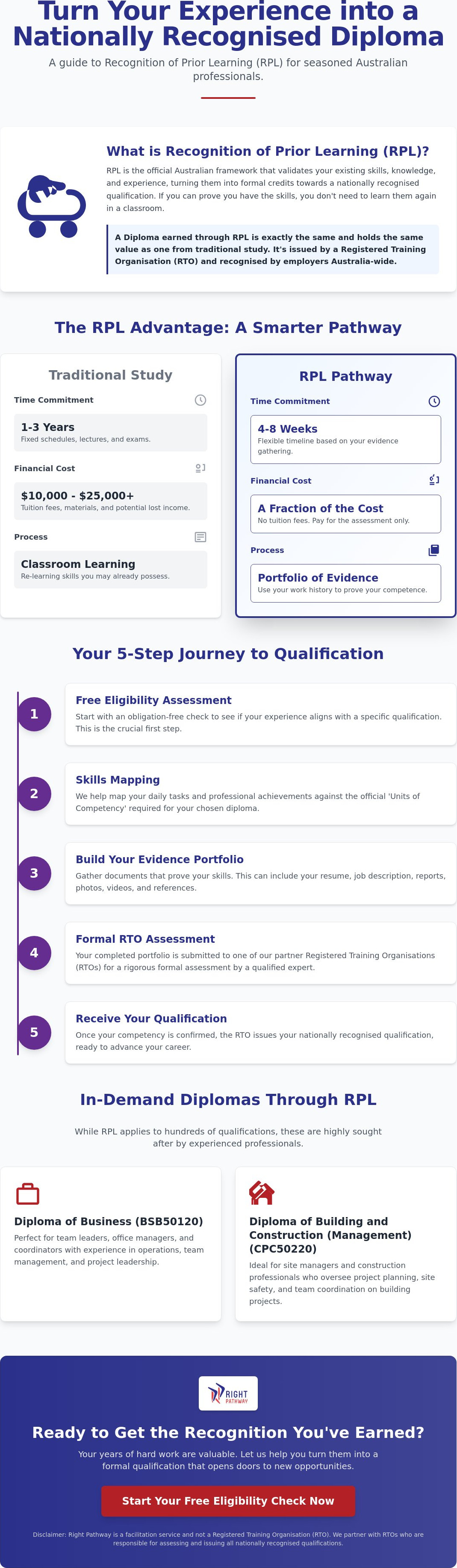
- Compare the significant time and cost savings of the RPL process against traditional university degrees to accelerate your career progression.
- Understand the 5-step journey from initial eligibility assessment to gathering a portfolio of evidence that meets the strict 2025 Standards for RTOs.
- Explore how a facilitation service can manage the complex paperwork and bridge the gap between your work history and formal certification.
Can You Really Convert Work Experience into a Diploma in Australia?
Many professionals assume that gaining a formal qualification always requires years in a classroom. In reality, the Australian vocational system is built on what you can actually do, not just where you sat. Recognition of Prior Learning (RPL) is the official framework that validates this expertise. If you want to get a diploma with work experience australia provides a structured, legal pathway to achieve it without repeating basic training.
A Diploma earned through RPL is exactly the same as one earned via full-time study. It carries the same weight with employers and is issued by a Registered Training Organisation (RTO). Right Pathway acts as your facilitation service to bridge the gap between your career history and the formal requirements of these RTOs. This isn't a "tick-and-flick" exercise or a way to buy a degree. It's a rigorous assessment of your actual competence against national standards. You must provide evidence that you can perform every task required by the qualification.
This process is highly effective in sectors with clear technical or managerial standards. In 2026, we see high demand in the construction industry due to the National Housing Accord's target of 1.2 million new homes. This makes qualifications like the Diploma of Building and Construction (Management) (CPC50220) very popular for RPL. Other common areas include community services, healthcare, and leadership roles such as the Diploma of Business (BSB50120).
The Australian Qualifications Framework (AQF) Explained
The AQF is the national policy for regulated qualifications in Australian education. A Diploma is classified as Level 5, while an Advanced Diploma is Level 6. These levels ensure your qualification is recognised in every state and territory. Every unit you earn through RPL must align with the current versions found on training.gov.au. This standardisation means your experience in Perth is just as valid as experience in Brisbane when applying for certification. It provides a transparent way for employers to verify your skill level regardless of where you learned your trade.
Who is Eligible for an Experience-Based Diploma?
Most successful candidates have between three and five years of relevant industry experience. Australian vocational education is "competency-based." This means it focuses on your ability to perform tasks to an industry standard. If you've spent years leading teams, managing budgets, or overseeing site safety, you likely already meet the requirements for several units of competency. You don't need to sit through a lecture on project management if you've been delivering projects for half a decade. Taking an eligibility check is the first step to seeing how your specific background aligns with these national standards.
How RPL Works: Turning Daily Tasks into Unit Credits
The process of how to get a diploma with work experience australia starts with understanding the architecture of vocational training. Every qualification on the Australian Qualifications Framework (AQF) is constructed from "Units of Competency." These units represent the specific, measurable skills that an industry expects from a qualified professional. If you're a project manager, you likely already perform tasks that align perfectly with units like "Manage project scope" or "Manage project time."
Skills mapping is the critical bridge between your daily work and these formal units. It involves a systematic review of your job description, your daily routines, and your professional achievements to see where they overlap with the requirements of a qualification. When you can demonstrate that you already perform these tasks to a high industry standard, you don't need to sit in a classroom to learn them again. This efficiency is why RPL is the preferred path for experienced workers who find traditional study redundant. It respects the time you've already invested in your career.
While the mapping identifies your skills, the final validation comes from a Registered Training Organisation (RTO). The RTO is the body authorised by the Australian Skills Quality Authority (ASQA) to conduct the formal assessment and issue the certificate. They look for "competency," which means you must prove you have the knowledge and the ability to apply it in a real-world setting. If you're unsure if your current role covers enough units, you can check your eligibility online to see where you stand.
Mapping High-Demand Qualifications
For those in corporate or administrative roles, the Diploma of Leadership and Management (BSB50120) is a frequent target for RPL. This qualification focuses on strategic planning, team leadership, and operational efficiency. Conversely, a site supervisor or experienced tradesperson might target the Diploma of Building and Construction (Management) (CPC50220). Using these specific codes from training.gov.au ensures your qualification is current, industry-relevant, and meets the latest national standards for 2026.
The Role of the Facilitator vs. the RTO
It's vital to understand the distinction between a facilitation service and an RTO. Right Pathway is a facilitation service. We act as your expert navigator to help you prepare a tidy, professional evidence portfolio. We don't issue the qualification directly. Instead, we bridge the gap by identifying which partner RTO is the best fit for your specific skills. This partnership ensures that your application is robust and meets all regulatory benchmarks before the final assessment, significantly reducing the risk of a rejected application.
Diploma vs. University Degree: Choosing Your Pathway
University degrees are often viewed as the default path for career growth, but for a working professional, they might be the long way around. A standard Bachelor's degree typically demands three years of full-time commitment and significant tuition debt. In contrast, if you choose to get a diploma with work experience australia allows you to achieve a Level 5 qualification in as little as 4 to 12 weeks through RPL. This speed isn't about cutting corners; it's about acknowledging that you've already completed the "practical labs" during your years on the job.
The core difference lies in the focus of the education. Degrees are traditionally academic, prioritising theory, research, and broad conceptual knowledge. While this has its place, it doesn't always translate to the immediate, high-pressure needs of an Australian worksite or corporate office. A Diploma is strictly vocational. It's built on competency, meaning it proves you can perform specific tasks to a national industry standard. Many employers in 2026 actually prefer a candidate with a Diploma and ten years of field experience over a fresh graduate with a degree but zero real-world context. The vocational route provides the formal validation that matches your existing seniority.
Using Your Diploma as a Bridge to University
If you eventually decide that a degree is necessary for your long-term goals, a Diploma acts as a strategic stepping stone. Many professionals didn't finish high school or lacked the ATAR required for direct university entry. An RPL Diploma satisfies these entry requirements while providing "advanced standing." Through a university pathway, your Level 5 qualification can often shave a full year off a three-year Bachelor’s degree. This approach saves you thousands in student loans and allows you to enter higher education with a recognised qualification already under your belt.
Industry Recognition and Licencing
In several Australian industries, a Diploma is a legal mandatory requirement rather than an optional extra. For example, the Diploma of Building and Construction (Management) (CPC50220) is often the key to securing specific trade licences. Employers and regulators prioritise "nationally recognised" codes found on training.gov.au because they ensure the holder meets the 2025 Standards for RTOs. A Diploma is currently considered the gold standard for promotion in these sectors:
- Construction and Site Management
- Community Services and Healthcare
- Project Management and Business Operations
- Work Health and Safety (WHS)
Securing this qualification ensures you aren't just experienced, but "qualified" in the eyes of the law and your peers. It removes the glass ceiling that often holds back those without formal papers, even when they have the superior skill set. If you're ready to see how your history aligns with these standards, you can start your free assessment to map out your next move.
The 5-Step Guide to Converting Experience into a Qualification
Transforming your professional history into a formal certificate is a logical, sequential journey. If you want to get a diploma with work experience australia, you must move through a structured process that satisfies both industry standards and regulatory bodies. This isn't about guesswork; it's about meticulous documentation that proves your seniority. We follow a proven pathway to ensure your application is robust before it ever reaches an assessor.
- Step 1: Free Eligibility Assessment. This is the initial filter. We determine if your years of service actually align with a specific qualification code, such as the Diploma of Business (BSB50120).
- Step 2: Evidence Collection. You gather the "proof" of your career. This includes everything from position descriptions to project reports that show your daily responsibilities.
- Step 3: Skills Mapping. This is the most technical phase. We facilitate the alignment of your portfolio with specific Unit of Competency requirements. We find the exact document that proves you've mastered a specific skill.
- Step 4: RTO Review. Your prepared portfolio is submitted to a partner Registered Training Organisation. Their assessors conduct a formal review to ensure you meet the 2025 Standards for RTOs.
- Step 5: Certification. Once the RTO is satisfied with your competence, they issue your nationally recognised parchment. It carries the same legal weight as a qualification earned through two years of TAFE.
Ready to see where your skills fit? Start your free eligibility assessment to map your history to a qualification.
What Counts as Valid Evidence?
To succeed in an RPL application, your evidence must follow the V.C.C.R. rule. This means your documentation must be Valid (relevant to the unit), Current (typically from the last 3-5 years), Consistent (showing you can do the task repeatedly), and Authentic (your own work). Essential items usually include a current CV, third-party testimonials from supervisors, and actual work samples. For trade-based RPL, video evidence or photos of you performing tasks on-site provide powerful, undeniable proof of your technical competence.
Common Mistakes to Avoid in Evidence Preparation
One of the biggest hurdles is providing "thin" evidence. This happens when a candidate provides documents that show they were present, but not that they were responsible for the outcome. An RTO needs to see your decision-making process. Another risk is relying on outdated evidence; skills from a decade ago often don't meet the current requirements on training.gov.au. Finally, remember that quantity doesn't mean quality. An assessor doesn't want a mountain of irrelevant emails; they want a few high-quality documents that clearly demonstrate you meet the national standard.
Why a Facilitation Service is Your Best Bet for RPL Success
The Australian vocational education sector is vast and often confusing for those outside the industry. With hundreds of Registered Training Organisations (RTOs) across the country, finding the right partner for your specific skills is a daunting task. If you want to get a diploma with work experience australia, you must ensure your chosen RTO is compliant with the 2025 Standards for RTOs and has a clean record with ASQA. Navigating this landscape alone often leads to wasted time and rejected applications because the evidence wasn't presented in the exact format assessors require.
Right Pathway acts as your expert facilitator to bridge the gap between your career history and these formal requirements. We take your "messy" work history, the years of emails, project logs, and site photos, and organise it into a tidy, professional evidence portfolio. This preparation ensures that when your application reaches an RTO, it is clear, compliant, and ready for assessment. We handle the complex bureaucracy so you can stay focused on your daily job without the stress of managing regulatory paperwork. We are the essential guide that makes the journey possible, ensuring you don't get bogged down in technical standards.
One of the most significant advantages of using a facilitation service is the free initial assessment. We help you determine exactly which qualification matches your experience before you commit financially. This prevents you from pursuing the wrong path or applying for a Diploma you aren't yet eligible for. By acting as your "Knowledgeable Navigator," we ensure the process is efficient and your time is respected throughout the entire mapping phase.
Reclaiming Your Time and Career Momentum
Securing a formal qualification is about more than just a piece of paper; it's about reclaiming your professional momentum. The emotional reward of having your expertise officially recognised often leads to increased confidence and a higher salary potential. Our process is designed to be entirely stress-free for busy Australian professionals. You've already done the hard work in the field or the office; our role is to ensure you get the credit you deserve without the anxiety of traditional study. It's a pragmatic partnership focused on your career progression.
Your Next Steps: The Free Eligibility Check
Taking the first step toward your qualification is simple and carries no obligation. When you click to check your eligibility, you'll be asked a few brief questions about your industry, your current role, and your years of experience. Our team then reviews this information to provide a clear, pragmatic path forward. We are here to support and guide you, not to lecture you. We'll help you identify if you're ready for a Diploma of Leadership and Management (BSB50120) or perhaps a trade-specific qualification like the Diploma of Building and Construction (Management) (CPC50220).
Take Control of Your Career Progression
Your years of professional dedication shouldn't go unrecognised. We've explored how Recognition of Prior Learning (RPL) acts as a bridge between your current expertise and the formal certification required for senior roles. By following a structured process, you can bypass redundant study and secure a qualification that carries the same national weight as any classroom-based certificate. When you choose to get a diploma with work experience australia provides a clear, legal path to validation that respects your time and seniority.
Since 2019, we've supported over 2,000 successful applicants across 18 high-demand Australian industries. As a facilitation service, we specialise in navigating the complex regulatory landscape so you don't have to. We ensure your evidence portfolio is robust and meets the latest national standards before it reaches an assessor. Start your free eligibility assessment with Right Pathway today to find out exactly what your experience is worth. There's no obligation; just a clear, manageable path to the official recognition you've already earned through your hard work.
Frequently Asked Questions
Is an RPL Diploma the same as a regular Diploma in Australia?
Yes, a Diploma obtained through Recognition of Prior Learning is legally identical to one earned through traditional classroom study. Both are issued by Registered Training Organisations (RTOs) and align with the Australian Qualifications Framework (AQF). Your certificate won't state that it was achieved via RPL, so it holds the exact same value for employment, licensing, and further education.
How much does it cost to get a Diploma through work experience?
The cost to get a diploma with work experience australia varies depending on the specific industry and the Registered Training Organisation (RTO) performing the assessment. While we don't provide fixed pricing, the process is typically more cost-effective than paying for a multi-year TAFE or university course. You save money by avoiding student services fees and the high tuition costs associated with full-time instruction.
How long does the RPL process actually take compared to studying?
Most RPL assessments are completed within 4 to 12 weeks, which is significantly faster than the one to two years required for traditional study. The timeline depends largely on how quickly you can gather your evidence portfolio. Once your documentation is prepared, the partner RTO conducts a formal review to confirm your competence against national standards.
Can I get a Diploma if my experience was gained overseas?
Yes, you can certainly use international work experience to apply for an Australian qualification. The key requirement is that your skills must align with the current Australian standards found on training.gov.au. You'll need to provide verifiable evidence, such as translated references or work samples, to prove that your overseas expertise matches local industry expectations.
Do I need to do any exams or tests for an RPL assessment?
No, you generally don't need to sit traditional exams or written tests during an RPL assessment. The process is portfolio-based, meaning you prove your skills through work samples, photos, and third-party testimonials. In some cases, an assessor might conduct a competency conversation or a practical observation to clarify specific points in your evidence.
What happens if I have gaps in my evidence for certain units?
If you can't provide sufficient evidence for a specific unit, you may need to complete gap training for that particular module. This allows you to study only the parts of the qualification you haven't already mastered. It's a targeted approach that ensures you still get a diploma with work experience australia without having to redo the entire course from scratch.
Will my employer recognise a Diploma earned through RPL?
Yes, employers across Australia recognise these qualifications because they are official, nationally accredited documents. Since the certificate is issued by a compliant RTO, it meets all the regulatory benchmarks required for promotions, pay rises, and industry licensing. It proves you've reached the professional standard expected of a Level 5 qualification holder.
Can I use RPL to get a higher-level qualification like a Graduate Diploma?
Yes, the RPL process is available for various levels of the Australian Qualifications Framework, including Graduate Diplomas at Level 8. If you have significant senior management or specialist experience, you can map those high-level skills to advanced units of competency. This is a common path for professionals looking to formalise their executive expertise for career advancement.

Article by
Right Pathway Team
Right Pathway is an Australian Recognition of Prior Learning (RPL) support and facilitation service helping experienced workers, tradespeople and skilled migrants prepare evidence for nationally recognised qualification pathways.
Founded in 2019, Right Pathway has supported over 2,000 applicants across construction, mining, healthcare, aged care, business, community services, hospitality, automotive and the trades.
We work with ASQA-regulated partner Registered Training Organisations (RTOs) to support evidence preparation, skills mapping and qualification pathway guidance. Right Pathway is not an RTO and does not issue qualifications directly.
Start with a free RPL eligibility assessment at rightpathway.com.au.
Disclaimer
Right Pathway is a facilitation and support service only. We are not a Registered Training Organisation (RTO), do not conduct formal RPL assessments and do not issue qualifications. All formal RPL assessments and certifications are completed by partner RTOs regulated by ASQA. Eligibility and qualification outcomes depend on each applicant’s evidence, experience and the RTO’s assessment decision.


