

What if the years you've spent mastering your trade or profession were actually worth more than just your current salary? It's a common frustration for many Australians who feel stuck in their career because they lack formal papers, despite having more hands-on knowledge than a fresh graduate. You shouldn't have to waste time and money on redundant training for things you already do every day. This guide shows you exactly how to get a qualification from work experience by leveraging the Recognition of Prior Learning (RPL) pathway.
We'll explain how you can convert your professional history into a nationally recognised Australian qualification, such as a BSB50120 Diploma of Business or a CPC30220 Certificate III in Carpentry, without ever stepping foot in a classroom. As a facilitation service, we've seen how the right evidence can bridge the gap between your existing skills and official certification. We'll break down the regulatory requirements and provide a clear, step-by-step map to help you secure the career progression or licensing you need to move forward with confidence.
Key Takeaways
- Understand how Recognition of Prior Learning (RPL) acknowledges your professional history to grant the same nationally recognised status as traditional study.
- Discover exactly how to get a qualification from work experience using a structured five-step process that avoids the need for redundant classroom time.
- Learn how to compile a robust evidence portfolio that meets the strict regulatory standards of being valid, sufficient, current, and authentic.
- Identify high-demand pathways, such as the CPC30220 Certificate III in Carpentry or BSB50120 Diploma of Business, to secure trade licences or pay rises.
- See how a facilitation service streamlines your journey by preparing your documentation for assessment by a Registered Training Organisation (RTO).
Understanding Recognition of Prior Learning (RPL) in Australia
Recognition of Prior Learning (RPL) is the formal process that acknowledges the skills and knowledge you've gained through your career, volunteer work, or life experience. Instead of sitting through lectures on topics you already master, this pathway assesses your existing competence against national standards. It is a practical way to address how to get a qualification from work experience without the traditional classroom commitment. The resulting certificate is identical to those earned through years of study; there is no "RPL" label on your diploma or trade certificate. It carries the same weight with employers, licensing bodies, and the Australian Qualifications Framework (AQF).
Many professionals choose this route to save time and reduce the financial burden of redundant training. However, it's vital to understand that Recognition of Prior Learning (RPL) is not a shortcut that bypasses quality standards. It is a rigorous assessment-only pathway where you must prove your competence through a portfolio of evidence. As a facilitation service, Right Pathway guides you through this documentation phase, though we do not issue qualifications directly. We ensure your evidence is prepared to the high standards required by our partner Registered Training Organisations (RTOs), who perform the final assessment.
Why Your Experience is More Valuable Than You Think
Every day you spend on a job site or in an office, you are performing tasks that align with specific "Units of Competency." These are the building blocks of any Australian qualification. For example, if you've spent years managing site safety or coordinating teams, you've already met the requirements for several units in a CPC30220 Certificate III in Carpentry or a BSB50120 Diploma of Business. Skills mapping is the process we use to link your daily activities to these official national benchmarks. We help you realise that informal learning, such as being mentored by a senior foreman or teaching yourself software, is just as valid as formal training when it's documented correctly.
RPL vs. Traditional Study: Which is Right for You?
The choice between RPL and traditional study usually comes down to your level of experience. A typical university or TAFE course might take two years of your life. In contrast, the RPL facilitation process often takes only a few weeks once your evidence is gathered. This makes it a highly cost-effective way to certify your skills, as you avoid tuition fees for subjects you already know. Generally, a successful RPL candidate has a minimum of two to three years of relevant experience. If you're a seasoned professional who can demonstrate your skills through documents, photos, or references, the RPL pathway is designed specifically for you. It allows you to stay in the workforce while your experience does the heavy lifting for your next career move.
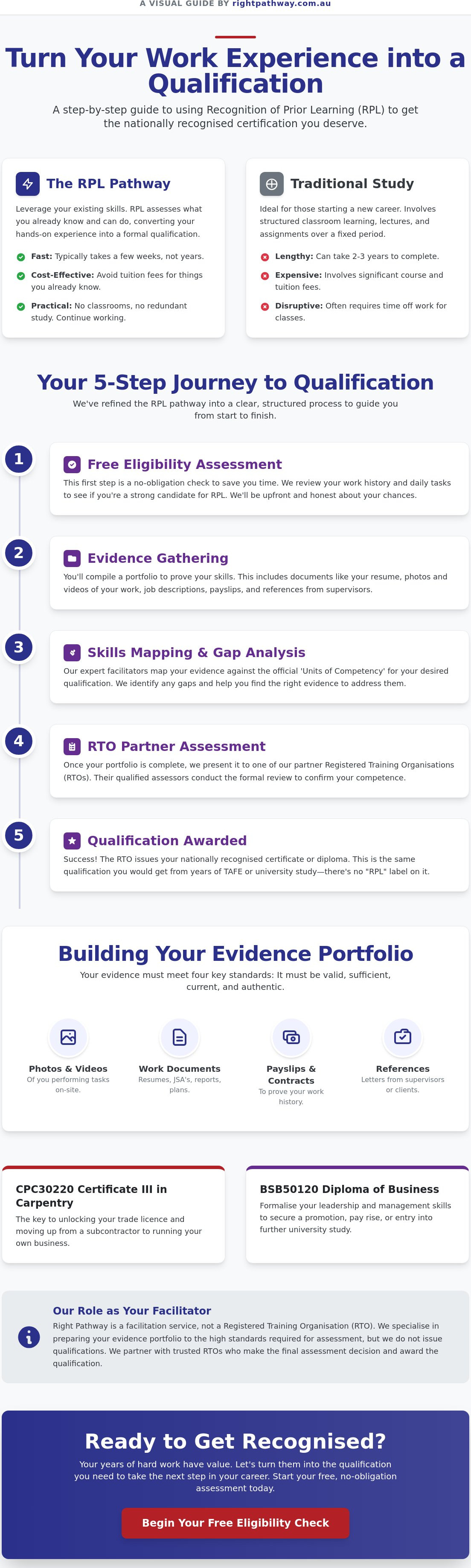
The 5-Step Process to Getting Your Qualification
Understanding how to get a qualification from work experience is largely about knowing the sequence of events. The Australian vocational system is robust, but it can feel bureaucratic without a clear map. We use a logical, five-stage RPL process to move you from an experienced worker to a qualified professional. This journey ensures that every skill you've acquired is accounted for and verified against national benchmarks without unnecessary repetition of learning.
Starting with a Free Eligibility Check
The first move is always a free initial assessment. This isn't a sales pitch; it's a transparency tool designed to save you time. You'll answer questions about your years in the industry, your current responsibilities, and the specific tasks you perform daily. We use this data to determine if you have the "Sufficient" and "Current" experience required by national standards. If the results show you're a strong candidate, we move forward. If there are gaps, we'll be honest about what you need to achieve before an assessment is viable.
Once eligibility is confirmed, the core work begins. Step 2 is evidence gathering, where you document your skills through photos, videos, payslips, and supervisor references. In Step 3, our facilitators perform a skills mapping and gap analysis. We translate your daily tasks into the technical "Units of Competency" language required by regulators. Step 4 involves the formal assessment by one of our partner Registered Training Organisations. Finally, Step 5 is the issuance of your nationally recognised qualification. This structured flow removes the guesswork and keeps the momentum high.
The Role of Facilitation in Your Journey
Right Pathway acts as your "Knowledgeable Navigator" throughout this timeline. We don't just tell you what to do. We partner with you to organise and refine your evidence portfolio so it meets the high standards of the VET sector. It's helpful to understand the regulatory landscape, which you can explore through TEQSA's official guidance on RPL. While we provide the expertise to prepare your application, the final assessment and "stamp" come from an ASQA-regulated RTO. This distinction ensures the integrity of your qualification. If you're ready to see where you stand, you can begin your free eligibility check to start the process.
Mapping Your Skills: What Counts as Evidence?
Evidence is the backbone of your application. To understand how to get a qualification from work experience, you must view your professional history through the lens of an assessor. Every piece of proof you provide must meet four strict national standards: it must be valid, sufficient, current, and authentic. These pillars ensure that the qualification you receive holds the same integrity as one earned through traditional study. NCVER research on RPL suggests that well-organised evidence is the single most critical factor in a successful outcome. It isn't just about what you've done; it's about how you prove you've done it.
Assessors look for two types of proof. Direct evidence involves someone watching you work, such as a video of you performing a technical task or an on-site observation. Indirect evidence is more common and includes the documents you produce daily. This might be project reports, site photos, or emails. Third-party reports are also vital. These are signed testimonials from supervisors or clients that verify your skills and reliability on the job. Organising these digital and physical files early makes the transition to a formal assessment much smoother.
Practical Evidence Examples for Tradies and Professionals
The type of evidence required varies significantly across industries. If you're working towards a CPC30220 Certificate III in Carpentry, you'll need high-quality photos of your framing work, site diaries, and copies of your safety inductions. For those seeking a BSB50120 Diploma of Business, the focus shifts to office-based documentation. You should gather meeting minutes, project plans, and organisational charts that demonstrate your leadership. In the healthcare sector, a CHC33021 Certificate III in Individual Support requires verified workplace logs and detailed position descriptions. We help you identify which of your existing documents carry the most weight for your specific goal.
The Importance of the USI and Official Records
Every student in Australia needs a Unique Student Identifier (USI). This is your lifelong record of nationally recognised training. If you've completed short courses or tickets in the past, your USI allows us to retrieve those records. We can then use them as "Credit Transfer" alongside your RPL evidence, which can significantly reduce the amount of new proof you need to gather. Even if your documents come from overseas or companies that no longer exist, there are ways to verify your experience. Statutory declarations and secondary evidence can often bridge these gaps. If you're unsure if your documents are enough, you can start a free assessment to get professional feedback on your portfolio.
High-Demand Qualifications You Can Fast-Track
In the Australian job market, having the right "paper" is often the difference between being a skilled worker and a licensed professional. Many industries now have mandatory regulatory requirements that make formal certification essential for insurance, site access, or promotion. If you've been working in your field for years, understanding how to get a qualification from work experience allows you to meet these legal benchmarks without repeating the basics. This is particularly vital for those seeking a trade licence or looking to secure a position in sectors currently facing critical skills shortages.
The demand for certified workers is at an all-time high. For instance, the National Housing Accord has set an ambitious target of 1.2 million new homes by 2029. This goal has created a surge in demand for qualified tradespeople who can prove their competence through the RPL pathway. Similarly, the 2026-2027 permanent migration program has allocated approximately 71% of its 185,000 places to skilled migration. For many international professionals, RPL is the essential bridge that translates overseas experience into the Australian standards required for visa skills assessments and local employment.
Building and Construction: From Labourer to Licensed Tradie
The construction industry relies heavily on formal validation. The CPC30220 Certificate III in Carpentry remains the gold standard for those wanting to be recognised as a qualified carpenter. If you're looking to step into a supervisory role or apply for a builder's licence, the CPC40120 Certificate IV in Building and Construction is often the required benchmark. Using RPL facilitation speeds up this transition significantly, allowing you to bypass the apprentice-level schooling while still meeting the rigorous standards set by state licensing boards.
Community Services and Early Childhood Education
Healthcare and education are also seeing a rapid increase in RPL applications due to workforce shortages. The CHC30121 Certificate III in Early Childhood Education and Care is mandatory for many roles in childcare centres. For experienced case workers or those in social support, the CHC52021 Diploma of Community Services provides the formal recognition needed for senior roles. These qualifications ensure you are compliant with the latest national standards while acknowledging the complex, hands-on work you've already performed in the community.
Beyond trades and care, the BSB50420 Diploma of Leadership and Management is a versatile tool for anyone in a senior role. It bridges the gap for managers who have the "soft skills" but lack the formal diploma to back them up. Whether you are in mining, IT, or retail, this qualification validates your ability to lead teams and manage operational plans. If you are ready to see which of these high-demand pathways fits your history, you can check your eligibility for a fast-track qualification here.
Choosing the Right Partner for Your RPL Journey
Selecting the right guide is the most important decision you'll make when researching how to get a qualification from work experience. The Australian vocational education landscape is highly regulated, and the paperwork can be daunting for even the most experienced professional. To navigate this successfully, you need a partner who understands the specific requirements of the Australian Skills Quality Authority (ASQA) and the various Registered Training Organisations (RTOs) that perform the final assessments. At Right Pathway, we act as your "Knowledgeable Navigator," bridging the gap between your daily work and the formal documentation required for certification.
It is essential to understand the distinction between a facilitation service and an RTO. Right Pathway is a facilitation and support service; we do not issue qualifications directly. Instead, we specialise in the "straight-talking" preparation of your evidence portfolio. We ensure your application is robust, complete, and mapped correctly before it ever reaches an assessor. This transparent approach protects you from the common pitfall of paying for a formal assessment that you aren't yet ready to pass. By leveraging our national network of partner RTOs, we find the specific organisation that best fits your trade or professional background, ensuring your skills are assessed by experts in your field.
What to Look for in an RPL Facilitator
A quality facilitator should offer more than just a checklist. You should look for a partner with deep experience in your specific industry, whether that is the high-stakes environment of mining, the regulatory complexity of healthcare, or the technical precision of the trades. They should be able to clearly articulate the benefits of RPL as they apply to your unique career goals. Most importantly, the support should feel like a partnership rather than a high-pressure sales pitch. You deserve honest feedback on your eligibility and a clear, manageable path forward that respects your time and existing expertise.
Final Steps: Moving from Experience to Qualification
The transition from being "the person who knows how" to "the person with the papers" is a career-changing milestone. Professional validation through RPL can unlock higher pay scales, meet mandatory licensing requirements, or provide the necessary credentials for senior management roles. It acknowledges that your years of hard work have a formal value within the Australian Qualifications Framework. You can take the first step toward this recognition without any initial financial risk. Identifying how to get a qualification from work experience starts with a simple conversation about what you've already achieved. To begin the process and see where your skills map against national standards, start your free eligibility assessment with Right Pathway today.
Take the Next Step Toward Your Professional Validation
Your professional journey has already provided you with the skills; now it's just about securing the official recognition you deserve. We've explored the rigorous standards of evidence and the structured five-step process that defines how to get a qualification from work experience in Australia. By mapping your daily tasks to national benchmarks like the CPC30220 or BSB50120, you can bypass the classroom and move straight to the assessment phase with confidence.
Since 2019, our team has supported over 2,000 applicants across 18 different Australian industries. As an expert facilitation service, we specialise in preparing your documentation to ensure it meets the strict requirements of our partner RTOs. You don't have to navigate this complex bureaucratic path alone. We offer a free initial eligibility assessment with no obligation, giving you a clear view of your options without any financial risk. It's a pragmatic way to determine exactly where you stand before committing to the full process.
Don't let your years of hard work go unrecognised. Begin your free eligibility assessment now and let us help you bridge the gap to your next promotion or trade licence. Your experience is your greatest asset; it's time to make it official.
Frequently Asked Questions
Is an RPL qualification the same as one from a TAFE or university?
Yes, it is exactly the same. Nationally recognised qualifications obtained through RPL are issued under the Australian Qualifications Framework (AQF) and carry the same legal weight as those earned via a TAFE or university. Employers and licensing bodies cannot distinguish between the two because the final certificate is identical. This ensures your professional validation is respected across all Australian states and territories.
How long does it actually take to get a qualification through work experience?
The timeline is typically measured in weeks rather than the years required for traditional study. Once you understand how to get a qualification from work experience, you'll find the speed depends mostly on how quickly you can gather your evidence portfolio. While a standard Diploma might take 18 months in a classroom, the RPL facilitation process often concludes in three to six weeks after your documentation is submitted.
What happens if I have gaps in my skills during the assessment?
If gaps are identified, you simply complete "gap training" for those specific units. You won't need to redo the entire qualification; instead, you only study the small sections where you lack current evidence. Our mapping process identifies these hurdles early so you can address them efficiently without wasting time on things you already know how to do.
Can I use work experience from overseas to get an Australian qualification?
Yes, overseas experience is a valid pathway for an Australian qualification. Many skilled migrants use their international history to meet local standards for visa requirements or trade licensing. We help you map these global skills to current Australian codes, such as the BSB50120 Diploma of Business, ensuring your past hard work is recognised in your new home.
Do I need to be currently working to apply for RPL?
You don't need to be currently employed, but your evidence must be "Current." In the Australian VET sector, this usually means your experience should have occurred within the last two to three years. If you've recently left a role or are between projects, you can still use your recent history to prove your competence to an assessor.
How much does it cost to get a certificate via RPL in Australia?
The cost depends on the level of the qualification and the complexity of the industry. While we don't set the final RTO fees, RPL is generally a more cost-effective choice than paying full tuition for a multi-year course. It eliminates the cost of textbooks, travel, and the "opportunity cost" of taking time away from work to attend classes. This makes it a pragmatic choice for how to get a qualification from work experience without the financial strain of long-term study.
Is there an expiry date on the work experience I can use?
Yes, the work experience must be relevant to the current national standards. Because qualification codes like CPC30220 are updated periodically to reflect new safety laws and technology, experience from a decade ago may no longer be sufficient. Generally, assessors look for proof of skills used within the last three years to ensure you are up to date with modern industry practices.
What is the difference between Right Pathway and an RTO?
Right Pathway is a facilitation service, while an RTO is a Registered Training Organisation. We act as your expert guide to prepare, organise, and map your evidence so it meets the RTO's strict assessment criteria. We don't issue qualifications directly; instead, we ensure your application is professional and complete before it's handed to the RTO for the final official assessment.

Article by
Right Pathway Team
Right Pathway is an Australian Recognition of Prior Learning (RPL) support and facilitation service helping experienced workers, tradespeople and skilled migrants prepare evidence for nationally recognised qualification pathways.
Founded in 2019, Right Pathway has supported over 2,000 applicants across construction, mining, healthcare, aged care, business, community services, hospitality, automotive and the trades.
We work with ASQA-regulated partner Registered Training Organisations (RTOs) to support evidence preparation, skills mapping and qualification pathway guidance. Right Pathway is not an RTO and does not issue qualifications directly.
Start with a free RPL eligibility assessment at rightpathway.com.au.
Disclaimer
Right Pathway is a facilitation and support service only. We are not a Registered Training Organisation (RTO), do not conduct formal RPL assessments and do not issue qualifications. All formal RPL assessments and certifications are completed by partner RTOs regulated by ASQA. Eligibility and qualification outcomes depend on each applicant’s evidence, experience and the RTO’s assessment decision.


