
The most obvious route to a new certificate often feels like the most tedious one. You might assume that heading back to the classroom is mandatory for career growth, but for many experienced workers, the traditional path is actually a redundant use of time and money. When weighing up RPL vs study in 2026, the right choice hinges on the evidence you've already built through years of hard work. It's frustrating to pay high tuition fees just to listen to a lecture about a task you performed successfully yesterday morning.
We're here to help you determine which pathway secures your nationally recognised qualification with the least amount of friction. While Right Pathway is not an RTO, does not conduct formal assessments, and does not provide migration or visa advice, we serve as your expert navigator. We help you map your existing skills to the Standards for RTOs 2025; however, final suitability always depends on your specific evidence and the assessment by a partner RTO. This guide compares both options across costs and time commitments to help you prepare for a free initial eligibility assessment. You'll discover how to fast-track your professional validation while keeping your current work schedule intact.
Key Takeaways
- Choose between RPL vs study by assessing whether you need to learn new concepts or if you simply require formal validation for skills already mastered in the workforce.
- Evaluate the significant differences in time and financial commitment, noting that an evidence-based approach often takes weeks whereas traditional study can span several years.
- Discover how two or more years of relevant experience can be leveraged, and how gap training offers a solution for those who possess most, but not all, required competencies.
- Use a free initial eligibility assessment to clarify your pathway and ensure your documentation meets the rigorous standards required by partner RTOs for formal certification.
Understanding RPL vs Study: Choosing Your Path to Qualification
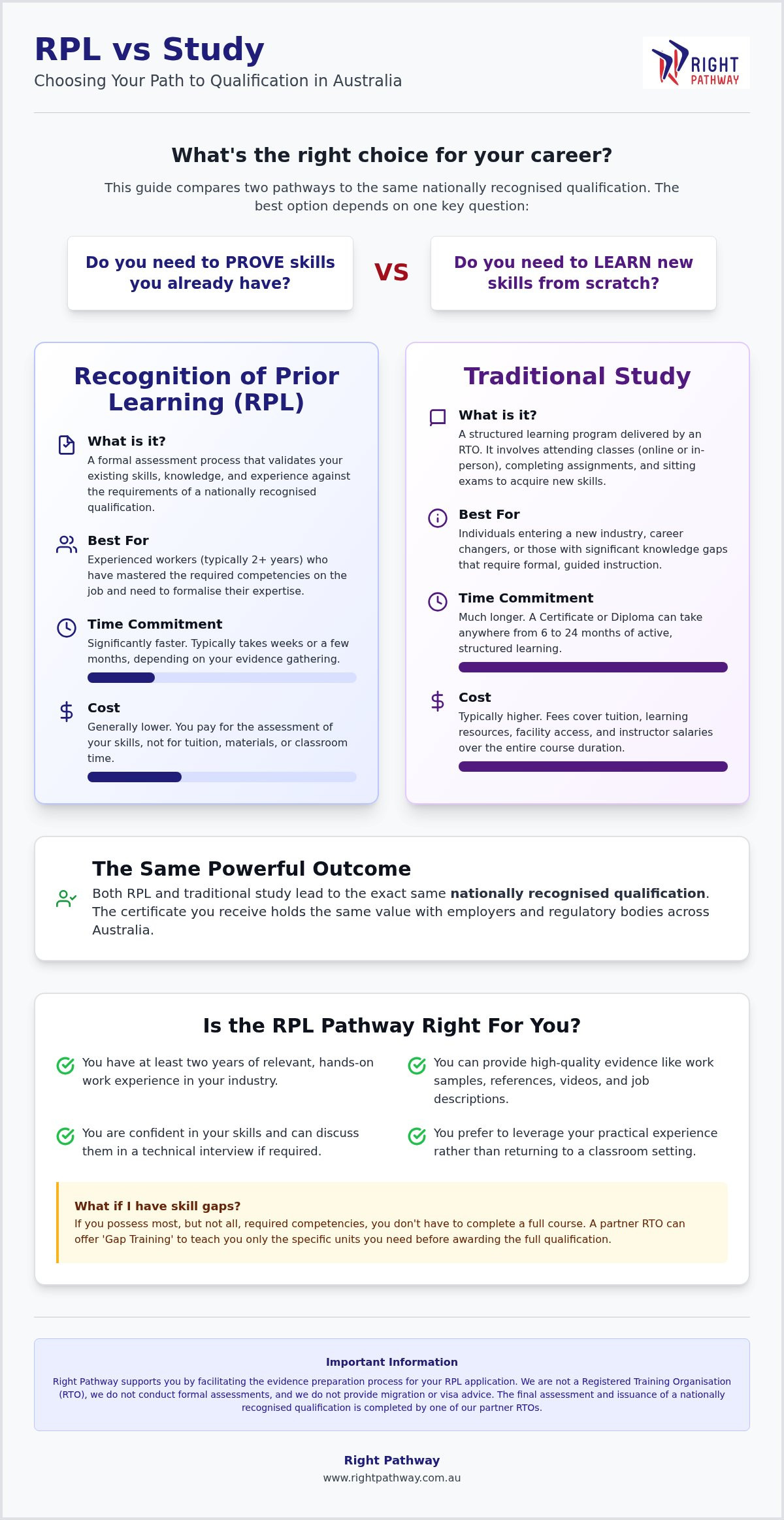
Deciding between RPL vs study effectively determines how you'll spend your evenings and weekends for the next year. The distinction is straightforward: traditional study is about acquiring new knowledge, whereas Recognition of Prior Learning (RPL) is about proving the knowledge you've already gained. For Australian professionals in 2026, this choice is often the difference between career stagnation and rapid progression.
Both pathways result in the same outcome: a nationally recognised qualification. Whether you sit in a classroom or submit a portfolio of work, the certificate you receive carries the same weight with employers and regulatory bodies like ASQA. The real challenge lies in the emotional weight of the decision. Many feel a sense of "back to school" dread at the thought of redundant lectures, while others worry about the rigour of collecting evidence for a formal assessment.
To better understand this concept, watch this helpful video:
What is Traditional Study?
Traditional study follows a structured learning model delivered by Registered Training Organisations (RTOs). It involves a set curriculum of lectures, assignments, and exams designed to build your skills from scratch. This is the ideal path if you're transitioning into a completely new industry or if you feel your current knowledge base has significant gaps that require formal instruction. It's a journey of discovery rather than validation.
What is Recognition of Prior Learning (RPL)?
RPL is a pragmatic assessment process where your existing work experience and previous training are mapped against national standards. It's built on the principle of competency. If you can demonstrate that you already perform a task to the required Australian standard, you shouldn't have to study it again. Right Pathway is not an RTO, does not conduct formal assessments, and does not provide migration or visa advice. We support you by facilitating the evidence preparation process, ensuring your submission is robust before it's assessed by one of our partner RTOs. To see if your experience aligns with this path, you can start with a free initial eligibility assessment.
Comparing Time, Cost, and Commitment: RPL vs Traditional Study
When evaluating RPL vs study, the most immediate difference is the impact on your calendar. A standard Diploma or Certificate IV typically requires a commitment of 6 to 24 months of active learning. Conversely, the evidence-based pathway often concludes in a matter of weeks or months, depending on how quickly you can compile your documentation. Consider the opportunity cost. If you spend 200 hours in a classroom covering material you already master, you're losing time that could be spent on higher-level projects or career growth. Efficiency is the primary driver for most experienced professionals.
Cost Breakdown: Tuition vs Assessment
Traditional tuition fees for higher-level qualifications in Australia reflect the high overheads of classroom facilities, teaching staff, and learning materials. Choosing the assessment pathway generally results in a lower financial investment because you aren't paying for the delivery of training you don't need. You're paying for the expert mapping of your skills and the formal assessment of your evidence by a partner RTO. Right Pathway is not an RTO and does not provide migration advice, but we facilitate this mapping process to reduce your administrative burden. This pragmatic approach ensures you only pay for the validation of your existing expertise.
The 'Fast-Track' Reality
It's vital to understand that while this path is more efficient, it's never instant. The Standards for RTOs 2025 require partner RTOs to conduct a rigorous assessment to ensure every candidate meets strict competency benchmarks. You'll need to provide high-quality work samples, employer references, and potentially undergo technical interviews. It isn't a paperwork-only shortcut. It's a legitimate way for skilled workers to secure a nationally recognised qualification by proving their current capabilities. If you're unsure where your experience fits, you can begin by taking a free initial eligibility assessment to see which units you might already satisfy.
Is RPL Right for You? Evaluating Your Evidence and Experience
The decision between RPL vs study often rests on the depth of your professional history. The "sweet spot" for a successful application typically involves at least two years of relevant experience, whether gained in Australia or overseas. This timeframe ensures you've likely encountered the variety of scenarios required to meet national standards. If you possess most skills but have minor knowledge gaps, "gap training" offers a middle ground, allowing you to study only the specific units you lack while receiving credit for your existing expertise.
Industry requirements vary significantly. A supervisor targeting the CPC40120 Certificate IV in Building and Construction might provide site diaries and safety audits, while someone pursuing the BSB50420 Diploma of Leadership and Management would focus on strategic plans and team development records. Right Pathway is not an RTO, does not conduct formal assessments, and does not provide migration or visa advice. We act as your facilitator to ensure your evidence aligns with what partner RTOs require for a nationally recognised qualification.
The Evidence Checklist
Assessors value quality over quantity. A few strong work samples that directly address competency standards are far more effective than a mountain of irrelevant paperwork. Key evidence often includes third-party reports, which allow a supervisor to formally validate your daily tasks. Other vital documents include project reports, photos of on-site work, and employment records like payslips to verify your tenure and role responsibilities.
When Traditional Study is the Better Option
Study is the more viable pathway if you're transitioning into a new industry or cannot provide documented proof of your skills due to strict confidentiality agreements. The classroom environment also provides structured networking and peer-to-peer learning that the independent evidence-gathering process lacks. If you're unsure which path fits your current situation, checking your documentation is the first logical step.
Streamlining Your RPL Journey with Right Pathway
Right Pathway acts as your "Knowledgeable Navigator" throughout the transition from worker to certified professional. When choosing RPL vs study, the sheer volume of bureaucratic requirements can often feel overwhelming. We simplify this journey by providing a clear, manageable path forward. Our role is to reduce the anxiety associated with complex skills mapping, allowing you to focus on your career while we handle the logistical heavy lifting. This partnership approach ensures you get the credit you deserve for your existing hard work without the need for redundant classroom time.
Why Use an RPL Facilitator?
Raw experience is valuable, but it must be translated into the specific language of Australian training packages to be valid. We bridge this gap by helping you organise your portfolio to meet the strict standards required by partner RTOs. Instead, we provide evidence preparation guidance that ensures your submission is robust and technically accurate. This saves you from the frustration of submitting incomplete documentation that might lead to delays or rejected applications.
Your Next Steps to Certification
The journey begins with a free initial eligibility assessment. This consultative step determines your chances of success before you commit significant time to the process. Once your eligibility is confirmed, we guide you through the collection of work samples and third-party reports. Our nationwide support ensures that whether you are on a remote mining site or in a metropolitan office, you have access to expert facilitation. Each step is methodical, moving you closer to your goal without the need for redundant study.
After the evidence is prepared, it is submitted to one of our ASQA-regulated partner RTOs for formal assessment. They are the final authority that issues the certificate upon successful completion. You can learn more about the RPL process and how we support your journey to professional validation. By choosing this facilitated path, you avoid the classroom while ensuring your skills are officially acknowledged across all Australian states.
Advancing Your Career with Confidence
The choice between RPL vs study ultimately depends on where you stand in your professional journey. If you possess years of hands-on experience, pursuing a pathway that acknowledges your existing expertise is a pragmatic way to avoid redundant learning and high tuition costs. By focusing on evidence quality and technical mapping, you can achieve the same outcome as classroom learners in a significantly shorter timeframe.
Right Pathway supports workers across more than 18 industries by facilitating the evidence preparation required for formal assessment. We are not an RTO, do not conduct formal assessments, and do not provide migration or visa advice. Instead, we guide you through every administrative hurdle to ensure your portfolio meets the standards required by our ASQA-regulated partner RTOs. Taking the first step towards your qualification shouldn't feel overwhelming when you have a dedicated navigator in your corner.
Your hard work deserves official recognition. We look forward to helping you bridge the gap between your current skills and your future career goals.
Frequently Asked Questions
Is an RPL qualification the same as one earned through study?
Yes, it is identical. The certificate issued by a partner RTO is a formal Australian qualification and does not state whether it was earned through classroom learning or assessment. It adheres to the same training package standards found on training.gov.au. This ensures that employers and industry bodies treat the certification with equal weight for licensing, insurance, or career promotion purposes across all states.
How much does RPL cost compared to traditional TAFE or Uni fees?
Choosing the assessment pathway typically results in a lower total investment than full-time classroom study. Traditional fees must cover lectures, campus facilities, and learning materials that you don't require if you already possess the skills. When comparing RPL vs study costs, remember that assessment fees focus on the validation of your existing evidence. The primary saving comes from avoiding redundant units and associated travel expenses.
What happens if I don't have enough evidence for a full RPL qualification?
If your evidence doesn't satisfy every unit of competency, you can complete gap training for the remaining requirements. This allows you to receive credit for what you already know while only studying the specific areas where you lack documented proof. It's a common outcome for workers with specialised experience. Our free initial eligibility assessment helps identify these gaps early so you can plan your certification efficiently.
Can I use overseas work experience for an Australian RPL assessment?
Relevant overseas experience is valid evidence for an Australian qualification. Partner RTOs look for proof that matches current Australian industry standards, regardless of where the work was performed. You'll need to provide high-quality documentation, such as translated references, project samples, or photos of your work. This is particularly helpful for skilled migrants looking to have their international expertise formally validated by an ASQA-regulated training organisation.
How long does the RPL process actually take from start to finish?
The timeline typically spans several weeks or months, which is significantly faster than the 6 to 24 months required for traditional study. The exact duration depends on how quickly you can gather your portfolio and the assessment turnaround times of the partner RTO. It isn't an instant process; a rigorous review is mandatory to ensure you meet national standards. We help streamline this by providing clear guidance.
Article by
Right Pathway Team
Right Pathway is an Australian Recognition of Prior Learning (RPL) support and facilitation service helping experienced workers, tradespeople and skilled migrants prepare evidence for nationally recognised qualification pathways.
Founded in 2019, Right Pathway has supported over 2,000 applicants across construction, mining, healthcare, aged care, business, community services, hospitality, automotive and the trades.
We work with ASQA-regulated partner Registered Training Organisations (RTOs) to support evidence preparation, skills mapping and qualification pathway guidance. Right Pathway is not an RTO and does not issue qualifications directly.
Start with a free RPL eligibility assessment at rightpathway.com.au.
Disclaimer
Right Pathway is a facilitation and support service only. We are not a Registered Training Organisation (RTO), do not conduct formal RPL assessments and do not issue qualifications. All formal RPL assessments and certifications are completed by partner RTOs regulated by ASQA. Eligibility and qualification outcomes depend on each applicant’s evidence, experience and the RTO’s assessment decision.


