

RPL may help you gain a vocational or trade qualification that matches your skills and experience. Options span areas such as construction, automotive, mining, aged care, community services, healthcare, hospitality, retail, and business and management. If you’re asking what qualifications you can get with RPL, the key is whether your experience and evidence align with a qualification’s competency requirements.
You don’t need to have learned your skills in a classroom, but time on the job alone isn’t enough. A Registered Training Organisation (RTO) assesses your evidence against the required competencies and may request more information or a practical demonstration. This guide explains who can apply, what evidence may support an application and how to choose a qualification that fits your goals. It also clarifies the difference between an RPL qualification and a licence or registration.
Key Takeaways
- Explore vocational and trade qualification pathways that may align with your skills, work history and career direction.
- Understand how an RTO evaluates evidence against competency requirements, and why unsupported claims about automatic qualifications should be treated cautiously.
- Prepare relevant evidence of your skills and experience, and learn what may happen if it does not cover every competency.
- Separate qualification goals from licensing requirements, and see how Right Pathway can help with preliminary eligibility guidance and evidence preparation.
What is recognition of prior learning?
In Australia, Recognition of Prior Learning (RPL) assesses skills, knowledge and work experience against a vocational qualification’s requirements. A Registered Training Organisation (RTO) may award credit for competencies already demonstrated, rather than requiring repeated learning. The outcome depends on evidence matched to relevant units, not simply time spent in an industry. An experienced worker considering a trade qualification or diploma can explore the RPL pathway to understand how prior learning may be considered.
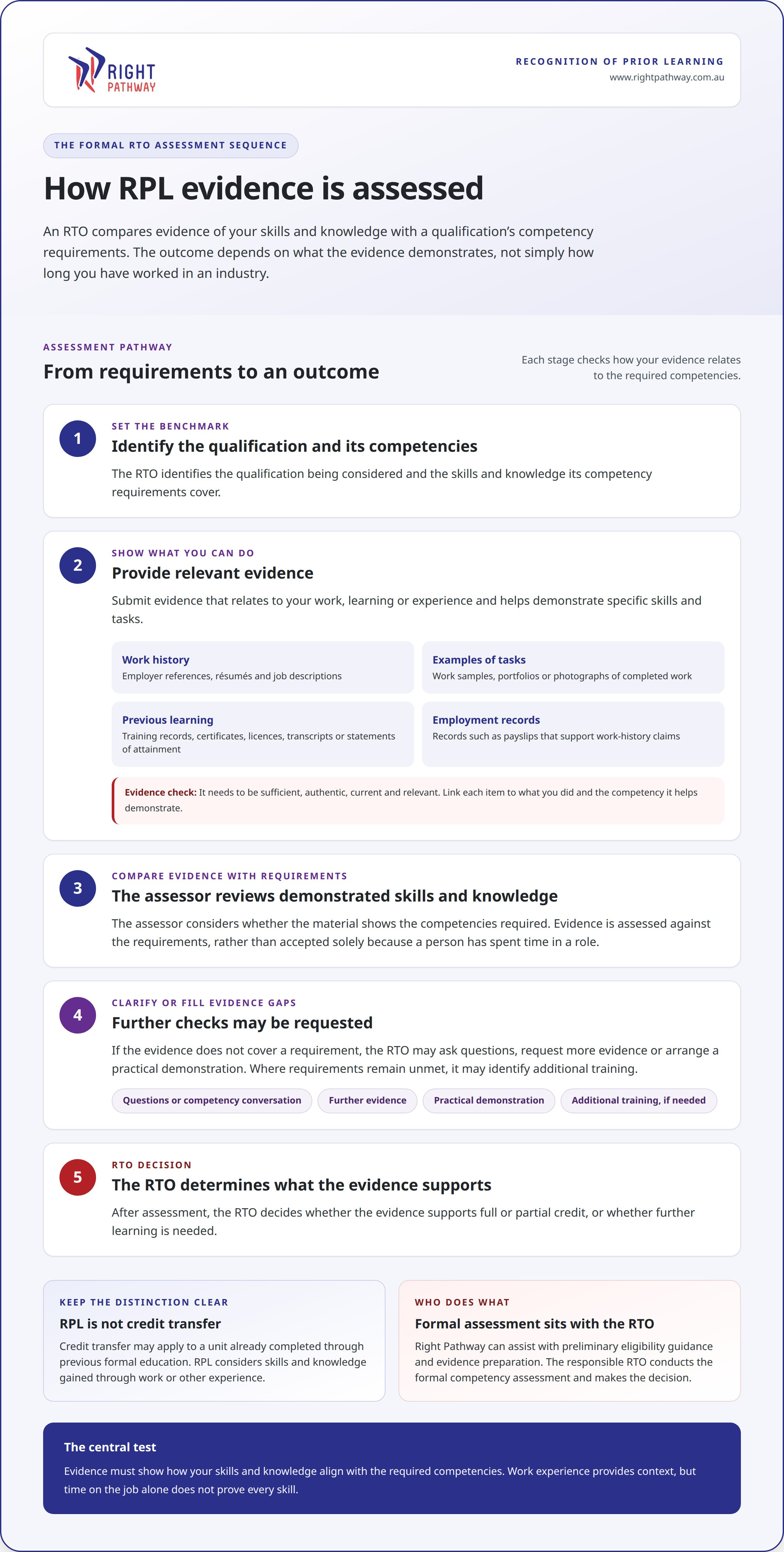
The formal assessment follows a clear sequence. First, the RTO identifies the qualification and its competency requirements. You then provide relevant evidence, such as work records or examples of completed tasks. An assessor reviews the material against the required skills and knowledge, and may ask questions, request further evidence or observe a practical demonstration. The RTO decides whether your evidence supports full or partial credit, or whether further learning is needed.
The RTO, not an RPL support service, conducts this formal competency assessment and makes the decision. This distinction matters because a qualification must reflect demonstrated competency, not a promise made before assessment. If evidence is weak or the assessment does not properly test required skills, the result may not reflect the person’s actual competence or the qualification’s standards.
Be cautious of claims promising an instant certificate, a guaranteed outcome or a qualification based on paperwork alone. RPL requires sufficient, authentic, current and relevant evidence, and the RTO may require additional assessment or training. A sound process explains what is assessed and how your evidence relates to each competency. Work experience alone does not secure a qualification; the RTO must assess evidence of your skills.
Evidence for an RPL application
In Australia, RPL eligibility depends on evidence that shows your skills match a qualification’s requirements. An RTO considers whether your evidence is authentic, current and relevant, and whether it demonstrates the required knowledge and practical competency. Work experience provides context, but time in a role alone does not prove every skill.
Evidence may come from paid or volunteer work, previous education, on-the-job learning and informal training. Examples include:
- Employer references, résumés and job descriptions that explain your responsibilities.
- Work samples, portfolios or photographs showing completed tasks and outcomes.
- Training records, certificates, licences, transcripts or statements of attainment.
- Employment records, such as payslips, that support claims about work history.
Link each item to a specific task or skill. For example, a construction worker could provide a job description, supervisor reference and project records that describe relevant duties. Evidence is more useful when it shows what you did, when you did it and how it demonstrates competency. Protect confidential information about employers, clients and worksites when preparing documents.
Previous formal education may support credit transfer if it includes a unit you have already completed. This differs from RPL, which considers skills and knowledge gained through work or other experience. A certificate or transcript documents completed study; work samples and references can demonstrate applied capability. Both can help an RTO understand your background.
If evidence leaves a gap, the RTO may ask for further records, a competency conversation or a practical demonstration. Where requirements remain unmet, it may identify additional training for those areas. A clear RPL process helps show how evidence is reviewed, while the RTO decides whether it supports the qualification outcome.
Choosing a qualification for licensing and career goals
Choose a qualification that fits the work you want to do and the competencies you can demonstrate. If the role requires a licence, treat that as separate from the qualification.
Licensing and industry requirements
Licensing and industry requirements determine whether a qualification, licence or registration is needed for particular work. An RPL qualification does not itself grant an occupational licence or permission to perform regulated work. Before choosing a pathway, identify your target role and its activities, then consult the relevant state or territory regulator for current licensing requirements. A qualification that recognises your prior learning may not meet every licensing condition. The regulator’s requirements, not the qualification title alone, determine what you need.
Qualifications for career goals
A career-focused qualification should match the responsibilities you want to take on and the competency areas your experience supports. For example, if you’re aiming for a supervisory role, consider whether your experience covers relevant leadership tasks as well as technical work. A qualification aligned with demonstrated skills can formalise existing capability; building competencies you haven’t yet gained may require further learning. Consider your target role, its responsibilities and the skills you can evidence. This helps narrow your options without assuming that time in an industry automatically meets qualification requirements.
For tradespeople and workers in sectors such as mining or construction, the right pathway depends on the qualification’s current requirements and how closely they match prior learning. A recognised qualification can support career progression, but it doesn’t guarantee employment, registration or licensing. RPL’s potential benefits are most relevant when the qualification fits a clear work goal. Keep the goal specific: identify the role, separate its qualification needs from licensing conditions, and consider which competencies your experience can demonstrate.
Recognition of skills from training, work or life experience
RPL can recognise relevant skills gained through work, training, volunteering or other experience. A preliminary skills check can help identify qualifications that may align with your background.
Using a skills check to find suitable qualifications
A skills check maps your previous tasks, training and responsibilities against potential qualification requirements. This is useful because a job title alone may not show which competencies you can demonstrate. For example, a construction worker’s experience might suggest a trade pathway, but their actual duties determine which units are relevant. The formal RTO assessment decides whether the evidence meets those requirements.
Skills recognition and qualification credit
Skills recognition compares demonstrated ability with the competencies required for a qualification, which may result in credit towards some or all requirements. Paid work, volunteering, informal learning and completed training can all provide relevant context. The Australian Skills Quality Authority identifies Standard 1.6 and 1.7 as additional resources for information about credit transfer and recognition of prior learning in Australia. The RTO determines the credit outcome.
RPL, credit transfer and course completion
RPL assesses skills and knowledge gained through experience, while credit transfer recognises a relevant unit completed through formal education. Completing a course involves its required learning and assessment; RPL may recognise existing competency. An RTO assesses RPL evidence and decides whether it supports full or partial credit. The right pathway depends on your previous study and experience.
Overseas qualifications and work experience
Overseas qualifications and work experience may support an Australian RPL application if they provide relevant evidence against the qualification’s competencies. Training records, employer references and work samples can help explain skills gained overseas. An RTO assesses this material against Australian requirements. RPL is not a migration skills assessment, and an Australian qualification does not determine visa eligibility or employment outcomes.
Right Pathway
Right Pathway helps workers explore potential RPL pathways through guidance and administrative facilitation. If you’re weighing qualifications against your skills, work history and career direction, a preliminary skills and experience eligibility consultation can help clarify which options may be relevant. This is an initial discussion, not a formal competency assessment or a decision about whether an RTO will award credit.
Right Pathway offers a free initial RPL eligibility check to help you consider your experience and possible pathway. A preliminary evidence-readiness review can identify records that may support an application and areas where more information could help. Right Pathway also provides guidance on organising relevant material, such as work records, training history and examples of completed tasks.
This support helps you understand the process and prepare for the next stage, but it does not replace formal assessment. The responsible RTO enrols applicants, assesses competency against the qualification requirements and decides whether the evidence supports RPL. If the RTO identifies gaps, it may require further evidence, practical assessment or training. The RTO also issues any qualification or statement of attainment resulting from its decision.
Use preliminary guidance to clarify your potential options, particularly if you have varied or overseas work experience, or are unsure which qualification fits your goals. The final pathway depends on your evidence and the RTO’s assessment, so treat early guidance as preparation, not an outcome.
To discuss your experience and possible next steps, complete Right Pathway’s free initial eligibility assessment.
Frequently Asked Questions
Who is eligible for RPL?
You may apply without a previous formal qualification or apprenticeship if your background is relevant to a vocational qualification. For instance, skills gained through supervised workplace tasks may be relevant. Eligibility is considered against the specific qualification, so the same work history may suit one pathway better than another.
How much experience do you need for RPL?
There’s no universal minimum number of years for every RPL qualification. The experience needed depends on the qualification’s competencies and the work involved. Two people with similar time in an industry may have different applications because their duties and responsibilities differ. Focus on the scope of your work, not a target number of years.
Which qualifications can you get through RPL?
RPL applies to current vocational qualifications that can be assessed against relevant competencies. Start by identifying the qualification’s exact title and status on the national training register. Similar-sounding qualifications may have different requirements, and some may no longer be current. The formal RTO assessment determines whether your experience aligns with the qualification.
How can RPL help me advance my career in 2026?
RPL may help you document your capabilities when planning a career move or discussing professional development with an employer. Before choosing a pathway, identify the role you’re working towards and the qualification relevant to it. This helps you focus on an outcome that fits your direction. A qualification alone doesn’t guarantee a new role or promotion.
What are the experience requirements to qualify for RPL Australia?
There isn’t one experience checklist that applies to every qualification in Australia. Requirements depend on the competencies being assessed and any relevant course or licensing conditions. Self-employment, volunteer duties or overseas work may form part of your background if they relate to those competencies. For regulated occupations, distinguish qualification requirements from the licence or registration conditions set by the relevant regulator.
What qualifications can be obtained through RPL in Australia?
When an RTO awards a qualification through RPL, the formal outcome is the qualification itself, not a separate “RPL version”. The award reflects the competencies the RTO has formally assessed and recognised. RPL may support more than one qualification if your skills and evidence meet the relevant requirements. Each qualification is considered separately.
RPL can provide a pathway to formal recognition when your experience aligns with a current vocational qualification. Right Pathway can help you explore possible next steps with a free initial eligibility check.
Complete the free initial eligibility assessment with Right Pathway to discuss your experience and possible pathway.

Article by
Right Pathway Team
Right Pathway supports experienced workers, tradespeople and skilled migrants with preliminary RPL eligibility guidance, evidence preparation and qualification pathway navigation.
Right Pathway is not a Registered Training Organisation and does not conduct formal competency assessments or issue qualifications. Formal enrolment, competency assessment and qualification issuance are completed by the responsible Registered Training Organisation.
Start with a free initial RPL eligibility assessment at https://www.rightpathway.com.au/eligibility-check
Disclaimer
Right Pathway is a facilitation and support service only. We are not a Registered Training Organisation (RTO), do not conduct formal RPL assessments and do not issue qualifications. All formal RPL assessments and certifications are completed by partner RTOs regulated by ASQA. Eligibility and qualification outcomes depend on each applicant’s evidence, experience and the RTO’s assessment decision.


