

A qualification can make existing experience count, but it doesn’t automatically mean a pay rise. An RPL cost benefit analysis weighs the cost of having existing skills assessed against the time and tuition involved in traditional training, while recognising that career and salary outcomes depend on more than a qualification alone.
If you’ve developed your skills on the job, repeating training may feel unnecessary. Recognition of Prior Learning (RPL) provides a way to have relevant experience assessed against a qualification, provided you can supply suitable evidence.
This article explains how RPL costs compare with traditional training and how a recognised qualification may support career progression and salary outcomes in Australia. It also covers the factors that affect RPL’s value, including the qualification, your evidence and how employers use credentials in hiring decisions.
Key Takeaways
- Compare RPL with traditional training by weighing assessment costs against the tuition and study time you may avoid.
- Understand how a recognised qualification may support career progression, without assuming it will automatically lead to a pay rise.
- See which workplace evidence can help demonstrate your skills and where further assessment or gap training may be needed.
- Identify the factors that shape the value of RPL, including your experience, evidence and the qualification pathway.
How Does an RPL Certificate Impact Career Progression and Salary Outcomes in Australia?
Recognition of Prior Learning (RPL) can help experienced workers have their skills considered for a formal qualification without repeating training they can already demonstrate. Its career value depends on the qualification, the evidence and the requirements of the role.
Career Advancement and Employability
Career advancement through RPL means having relevant workplace skills assessed towards a formal qualification. A recognised qualification may help show employers that your experience aligns with industry competency requirements, which can support applications for roles where a credential matters. For example, if your duties have expanded, you may be able to have relevant skills assessed against applicable units instead of starting training from the beginning. That can make your capabilities clearer on a résumé, but it does not secure a job or promotion.
Government funding depends on state or territory rules, the qualification, provider and individual eligibility. RPL alone does not establish eligibility for a subsidy.
Potential Salary Benefits
A salary benefit is a change in pay that may follow when a qualification helps meet an employer’s requirements for a role. In Australia, a certificate gained through RPL may strengthen your case for progression where a position requires recognised training or documented competency. However, pay also depends on the role, industry, location, experience and employer arrangements. A qualification alone does not set your salary or guarantee an increase.
When comparing providers, review the written fee inclusions, possible assessment or gap-training costs, which RTO is responsible for assessment, the evidence required and the refund terms. Compare the process and conditions, not just the headline fee.
Career and Licensing Benefits
Career and licensing benefits are separate: an RPL qualification may support career pathways, while a licence or registration is a separate authorisation. An RTO assesses evidence against relevant units of competency and decides whether further evidence, practical demonstration or gap training is needed. RPL doesn’t automatically provide a trade licence or authority to do regulated work. Requirements depend on the occupation and relevant state or territory regulator. Information about RPL pathways can help you understand how experience may relate to a qualification.
The responsible Registered Training Organisation (RTO) reviews authentic, current and relevant evidence against the applicable units, then determines whether you have demonstrated competency. A low-cost service may not be the RTO conducting the assessment, so confirm which RTO is responsible and what the fee covers before proceeding. A low fee alone does not show that assessment requirements will be met.
RPL costs and savings compared with traditional training
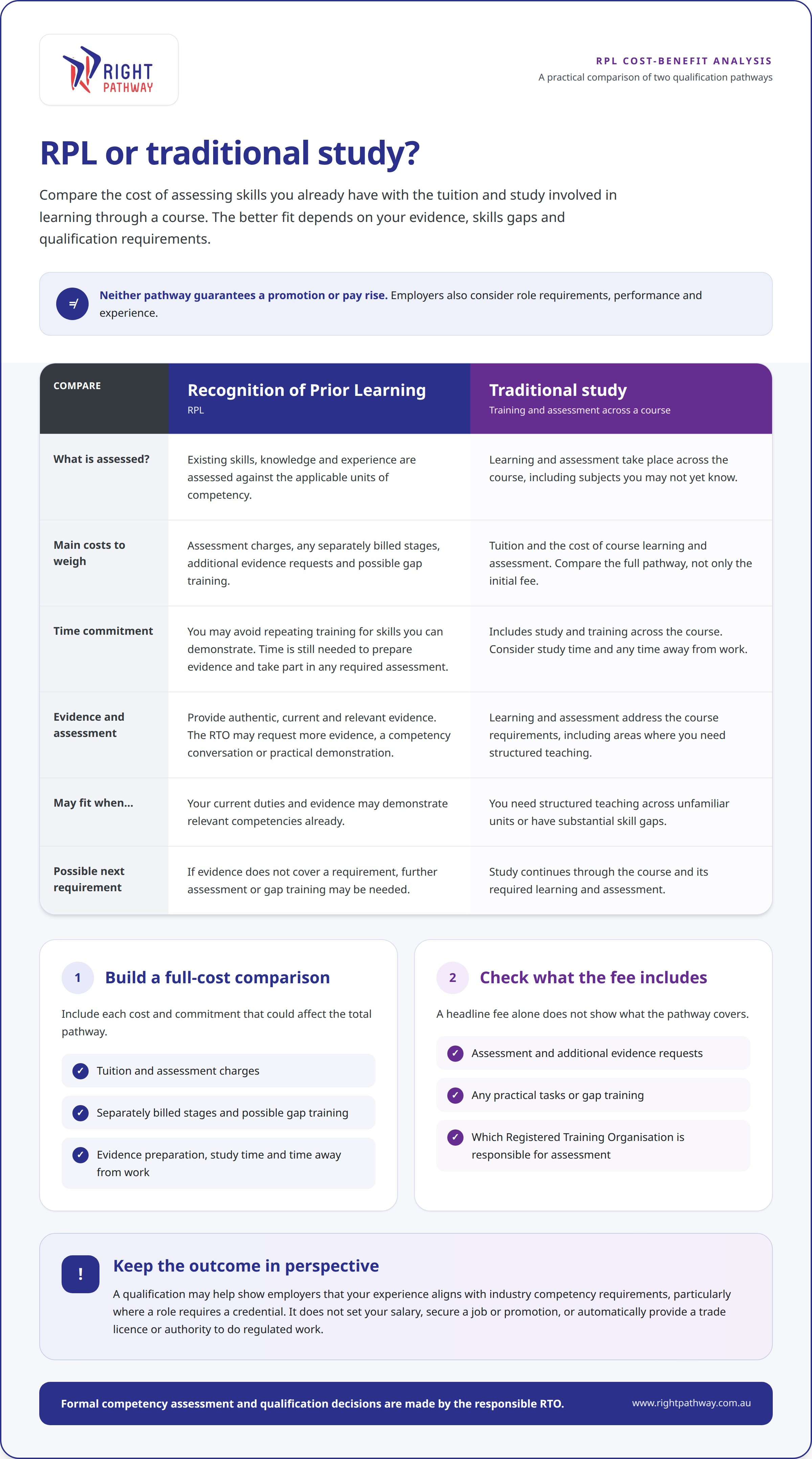
RPL compares the cost of assessing existing skills with the tuition and time involved in further study. The better option depends on how much of the qualification your evidence can support.
RPL Costs Compared with Traditional Study
RPL costs are the charges for assessing existing skills against qualification requirements. Traditional study involves tuition for learning and assessment across a course, while RPL focuses on assessing relevant prior learning. If you have substantial, well-documented experience, RPL may reduce the need to repeat training. Assessment costs and any required gap training still affect the total.
Compare the full pathway, not just its initial fee. An RTO may charge a combined amount or bill for separate stages, and a Diploma pathway may differ from a trade qualification. Ask what the fee covers, including assessment, requests for additional evidence and gap training. A cost comparison should account for each of these items.
Time Savings Compared with Traditional Training
Time savings are the study and training hours you may avoid when your skills already meet some qualification requirements. Through RPL, an RTO assesses evidence against applicable units of competency instead of teaching every subject from the beginning. The process still takes time: you may need to gather evidence, take part in competency conversations or complete practical demonstrations.
Traditional training can suit you if you need structured teaching across unfamiliar units. RPL may suit you if your current duties already demonstrate the required skills. For example, a tradesperson seeking a formal qualification may value spending less time away from paid work, while someone with substantial skill gaps may need further training. Neither pathway guarantees a promotion or leadership role; employers also consider role requirements, performance and experience.
To weigh the options, list tuition, assessment, study time, time away from work and possible gap training. A free initial eligibility assessment can help you understand whether your experience may align with a qualification pathway.
Quantifying costs and market benefits
A cost-benefit analysis compares the resources involved in an RPL pathway with its practical gains. As a worker in Australia, consider direct charges, time spent preparing evidence, any gap training and the value of having relevant competencies formally recognised.
Build the comparison around the qualification and the responsible Registered Training Organisation (RTO). Record the assessment charge, any separately charged stages, possible practical tasks and additional training. Then compare these items with the tuition and study commitments of a traditional pathway. This gives you a clearer picture than headline fees alone.
Evidence affects the calculation. A construction worker with current project records, work samples and supervisor references may be able to demonstrate some competencies directly. If the RTO identifies gaps, further assessment or training adds time and expense. A flexible pathway must still meet the same competency requirements, and speed alone does not establish value.
Consider benefits beyond the qualification document. A formal credential can help employers understand how your skills align with role requirements. It may support applications for positions that specify a qualification, while your experience and performance still matter to hiring decisions. Treat potential career benefits as possible value, not guaranteed income.
Separate individual benefits from broader market effects. For you, value may include less repeated training and clearer evidence of your capability. For an employer, a qualified employee may bring documented skills relevant to the team’s work. In construction, for example, an employer can consider assessed competencies alongside site experience when allocating responsibilities.
Use a simple pathway comparison: list the direct charges, time commitments, evidence preparation and likely gap-training needs for each option. Then note which qualification requirements each route addresses. This helps you identify where RPL may avoid duplicated learning and where traditional study may better address missing skills.
The result is a practical decision tool, not a promise of financial return. Employers set role requirements, and an RTO determines competency through formal assessment. Weigh these factors alongside your evidence and intended career pathway.
Recognition of workplace and informal learning
Recognition of Prior Learning (RPL) assesses existing skills and knowledge against qualification requirements. It can recognise learning gained through work, informal training and practical experience, not only classroom study. The outcome depends on how well your evidence demonstrates the relevant competencies. A nationally recognised qualification is issued only after the responsible Registered Training Organisation (RTO) completes the formal assessment.
You need sufficient, authentic, current and relevant evidence connected to the applicable units of competency. Examples include work samples, job descriptions, résumés, training records, references and employer testimonials. Your evidence should show what you personally did, how you performed tasks and whether those skills remain current.
For example, a construction worker might provide project records, photographs of completed work and a supervisor reference. An RTO may use these materials to identify which competencies they support. Simply providing a document does not prove competency: assessors consider its relevance, authenticity and how clearly it demonstrates the required knowledge and skills.
Informal learning includes skills developed through workplace tasks, on-the-job guidance or employer training. If you have taken on advanced responsibilities, your experience may be relevant, but your job title and years worked do not establish competency by themselves. Your evidence must connect the tasks you performed to the qualification’s requirements.
The RTO may request more evidence, a competency conversation, practical demonstration or challenge test. If your evidence reveals gaps, you may need additional training before a qualification can be issued. This is what distinguishes RPL from simply exchanging work history for a certificate: an assessor checks demonstrated capability against the relevant standards.
RPL also differs from credit transfer, which recognises previously completed formal units or qualifications. The appropriate pathway depends on whether the applicant is presenting prior study, workplace learning or both. If you’re considering how your experience and records may fit, a free initial RPL eligibility assessment can help clarify possible next steps.
Right Pathway
Right Pathway helps experienced workers consider whether RPL may suit their skills, evidence and career goals. We provide preliminary eligibility guidance, an initial evidence-readiness review and help navigating qualification pathways. This support can clarify likely next steps before you decide whether to proceed with an RPL pathway.
Right Pathway does not conduct formal competency assessments or issue qualifications. The responsible Registered Training Organisation reviews your evidence against the relevant units of competency, determines whether you meet the requirements and issues any resulting qualification.
If you’re weighing RPL against further study, start with an initial discussion of your experience and available evidence. Complete a free initial eligibility assessment with Right Pathway to discuss possible next steps.
Choose a pathway that fits your next move
Before choosing a study route, define what you want the qualification to help you do. You might be seeking access to a particular role, clearer evidence of your capabilities or direction for further training. A useful RPL cost benefit analysis starts with that goal, then considers whether recognising your existing skills supports it.
The value of a pathway depends on your circumstances, including the role you are targeting, your evidence and the qualification requirements. RPL may be worth exploring if your practical experience is relevant and you want it considered towards formal learning. If you need structured instruction to develop your skills, traditional training may be a better fit. Choose the option that supports your next step without assuming a particular career or salary outcome.
Take the next step with a clear goal and a realistic view of what your experience can demonstrate. That gives you a sound basis for deciding where to go next.
Frequently Asked Questions
How Much Does an RPL Application Really Cost in 2026?
A useful 2026 estimate needs to identify the exact qualification and who is charging the fee. An RPL cost benefit analysis should distinguish charges for administrative support from fees charged by the Registered Training Organisation responsible for formal assessment. Ask for a quote that names the service, the organisation receiving payment and any conditions affecting the amount, so you can compare like with like.
What does RPL (Recognition of Prior Learning) cost in Australia?
There is no single figure that applies to every Australian RPL application. The qualification and assessment arrangement shape what an RTO quotes. Before comparing amounts, confirm the qualification’s current title and code, then make sure each quote relates to that same credential. A quote for a different qualification, or for support rather than formal assessment, is not a direct comparison.
What fees do Australian RTOs charge for RPL assessment by qualification or unit?
Ask whether the quoted amount covers assessment for a complete qualification or only specified units. This matters if you want a full credential but the quote covers a smaller scope. Request the unit coverage in writing and check whether the quote describes assessment only or another service. That makes it easier to understand what the amount covers.
What is included in RPL fees, and what extra costs may apply for evidence gathering, gap training, or reassessment?
Ask the RTO to separate included services from charges that may arise later, and review its refund and withdrawal terms before committing. If further assessment or training is proposed, clarify whether it changes the amount payable and how approval works. Keep the quote and any written updates together to maintain a clear record of the agreed scope and changes during the process.
How much time can RPL save compared with completing a course in Australia?
Estimate the time difference by comparing the course’s scheduled learning commitments with the RPL pathway’s assessment milestones. Include the time needed to arrange workplace records, respond to assessor requests and attend any practical assessment. The effect on your roster may matter more than the calendar difference: consider whether either option requires regular study outside work or time away from shifts.
What are the benefits and drawbacks of RPL compared with formal study or credit transfer?
Choose a pathway that matches your immediate purpose. If you need teaching and practice to build capability, formal study may suit you better. If you already hold relevant formal units, ask whether credit transfer applies. If workplace experience is central, an RPL cost benefit analysis can help you weigh the assessment route against your learning goals and the qualification you need.

Article by
Right Pathway Team
Right Pathway supports experienced workers, tradespeople and skilled migrants with preliminary RPL eligibility guidance, evidence preparation and qualification pathway navigation.
Right Pathway is not a Registered Training Organisation and does not conduct formal competency assessments or issue qualifications. Formal enrolment, competency assessment and qualification issuance are completed by the responsible Registered Training Organisation.
Start with a free initial RPL eligibility assessment at https://www.rightpathway.com.au/eligibility-check
Disclaimer
Right Pathway is a facilitation and support service only. We are not a Registered Training Organisation (RTO), do not conduct formal RPL assessments and do not issue qualifications. All formal RPL assessments and certifications are completed by partner RTOs regulated by ASQA. Eligibility and qualification outcomes depend on each applicant’s evidence, experience and the RTO’s assessment decision.


