

Experience in aged care can support a qualification pathway, but time on the job alone does not earn a certificate. An aged care qualification through work experience may be possible through Recognition of Prior Learning (RPL), where an RTO assesses your skills and knowledge against the requirements of the Certificate III in Individual Support.
If you have developed practical care skills at work, it is reasonable to ask whether you need to repeat training you already know. The answer depends on how relevant and strong your evidence is, and whether it demonstrates the required competencies.
This article explains how RPL may recognise existing experience, the skills and knowledge covered by the qualification, and how a Registered Training Organisation (RTO) conducts formal assessment. It also outlines other ways to enter aged care, so you can consider which pathway suits your background and career plans.
Key Takeaways
- Understand how the Certificate III in Individual Support can relate to your aged care experience and career goals.
- See what makes work experience relevant to RPL, and why evidence needs to demonstrate skills and knowledge against the qualification requirements.
- Explore the practical care capabilities covered, from supporting daily activities to working in line with care plans.
- Compare RPL with training and traineeship pathways to identify a suitable next step into aged care work.
Certificate III in Individual Support
In Australia, the Certificate III in Individual Support is commonly treated as an entry-level qualification for aged care support work. Some aged care roles have no formal qualification prerequisite. However, employers commonly expect applicants to be working towards a relevant certificate. This distinction separates a legal entry requirement from a practical hiring expectation.
Course descriptions may use “Ageing” or “Ageing and Disability” to describe the study focus. Those labels do not guarantee identical units or outcomes across courses. Unit selection shapes what students learn and what the RTO assesses. An ageing focus relates directly to aged care, while combined study also covers disability support.
The Certificate III prepares students for individual support across settings such as residential aged care and community care. For example, assisting an older person with daily routines involves following their support plan, communicating respectfully and supporting independence. These practical capabilities suit entry-level support roles. The qualification is distinct from nursing training and a Diploma of Nursing, which follow different career pathways.
Certificate IV in Ageing Support serves a different purpose. It is designed for people already working in aged care, with advanced training in leadership and specialised care. A worker seeking broader responsibilities may consider this pathway, while a new entrant will often start with Certificate III. Depending on the course, some Certificate IV units may be available as Certificate III electives.
For an experienced worker, an aged care qualification through work experience may involve RPL against applicable Certificate III units. Relevant experience must demonstrate the required skills and knowledge, not simply time spent in a role. The RTO assesses the evidence and may identify further assessment or training. Suitability depends on the worker’s experience, evidence and chosen study focus.
Recognition of prior learning (RPL)
RPL is a formal assessment of relevant skills and knowledge against a qualification’s units. The responsible RTO conducts the assessment and decides whether further evidence or training is needed.
Recognising workplace experience
Workplace experience may count when it demonstrates competencies required by the qualification. For example, supporting an older person with daily living can be relevant when evidence explains the worker’s responsibilities and practice. Overseas experience can also be presented for an Australian qualification pathway. The RTO considers how that experience aligns with the applicable units and whether the evidence is authentic, current and relevant.
Evidence for an RPL application
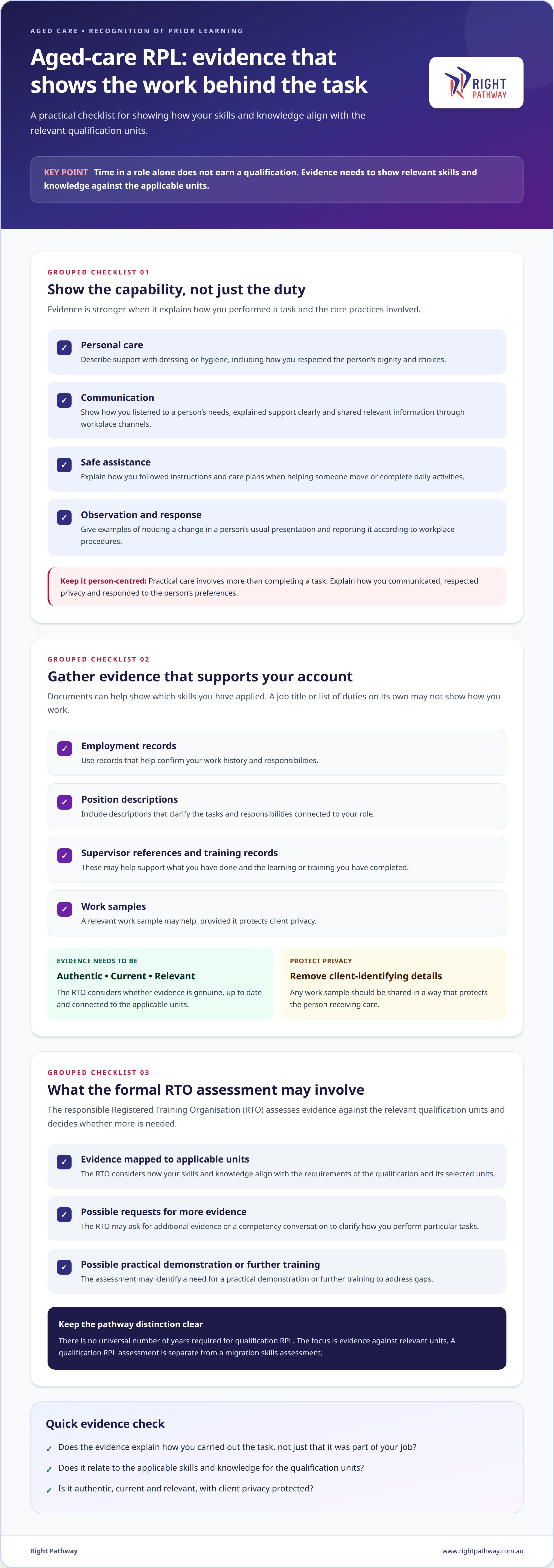
Evidence helps show which skills a worker has applied, rather than relying on a job title or time in a role. Useful documents may include employment records, position descriptions, supervisor references and training records. A work sample can also help, provided it protects client privacy. The RTO may request more evidence, a competency conversation or a practical demonstration to clarify how the worker performs particular tasks.
Qualifications available through RPL
RPL may be considered for aged care qualifications such as the Certificate III in Individual Support or Certificate IV in Ageing Support. The appropriate option depends on the person’s experience, evidence and the qualification requirements. An RTO may assess relevant units and identify any gaps. A qualification issued after formal RTO assessment is distinct from a migration skills assessment, which has a separate purpose.
RPL eligibility and assessment
There is no universal number of years required for qualification RPL; evidence against the relevant units is central. Separately, for the Aged or Disabled Carer skills assessment, applicants without a relevant qualification need at least 12 months of relevant full-time work experience, or a part-time equivalent. This is not an RPL requirement. Fees are discussed after eligibility is confirmed, and assessment time depends on evidence and any further assessment or training. Employers set role requirements and any related checks. A free initial eligibility assessment can help clarify a potential pathway.
Core units and practical skills
In Australia, individual support work combines practical assistance with respectful, person-centred communication. A support worker may help an older person choose clothing, move safely around their home or maintain everyday routines. The Certificate III relates to support for ageing and disability, but the precise units depend on the qualification and its selected electives.
Practical capability involves more than completing a task. For example, a worker assisting someone with personal care needs to communicate clearly, respect privacy and respond appropriately to the person’s preferences. In community or residential care, workers also need to follow care plans and organisational procedures. These examples show why evidence should explain how a task was performed, not simply list duties.
- Personal care: Support activities such as dressing or hygiene in a way that respects the person’s dignity and choices.
- Communication: Listen to a person’s needs, explain support clearly and share relevant information through workplace channels.
- Safe assistance: Follow instructions and care plans when helping someone move or complete daily activities.
- Observation and response: Notice a change in a person’s usual presentation and report it according to workplace procedures.
Some aged care workers may perform medical tasks under supervision, including changing dressings or administering medication. These tasks depend on workplace instructions and the worker’s responsibilities. Experience with a task does not, by itself, show that every associated competency has been demonstrated.
For RPL, the RTO maps evidence to the applicable units and identifies any skills that still need assessment. A work record describing support for a resident with limited mobility, for instance, may help demonstrate practical experience. The assessor may still need to confirm safe practice through questions or a demonstration. Certificate IV in Ageing Support provides advanced training for workers already in the sector, including leadership and specialised care. This pathway differs from the entry-level focus of Certificate III.
Qualification pathways into aged care work
There is no single route into every aged care role in Australia. Some entry-level positions have no minimum qualification standard, while employers commonly expect applicants to be working towards a relevant certificate. Start by identifying the role you want, then consider whether study, workplace training or recognition of existing skills best suits your background.
For support work, the Certificate III in Individual Support is a common entry pathway. A worker with relevant duties may instead explore RPL, with an RTO assessing evidence against the qualification requirements. These routes differ: one involves training, while the other evaluates existing skills. Neither guarantees employment, as organisations set their own role requirements.
A traineeship combines paid employment with structured training through a registered training provider. In Western Australia, aged care trainees work while completing training towards a recognised qualification. This pathway can suit people who want workplace learning alongside formal study. Volunteering in a residential facility can also provide insight into care work and may lead to a traineeship.
- Starting in support work: Certificate III study or a traineeship can provide structured preparation for direct care.
- Already experienced: RPL may be worth exploring when your duties and evidence align with the qualification requirements.
- Seeking advanced capability: Certificate IV in Ageing Support offers further training for people already working in the sector.
- Considering nursing: Aged care nursing follows a separate pathway and requires a nursing qualification, such as a Diploma of Nursing or Bachelor of Nursing.
Choosing an RPL service without a clear formal assessment pathway can leave you with support that does not lead to an assessment or qualification. Confirm that an RTO will enrol you, assess competency and issue any qualification. A low price alone does not establish that these formal steps are covered.
Right Pathway: Aged-care RPL support
Right Pathway supports aged care workers exploring whether their experience may align with an RPL qualification pathway. Its preliminary skills and experience guidance helps you understand what evidence may be relevant before formal assessment.
Use Right Pathway’s free initial RPL eligibility assessment to discuss your background and possible next steps. Right Pathway assists with RPL administration and qualification pathway guidance, while the responsible RTO conducts formal competency assessment and decides on recognition, further training and qualification issuance. Work experience or an initial eligibility review alone does not award a certificate.
If you’re ready to discuss your aged-care experience and potential pathway, complete the free initial eligibility assessment with Right Pathway.
Plan your next move in aged care
An aged care qualification through work experience can connect practical capability with a formal career pathway, but the right direction depends on the work you want to pursue. Consider whether your next step is direct support, community care or further study. That goal helps frame which qualification pathway may be relevant.
Experience is a useful starting point, not a substitute for formal assessment. The RTO considers how your knowledge and evidence match the qualification requirements, then decides whether further assessment or training is needed. Your experience and documentation will shape the discussion, so focus on what you can demonstrate in practice.
A preliminary conversation can help clarify possible next steps, although it cannot determine the RTO’s final decision. If you are ready to discuss your aged care experience, take the next step at your own pace.
Frequently Asked Questions
What is an aged care qualification through work experience?
It is a formal qualification pathway where an RTO considers whether your existing aged care skills and knowledge meet the required competencies. Work experience can inform an RPL assessment, but it does not itself grant a certificate. For example, a worker’s routine support duties may be relevant, while the RTO still needs evidence showing how the work meets the qualification requirements.
What is a relevant qualification?
A relevant qualification is one whose learning and competencies relate to the work or pathway being considered. For aged care support, this may include the Certificate III in Individual Support, depending on its content and the role. A qualification title alone does not establish relevance: its units, practical learning and connection to the person’s experience all matter when an RTO reviews a pathway.
Who is aged care RPL for?
Aged care RPL may suit workers who already perform relevant care duties and want their existing skills considered towards a formal qualification. For example, someone supporting older people with daily activities may have relevant experience to discuss. It may also be worth exploring for workers with overseas experience. The key consideration is whether the evidence demonstrates relevant competencies, not simply whether someone has worked in care.
Can work experience count towards an aged care qualification in Australia?
Yes, relevant experience can be considered through RPL for an aged care qualification in Australia. An RTO assesses whether your knowledge and practical capability align with the qualification requirements. A worker’s experience supporting residents, for instance, may be relevant, but duties need to be substantiated with appropriate evidence. The RTO may ask questions or request a practical demonstration to confirm competency.
What is recognition of prior learning (RPL) for aged care qualifications in Australia?
RPL is a formal process for assessing skills and knowledge gained through work, life experience or previous study against qualification requirements. It differs from credit transfer, which recognises relevant units completed through formal training. For instance, a worker may present workplace evidence for RPL, while a previous transcript may support credit transfer. The RTO determines which assessment pathway applies.
What does the aged care RPL application process with a registered training organisation involve, and what information should you provide?
The RTO reviews your background and evidence, maps them against the relevant competencies, then decides whether further assessment or training is needed. Provide an accurate work history, role descriptions, relevant training records and employment evidence, such as references or payslips. Avoid sharing confidential care records. The RTO may arrange a competency conversation or practical demonstration, and usually requires a USI when issuing a qualification.

Article by
Right Pathway Team
Right Pathway supports experienced workers, tradespeople and skilled migrants with preliminary RPL eligibility guidance, evidence preparation and qualification pathway navigation.
Right Pathway is not a Registered Training Organisation and does not conduct formal competency assessments or issue qualifications. Formal enrolment, competency assessment and qualification issuance are completed by the responsible Registered Training Organisation.
Start with a free initial RPL eligibility assessment at https://www.rightpathway.com.au/eligibility-check
Disclaimer
Right Pathway is a facilitation and support service only. We are not a Registered Training Organisation (RTO), do not conduct formal RPL assessments and do not issue qualifications. All formal RPL assessments and certifications are completed by partner RTOs regulated by ASQA. Eligibility and qualification outcomes depend on each applicant’s evidence, experience and the RTO’s assessment decision.


