

Yes, business qualifications may be available through RPL, including the Certificate IV in Business, Diploma of Business, Certificate IV in Leadership and Management, Diploma of Leadership and Management and Advanced Diploma of Business. An RPL pathway for a business management qualification matches your skills, knowledge and work experience to the relevant units of competency. The Registered Training Organisation (RTO) makes the formal assessment and decides whether the evidence meets those requirements.
Experience managing people, coordinating operations or overseeing business functions may be relevant to RPL for a business management qualification, but time on the job alone does not establish eligibility. Your evidence needs to show how your skills align with the qualification requirements, and the RTO may request further evidence or a practical demonstration. This article explains how different management backgrounds may fit a qualification pathway, how eligibility and qualification matching work, and what national recognition means in Australia. It also clarifies the difference between preliminary eligibility guidance and the RTO’s formal assessment, so you can understand the process before deciding on a next step.
Key Takeaways
- Explore business and management qualification options that may align with your workplace responsibilities.
- Learn how an RTO matches evidence of your skills and experience to a qualification’s competency requirements.
- Understand what qualification codes and national recognition tell you about an Australian qualification.
- See how preliminary eligibility guidance can help map a potential pathway before formal RTO assessment.
Can You Get a Business Management Qualification Through RPL?
Recognition of prior learning (RPL) for a business management qualification assesses skills and knowledge gained through work, training and other relevant experience. In Australia, a Registered Training Organisation (RTO) compares that experience with the units of competency for a specific qualification. It may recognise demonstrated competence, but work history alone does not establish that every requirement has been met.
The qualification’s level and scope help determine whether it fits your responsibilities. For example, the Certificate IV in Business (BSB40120) has 12 units, according to the Australian Government Department of Employment and Workplace Relations. The Diploma of Business (BSB50120) also has 12 units, according to the Australian Government Department of Employment and Workplace Relations. An RTO considers the competencies in the selected qualification, not just your position title.
Business skills assessed may include organising work, communicating with colleagues, coordinating projects, supporting staff and contributing to operational plans. A team leader who allocates tasks under supervision may demonstrate different competencies from a manager who oversees budgets, procedures and staff performance. The RTO maps each example to relevant units and checks whether it meets the required standard.
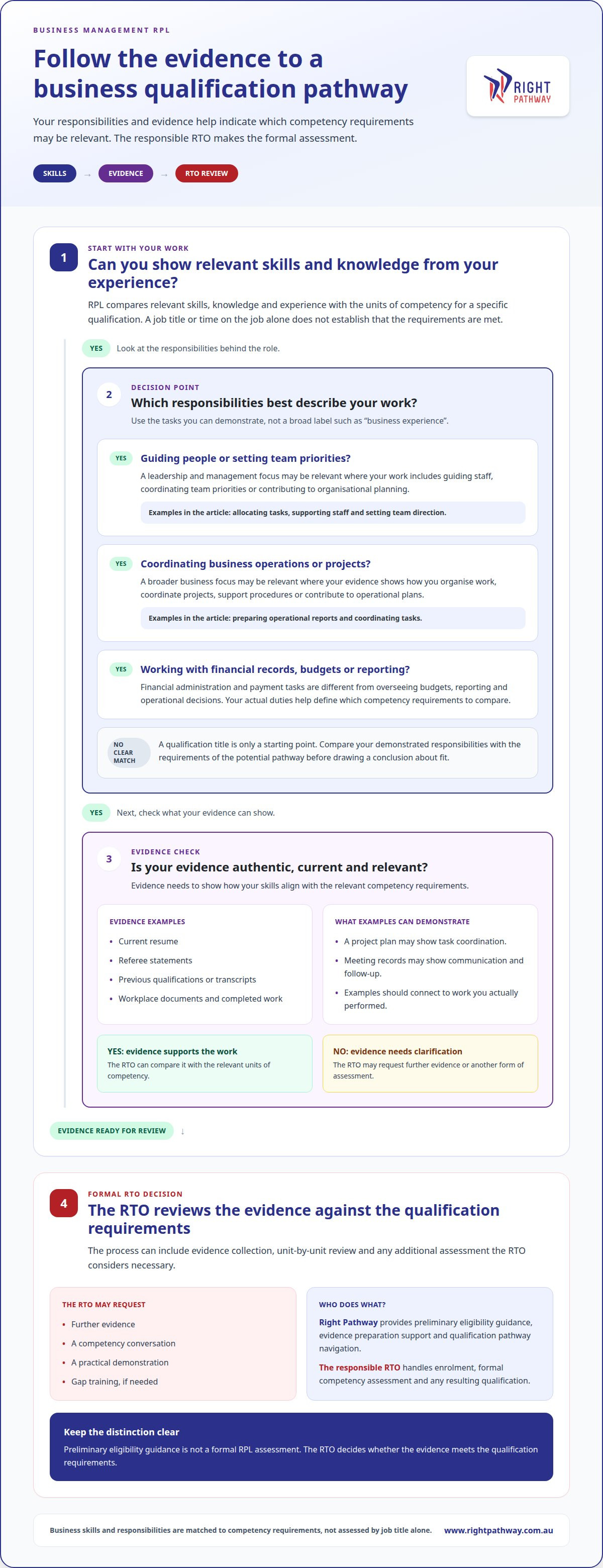
Evidence may include a current resume, referee statements, previous qualifications or transcripts, workplace documents and examples of completed work. A project plan, for instance, may show how you coordinated tasks, while meeting records can demonstrate communication and follow-up. Evidence needs to be authentic, current and relevant. The RTO may also request a competency conversation, practical demonstration or further evidence to clarify how you performed the work.
The process typically moves from evidence collection to unit-by-unit review, followed by any additional assessment the RTO considers necessary. Timing depends on evidence quality, assessor follow-up and whether practical demonstrations or gap training are needed. The Australian RPL process involves formal RTO assessment, which determines whether your existing skills match the qualification.
Business qualifications available through RPL
Business and finance RPL pathways may cover administration, business operations, leadership and financial services. The right direction depends on the qualification’s required competencies and the work you can demonstrate. A qualification title is a starting point, but its scope and your responsibilities matter more than a broad label such as “business experience”.
Leadership pathways may suit workers whose responsibilities include guiding staff, coordinating team priorities or contributing to organisational planning. The Certificate IV in Leadership and Management (BSB40520) and Diploma of Leadership and Management (BSB50420) are examples to consider. The Diploma of Business (BSB50120) offers a broader business focus, while the Advanced Diploma of Business (BSB60120) may be relevant where evidence reflects higher-level business responsibilities.
Business and finance roles can involve distinct responsibilities. Someone who maintains financial records or administers payments may have evidence relevant to business administration or finance competencies. A person who oversees budgets, reporting and operational decisions may have a different profile. The RTO compares your duties and evidence with the qualification requirements to determine which pathway is appropriate.
Use the responsibilities behind your work history to compare options. Arranging staff rosters, preparing operational reports and supporting business procedures demonstrate different activities from setting team direction or developing organisational plans. Previous study or a certificate can add context, but the RTO assesses whether your demonstrated competency matches the relevant requirements.
Qualification pathway navigation can help connect your experience with a business or finance direction before formal assessment. If you’re weighing up which qualification may suit your background, a free initial eligibility assessment can help clarify potential next steps.
Qualification code and national recognition
A qualification code identifies a specific Australian vocational qualification, while its title describes its subject and level. Before choosing a pathway, use training.gov.au to confirm the current title, code and status. This helps distinguish a current qualification from an older or similarly named one. Check these details against the qualification you plan to pursue, rather than relying on a general course description.
Which Australian registered training organisations offer business management RPL? The available RTO depends on which organisations are registered and have the relevant qualification within their scope. Right Pathway helps you navigate the qualification pathway and coordinates referrals to RTOs. The responsible RTO handles enrolment, formal assessment and any resulting qualification.
National recognition depends on the qualification being issued by an RTO authorised to deliver it. A course advertisement or certificate displaying a familiar title does not, on its own, establish that status. Check the issuing RTO and qualification record. This distinction matters when an employer or another organisation needs to understand exactly what a credential represents.
What are the risks of RPL scams or unaccredited qualifications in Australia? Claims of guaranteed certification, or offers to issue a qualification without formal assessment, can leave you with a credential that does not represent an assessed Australian qualification. Before proceeding or paying, verify the RTO and qualification details on training.gov.au, and be cautious of claims that work history alone guarantees a qualification.
Overseas work experience can provide evidence of skills relevant to an Australian qualification. Records of managing staff or coordinating business operations overseas, for example, may help demonstrate workplace capability. The RTO assesses that evidence against the qualification requirements. RPL is separate from a migration skills assessment, and an Australian qualification does not itself determine visa or employment eligibility.
RPL eligibility and qualification matching
Eligibility depends on whether your prior learning and workplace skills match the competencies in a specific qualification. The responsible Registered Training Organisation (RTO) conducts the formal assessment, examining evidence against unit requirements. Job titles alone do not demonstrate competency. A business manager and an operations coordinator may share responsibilities, but their evidence can show different levels of authority and decision-making.
There’s no universal minimum period of experience for RPL. For a Leadership and Management pathway, the RTO considers the relevance and currency of your industry experience, the duties you performed and the evidence you can provide. Together, these factors help establish whether your demonstrated capability aligns with the selected qualification.
Qualification matching compares your actual work with the qualification’s scope. For example, a supervisor who allocates tasks and supports staff may present different evidence from a manager who develops plans and oversees business operations. For the Certificate IV in Business (BSB40120), an RTO assesses evidence against its applicable competencies. It determines whether your skills demonstrate the required standard, rather than relying on your position title.
Prepare by organising evidence that shows what you did, how you did it and the outcome. A project plan, workplace procedure, performance record or referee statement may help explain your responsibilities. The RTO may ask questions or request more evidence if documents do not clearly demonstrate a competency. Previous education can provide context for your learning, but it does not replace evidence of relevant skills.
Higher education qualifications at AQF levels 7, 9 or 10 do not have RPL qualifications. This differs from vocational qualifications assessed through recognition of prior learning. An Australian RPL qualification also does not establish visa or employment eligibility. For skilled migrants, qualification recognition and migration skills assessment are separate processes.
Right Pathway: Business and management RPL support
Right Pathway provides business and management RPL support for experienced workers exploring a suitable qualification pathway. Turn to us when you need help understanding how your management responsibilities and existing evidence may align with business competencies.
A free initial RPL eligibility assessment and preliminary skills and experience consultation can help clarify potential next steps. Right Pathway also provides RPL support and administrative facilitation, including guidance to help you prepare evidence for the formal process. The responsible Registered Training Organisation conducts the competency assessment and makes the final RPL decision. It may request further evidence or other assessment activities.
This support is for pathway guidance, not a promise of enrolment or a qualification. To discuss your business management experience, complete a free initial eligibility assessment with Right Pathway.
Take the next step towards formal recognition
If you’re considering RPL for a business management qualification, treat the next step as a pathway discussion, not a commitment to a particular award. Clarify which responsibilities you want recognised and how that outcome fits your professional direction.
Right Pathway offers a preliminary skills and experience eligibility consultation, a free initial RPL eligibility assessment, and RPL support and administrative facilitation. We can help you organise the next stage and identify questions for the responsible RTO. Formal assessment and qualification decisions remain with the RTO.
Consider whether you’re seeking recognition for your current duties, broader leadership responsibilities or a planned change in role. Keeping that focus can connect the pathway discussion to your work and goals, rather than your position title alone.
Your experience deserves to be presented clearly, and a considered next step can help you do that.
Frequently Asked Questions
How long does the RPL process take?
Timing varies with evidence readiness, assessor requests and the qualification pathway. Right Pathway’s general guidance gives an approximate assessment timeframe of 4-8 weeks after complete evidence is received. This refers to the RTO assessment stage, not a guaranteed end-to-end completion date. For a business qualification, incomplete records or follow-up questions about a particular competency can affect how quickly the RTO reaches its decision.
How much does RPL cost?
There isn’t one fixed cost for every RPL pathway. The amount depends on the qualification, the responsible RTO’s assessment fees and whether additional evidence or gap training is needed. Right Pathway’s initial eligibility check is free, but it is not a formal RPL assessment. Fees for RTO assessment and any required gap training are discussed after eligibility is considered, before you decide whether to proceed.
Is an RPL qualification the same as one from TAFE?
An RPL qualification can be the same nationally recognised qualification as one gained through TAFE when the responsible RTO issues the same qualification. The difference is the assessment pathway: RPL assesses demonstrated existing competence, while study involves completing training and assessment. Compare the qualification code and title on the outcome, rather than focusing only on whether it was obtained through RPL or classroom learning.
What Are the Possible Results?
An RTO may find that your evidence demonstrates competence across the qualification, or recognise only the units you have demonstrated. It may also request more evidence, a competency conversation or gap training for particular requirements. If the evidence does not demonstrate the required skills, those units may remain unrecognised. The RTO, not preliminary eligibility guidance, determines the formal outcome.
What evidence do I need for RPL?
Evidence should show your own work and responsibilities, not just your job title. Examples include position descriptions, employment records, references, workplace reports, project plans and records of decisions you made. A business manager might provide a procedure they developed alongside records showing how it was used. The RTO considers whether each item is authentic, relevant and current, and may ask how it relates to specific units.
What happens if my evidence is insufficient for some parts of the qualification?
If evidence does not demonstrate a particular competency, the RTO can identify the gap and request more evidence or another assessment activity. For example, it may ask a referee to clarify your role in a project or discuss how you handled a management decision. Where competency remains unmet, gap training may be an option. The RTO explains the available next steps and any applicable requirements.

Article by
Right Pathway Team
Right Pathway supports experienced workers, tradespeople and skilled migrants with preliminary RPL eligibility guidance, evidence preparation and qualification pathway navigation.
Right Pathway is not a Registered Training Organisation and does not conduct formal competency assessments or issue qualifications. Formal enrolment, competency assessment and qualification issuance are completed by the responsible Registered Training Organisation.
Start with a free initial RPL eligibility assessment at https://www.rightpathway.com.au/eligibility-check
Disclaimer
Right Pathway is a facilitation and support service only. We are not a Registered Training Organisation (RTO), do not conduct formal RPL assessments and do not issue qualifications. All formal RPL assessments and certifications are completed by partner RTOs regulated by ASQA. Eligibility and qualification outcomes depend on each applicant’s evidence, experience and the RTO’s assessment decision.


