

Proving you're an expert shouldn't feel like you're on trial, yet the gap between doing the job and proving the job is where many experienced professionals stall. You've spent years honing your craft, so it's naturally frustrating when a mountain of paperwork stands between you and the formal recognition you deserve. Under the revised Standards for RTOs that commenced on 1 July 2025, the benchmark for quality has reached a new level of rigour. Understanding the specific RPL evidence requirements Australia mandates is now the most critical step in your career progression.
This guide empowers you to master these complexities, ensuring your portfolio meets the exact standards of Australian Registered Training Organisations. We provide a clear checklist of required proof and explain how to bridge the gap between your daily tasks and formal competency. While Right Pathway is not an RTO and does not provide migration or visa advice, we act as your expert facilitator. We'll show you how to organise your overseas or local experience into a portfolio that partner RTOs can assess with confidence, turning your hard work into the credit you've earned.
Key Takeaways
- Understand the rigorous regulatory framework that governs how RTOs assess your skills, ensuring every piece of proof aligns with current training package benchmarks.
- Learn to distinguish between direct and indirect proof to satisfy the specific RPL evidence requirements Australia demands for nationally recognised qualifications.
- Discover how to effectively map your daily workplace tasks and technical expertise against formal units of competency to simplify the evidence collection process.
- Gain the confidence to build a robust portfolio that proves your competency to an RTO, whether your experience was gained locally or through overseas employment.
Understanding the RPL Evidence Framework in Australia
In the Australian Vocational Education and Training (VET) sector, Recognition of prior learning serves as a critical bridge for experienced workers. It's not a shortcut, but a formal assessment process that validates the skills you've acquired through years of on-the-job experience. While your work history shows where you've been, competency evidence proves what you can actually do against national benchmarks.
Meeting the RPL evidence requirements Australia demands is about more than just submitting a CV. You must demonstrate that your current skills align perfectly with the specific requirements of a training package. This involves mapping your daily tasks to the performance criteria of each unit of competency. To better understand this concept, watch this helpful video:
The Regulatory Standard for Skills Recognition
The Australian Skills Quality Authority (ASQA) sets the standards that Registered Training Organisations (RTOs) must follow. Since the revised standards took effect on 1 July 2025, RTOs have a heightened focus on the quality of assessment outcomes. They can't simply accept a job description as proof. Instead, they require authentic evidence that shows you've performed specific tasks in a real-world environment. Every piece of documentation must directly link to the performance evidence and knowledge evidence outlined in the relevant training package on training.gov.au.
Why Quality Evidence is Non-Negotiable
A common misconception is that RPL is a "tick-and-flick" administrative exercise. In reality, it's a rigorous assessment of your professional capabilities. Providing high-quality evidence is essential because it reduces the likelihood of "gap training." If your evidence is thin or outdated, an RTO may require you to complete additional study to prove your competency. By focusing on the quality and currency of your portfolio from the start, you ensure a smoother RPL process toward your qualification.
The Four Rules of Evidence: How RTOs Assess Your Skills
Registered Training Organisations don't simply scan your resume and grant a qualification. They apply a rigorous framework known as the "Rules of Evidence" to evaluate every portfolio. These rules are the benchmarks used by assessors to determine if your professional background satisfies the RPL evidence requirements Australia mandates for competency recognition. Understanding these criteria is the difference between a successful application and one that requires extensive revisions.
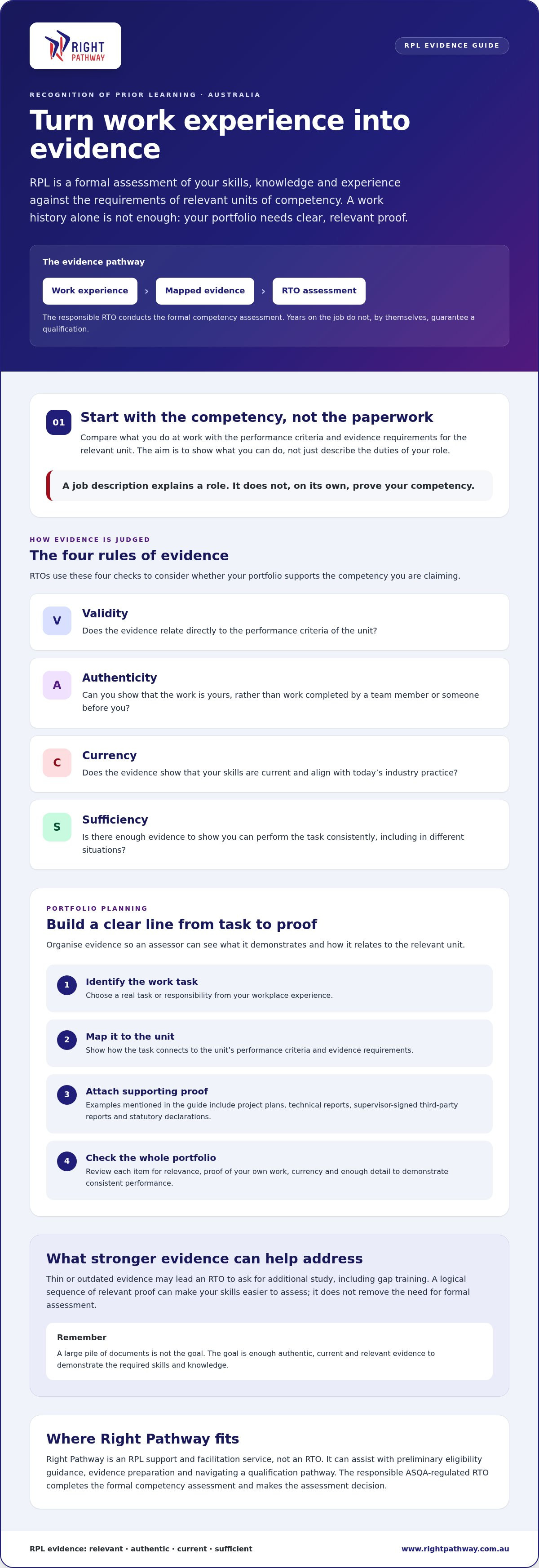
Every piece of proof you submit must meet four specific standards:
- Validity: The evidence must relate directly to the performance criteria of the unit you're claiming.
- Authenticity: You must prove the work was performed by you, not a team or a predecessor.
- Currency: Your skills must be recent, typically demonstrated within the last two to three years to ensure they align with modern industry standards.
- Sufficiency: You must provide enough evidence to show you can perform the task consistently over time and in different situations.
Proving Authenticity and Validity
Generic job descriptions are rarely accepted as valid evidence because they outline what a role involves rather than what you've actually achieved. To satisfy the authenticity rule, partner RTOs often require statutory declarations or third-party reports signed by a supervisor. These documents verify that the work samples, such as project plans or technical reports, are your own. You can determine if your current documentation is on the right track by completing a free initial eligibility assessment today.
Currency and Sufficiency in 2026
Under the revised standards implemented in 2025, RTOs have placed a much higher premium on currency. For long-term professionals, this means you can't rely solely on experience from a decade ago; you must show you're still competent in the current industry landscape. Sufficiency doesn't mean providing hundreds of pages. It means providing a logical sequence of proof that demonstrates you've mastered a skill through repeated, successful application in the workplace.
Common Types of RPL Evidence Requirements
Meeting the RPL evidence requirements Australia sets involves collecting a diverse range of documentation. RTOs typically categorise this proof into three distinct streams. Direct evidence is the most powerful; it includes tangible outputs like project plans, technical drawings, or signed contracts. Indirect evidence, such as third-party reports and performance reviews, provides a supervisor's perspective on your skills. Supplementary evidence, including transcripts of prior study or overseas qualifications, helps map your foundational knowledge. Navigating the RPL evidence requirements Australia mandates is simpler when you understand which documents carry the most weight.
Beyond the paperwork, many RTOs require a technical interview or "competency conversation." This allows an assessor to verify that your practical skills match the depth of your portfolio. It's a chance to explain the "how" and "why" behind your work, bridging the gap between simply doing a task and proving your mastery of it.
Evidence for Trade and Construction Roles
In trade sectors, visual proof is essential. However, simply providing a photo of a finished wall or a wired circuit isn't enough. You must provide context, such as site photos where you are clearly identifiable or documentation with metadata. Primary proof often includes safety inductions, Job Safety Environmental Analyses (JSEAs), and toolbox talk records. RTOs prioritise evidence that demonstrates end-to-end project involvement, showing you can plan, execute, and finalise a task safely.
Evidence for Leadership and Healthcare
Corporate and healthcare roles require a different documentation strategy. For the BSB50420 Diploma of Leadership and Management, evidence focuses on your ability to lead teams and manage budgets. This might include meeting minutes, strategic plans, or de-identified performance management records. In healthcare, specifically for the CHC33021 Certificate III in Individual Support, you must document your adherence to compliance. Evidence often includes care plans, progress notes, and incident reports that demonstrate your competency in a clinical or community setting. Suitability for these qualifications depends on the specific evidence provided and the final RTO assessment.
Organising Your Portfolio for Success
Building a portfolio that satisfies RPL evidence requirements Australia demands a methodical approach. A structured four-step journey ensures your experience is presented with clarity and precision. First, conduct a free initial eligibility assessment to confirm your experience aligns with a specific qualification. Next, map your daily workplace tasks against the training package units. Collate and categorise your documents into logical sections to prevent "evidence fatigue" during the review. Finally, review your portfolio for any missing gaps before it's submitted to a partner RTO for formal assessment.
The Right Pathway Evidence Mapping Process
Our facilitators act as the bridge between your raw experience and the formal standards required by partner RTOs. We help you translate your years of "doing the job" into the specific language of competency. This mapping process is essential for ensuring your portfolio is robust and professional. Learn more about our RPL process to see how we've supported over 2,000 applicants across 18 industries. We simplify the complexities of RPL evidence requirements Australia by providing structured guidance throughout your preparation.
Final Checklist Before RTO Submission
Before your portfolio moves to the formal assessment stage, perform a final self-audit. Ensure every document is clearly labelled and organised according to the units of competency. Check your evidence against the "Rules of Evidence" to verify it is valid, authentic, current, and sufficient. A well-organised portfolio demonstrates professional pride and makes it easier for an assessor to verify your expertise. It's important to remember that Right Pathway is a facilitation service, not an RTO, and we don't provide migration or visa advice. We support your evidence preparation, while formal certification is completed by our partner RTOs.
Secure Your Professional Validation
Mastering the RPL evidence requirements Australia mandates is the most effective way to turn your years of hard work into a formal professional asset. By aligning your workplace experience with the rigorous standards of ASQA-regulated RTOs, you ensure your portfolio stands up to modern regulatory scrutiny. We've supported over 2,000 applicants across 18 industries, providing the expert facilitation needed to bridge the gap between your daily tasks and formal competency benchmarks.
Your dedication and technical expertise deserve to be validated through a nationally recognised qualification. While Right Pathway is not an RTO and does not provide migration or visa advice, we serve as your knowledgeable navigator throughout the evidence preparation phase. Final certification is completed by our partner RTOs, ensuring your outcome meets the highest industry standards. Take the next step toward your professional goals with confidence, knowing you have an expert facilitator in your corner.
Frequently Asked Questions
How far back can my work experience go for an RPL assessment?
Most RTOs require evidence of work performed within the last two to three years to satisfy the currency rule. While you can include older experience to show career depth, the assessor must see that your skills align with modern industry benchmarks. If you've been in the same role for a decade, focus on your most recent achievements to meet the strict RPL evidence requirements Australia mandates for 2026.
Can I use overseas work experience as RPL evidence in Australia?
Yes, overseas experience is highly valued, provided it maps directly to Australian training package units. You'll need to provide high-quality evidence like technical drawings, site photos, or employment contracts, translated into English where required. Right Pathway specialises in supporting skilled migrants with this mapping process. We help you organise your international portfolio so partner RTOs can assess your competency against Australian benchmarks through a free initial eligibility assessment.
What happens if I cannot provide copies of confidential work documents?
You can still prove your skills by using de-identified documents or redacting sensitive client information before submission. If confidentiality agreements prevent any document sharing, RTOs often accept third-party reports from supervisors or statutory declarations as alternative proof. Our facilitators guide you on how to present your expertise without breaching professional obligations. It's important to note that Right Pathway is a facilitation service, not an RTO, and certification is completed by partner RTOs.
Do I need to have a current job to apply for RPL?
You don't need to be currently employed to apply, but you must demonstrate that your skills are still current. If you've recently left a role or are between projects, you can use evidence from your most recent employment. The key is showing that your knowledge hasn't lapsed. We recommend a free initial eligibility assessment to determine if your previous experience is sufficient to meet the current requirements for your chosen qualification.
Is a reference letter from my boss enough to get a qualification?
A reference letter is considered indirect evidence and is rarely enough on its own to secure a qualification. RTO assessors require a mix of direct proof, such as work samples or project logs, to verify your actual performance. While a strong letter supports your application, it must be part of a broader portfolio that satisfies the rules of validity and sufficiency. For candidates who also need to manage employment verification or referee details when applying for new roles, resources such as workreferences.com can provide specialised support. Right Pathway helps you identify the additional documents needed to strengthen your case.

Article by
Right Pathway Team
Right Pathway supports experienced workers, tradespeople and skilled migrants with preliminary RPL eligibility guidance, evidence preparation and qualification pathway navigation.
Right Pathway is not a Registered Training Organisation and does not conduct formal competency assessments or issue qualifications. Formal enrolment, competency assessment and qualification issuance are completed by the responsible Registered Training Organisation.
Start with a free initial RPL eligibility assessment at https://www.rightpathway.com.au/eligibility-check
Disclaimer
Right Pathway is a facilitation and support service only. We are not a Registered Training Organisation (RTO), do not conduct formal RPL assessments and do not issue qualifications. All formal RPL assessments and certifications are completed by partner RTOs regulated by ASQA. Eligibility and qualification outcomes depend on each applicant’s evidence, experience and the RTO’s assessment decision.


