

A strong RPL application isn’t measured by the size of its file. The common mistakes to avoid in RPL applications often start with evidence that isn’t clearly matched to the relevant units of competency, or with a qualification that doesn’t reflect the applicant’s actual work.
It’s easy to assume that years on the job or a large collection of documents will speak for themselves. But evidence must be relevant, authentic and current, with enough context to show what you did and how your experience relates to the required skills. The responsible Registered Training Organisation (RTO) conducts the formal assessment and may ask for further evidence or a practical demonstration.
This article explains how to map evidence to competencies, choose a suitable qualification, present overseas experience and review an application before submission. You’ll also learn how gaps, unclear work histories and disorganised documents can make your experience harder to assess.
Key Takeaways
- See how recent, relevant evidence can be organised to show skills against competency requirements.
- Learn why a suitable qualification should reflect your actual duties and experience, not just your job title.
- Understand how overseas work history and supporting documents can be presented clearly and consistently.
- Find out what a careful pre-submission review can catch, from missing details to unclear evidence.
How Does Professional Support Map Evidence to Competencies?
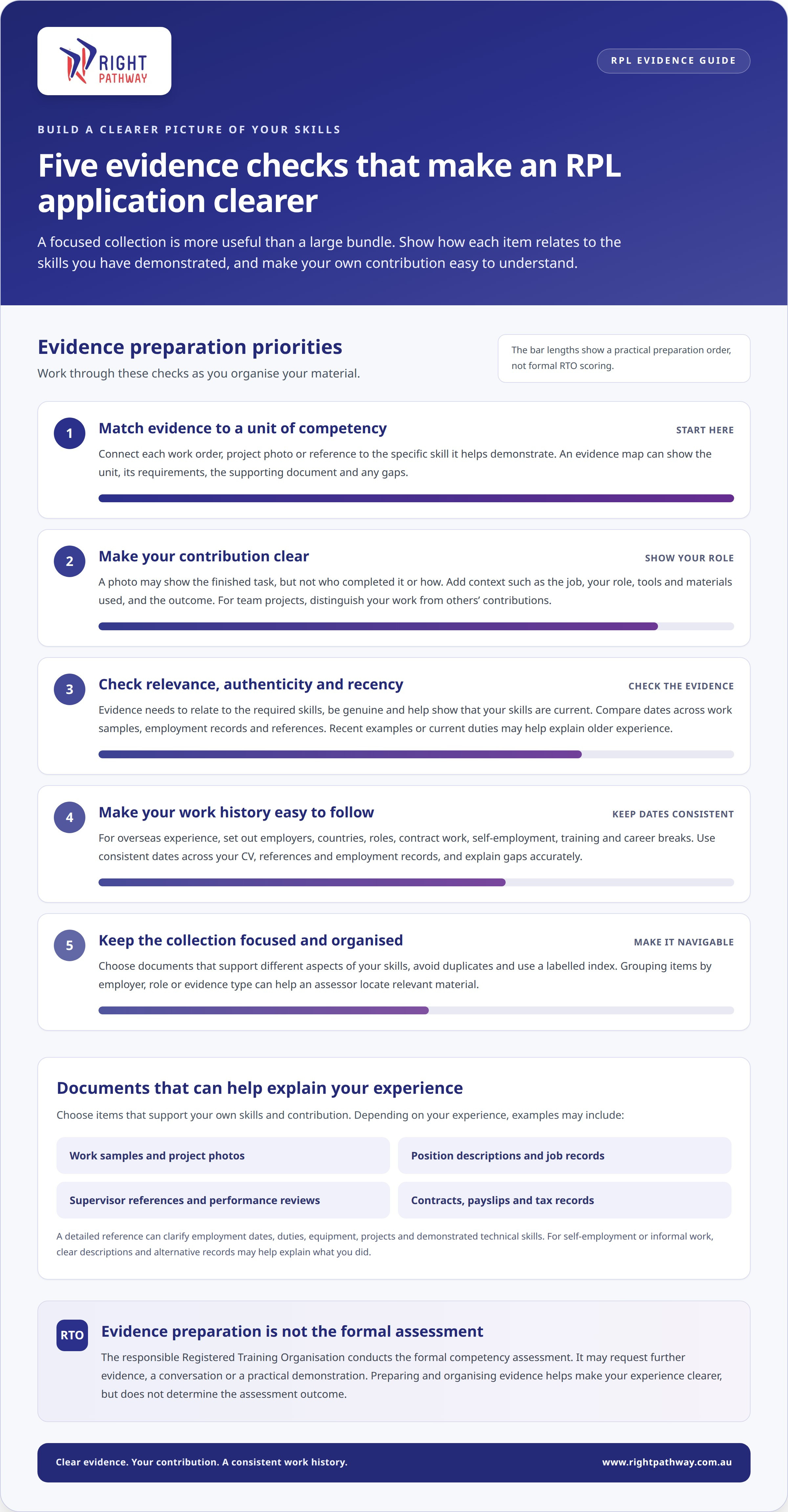
Start by matching each piece of evidence to the relevant unit of competency. A work order, project photo or supervisor reference should demonstrate a specific skill, not simply add pages to an application. An evidence map can list the unit, its requirements, the document that supports it and any gaps to address. This makes the connection between your work experience and the required skills clear.
Then check each item for relevance, authenticity and context. A photo of a completed construction task, for example, may show the result but not who did the work or how. Add a caption explaining the job, your role, the tools and materials used, and the outcome. For team projects, distinguish your contribution from other workers’ work. References and job records can provide further context about your responsibilities and work quality.
Recency matters: an old record may not show that your skills are current. Compare dates across work samples, employment records and references, and identify where more recent examples could strengthen your evidence. If your experience is older, current duties or recent examples may help show how you use your skills now. Be precise about your own work rather than relying on broad claims about a team or role.
Before preparing a submission, support can organise evidence against competency requirements and flag missing or unclear material. A concise index helps the assessor locate each item, while honest notes explain what a document demonstrates. The responsible Registered Training Organisation conducts the formal assessment and may request a conversation, practical demonstration or further evidence. This distinction matters: preparation helps present relevant evidence clearly, but does not decide whether competency has been demonstrated. A structured RPL pathway can help applicants understand how evidence relates to their experience and career goals.
Choosing a qualification that reflects your actual work experience
Choose a qualification that matches the work you’ve actually performed, not just your job title or career goal. Compare your duties, skills and prior learning with the qualification’s units of competency, then identify where your evidence appears strong or incomplete. Time in the industry alone doesn’t demonstrate competency across every unit.
For example, a tradesperson may have experience in installation and maintenance, while a proposed qualification also covers planning or documentation. Reviewing actual work records helps show which requirements your experience may address. Check the qualification’s current title and status on training.gov.au before proceeding. This can help you avoid preparing evidence for an unsuitable pathway.
Overseas qualifications and work experience can support an RPL application, but they must be considered against the applicable requirements. Where relevant to the qualification and assessment, the RTO may consider how overseas competencies align with Australian legislative and regulatory requirements. A translated certificate may help explain prior learning, while detailed job descriptions and references can clarify the tasks, responsibilities and standards involved.
Ask what role a consultant performs before engaging them. A consultant can help organise evidence and explain potential pathways, but cannot make the RTO’s formal assessment decision. A guaranteed qualification service risks creating false expectations, because recognition depends on evidence and competency assessment. Australian Registered Training Organisations are required to ensure that all assessors, including any engaged through third parties, meet relevant trainer and assessor competency standards.
If an Australian RPL application is unsuccessful, ask the RTO for its reasons and identify which competency requirements remain unmet. Then discuss whether further evidence, a practical demonstration or gap training could address those areas before deciding on your next steps.
Preliminary guidance can help you understand whether your work history aligns with a potential qualification before formal assessment. A free initial eligibility assessment can help identify a suitable pathway and evidence considerations, without replacing the RTO’s decision.
How overseas work experience and supporting documents are reviewed
Overseas experience is easier to review when documents support a clear work-history timeline. Include employers, countries, roles, contract work, self-employment, training and career breaks. Job descriptions should state what you did, where you worked and when. Consistent dates across your resume, references and employment records help the assessor follow your experience without having to resolve conflicting details.
Supporting documents may include position descriptions, payslips, contracts, tax records, performance reviews, recent work samples and written supervisor references. A detailed reference should give employment dates, job title, duties, equipment used, projects and technical skills demonstrated. For self-employment or informal work, alternative records and clear descriptions can explain what you did. The documents should support your own ability and contribution, not just confirm that you held a job.
Check that each document can be understood and authenticated. RTOs need to ensure RPL evidence is authentic. A reference that names the supervisor and gives their role, for example, provides clearer context than an unsigned note. For team projects, explain your individual responsibilities. If your timeline includes an employment gap, describe it accurately rather than leaving the dates unexplained.
A large bundle can make relevant evidence harder to find. Select a focused set of documents that supports different aspects of competency, then organise them in a labelled index by employer, role or evidence type. Avoid duplicates that repeat the same information. A position description and supervisor reference can complement each other if one outlines expected duties and the other describes what you did. A concise, consistent set of documents helps the assessor locate useful evidence.
How application information is reviewed before submission
A pre-submission review checks whether your application presents a consistent account of your work. Make sure your resume, work history and references agree on roles, dates and responsibilities. If your resume says you supervised a project but a reference says you assisted another worker, explain the difference before the RTO reviews your application. A clear account keeps inconsistencies from distracting from your evidence.
Next, compare each claim with the relevant competency requirements. A reviewer can flag unsupported statements, missing attachments or evidence that doesn’t clearly demonstrate a skill. For example, a project report should explain your contribution, the problem you addressed and the methods you used. A generic list of duties may not show what you personally did or how it relates to the requirements.
Check the files as well. Make sure they open, pages are legible, names and dates are visible, and filenames are clear. A file called “scan final” can be difficult to identify among several uploads. A concise index linking filenames to competency areas gives the assessor a practical guide and can reveal files attached to the wrong section.
A final review can catch common mistakes to avoid in RPL applications, including inconsistent details, duplicate files and unsupported claims. It should also flag competencies that may need further information before submission. If a document doesn’t support a claim, revise the description so it accurately reflects the evidence. RPL considers skills, knowledge and experience against applicable units, while the RTO makes the formal assessment decision.
Before submitting, compare the application form with its supporting records and make sure descriptions reflect your own work. Remove repeated files that add no new information. If a competency remains unclear, resolve the details or note what still needs attention instead of leaving an unexplained claim for the assessor to interpret.
Right Pathway
Right Pathway helps applicants organise RPL information and navigate potential qualification pathways. Our support can help when you’re unsure which documents relate to your experience, whether your work history aligns with a qualification, or what evidence may need further preparation.
With preliminary skills and experience guidance and an evidence-readiness review, Right Pathway helps clarify next steps before formal assessment. This is preparation: the RTO enrols applicants, assesses competency and makes the final RPL decision. It may also request further evidence or a practical demonstration.
If you’d like support making sense of your experience and potential RPL pathway, contact Right Pathway.
Take the next step with a clearer pathway
Your next step is to turn what you know about your work into a clear plan. Consider which qualification reflects your actual duties and whether your records explain your role. Common mistakes to avoid in RPL applications often start when people choose a pathway before considering their experience and supporting evidence together.
A preliminary conversation can help clarify how your background may align with a potential pathway and what preparation could help. Right Pathway provides RPL support and administrative facilitation, including a preliminary skills and experience eligibility consultation. This guidance helps you consider your options before formal assessment by the RTO.
Take the process one considered step at a time. A clearer understanding of your options can help you prepare for what comes next.
Frequently Asked Questions
How Can You Properly Map Evidence to Competencies?
Use the qualification’s unit requirements to note what each piece of evidence helps demonstrate. Then consider whether it reflects your own performance or merely describes a workplace process. For instance, a maintenance procedure may show the steps used, while your account can explain the decisions you made. The RTO considers whether the overall evidence supports the required competency.
How Does Poor Portfolio Organisation Impact Success?
A portfolio that’s difficult to navigate can make missing or inconsistent information harder to spot. Records filed under different employer names, for example, may appear to relate to separate roles when they refer to the same one. Clear labels and consistent naming help reviewers follow your work history and identify questions to resolve. Organisation supports the review, but doesn’t determine whether competency is demonstrated.
What Evidence Problems Cause RPL Rejections?
Evidence can be problematic if it can’t be authenticated, doesn’t relate to the qualification or fails to show your contribution. A reference that confirms employment but says little about the work may not support a particular competency. The RTO assesses the material against its requirements and may seek clarification or further evidence before deciding whether you’ve demonstrated competency.
What Happens When You Ignore Skill Gaps?
An identified gap means the available evidence may not yet demonstrate a particular requirement. The RTO can explain what remains to be shown and may request further evidence, a practical demonstration or gap training. Gap training addresses a shortfall through learning, rather than simply adding documents to your portfolio. Clarifying the gap helps distinguish missing evidence from skills that need development.
Why Do Outdated Documents Undermine RPL Applications?
Older records may describe work methods, equipment or responsibilities that no longer reflect your current practice. They can still provide useful background, but may not show how you work now. The assessor considers their relevance alongside other information and may request current examples. Explain the date and circumstances of older material so its value is clear.
What evidence do Australian RPL assessors require for competency assessment?
There’s no single set of evidence that suits every qualification. The RTO considers the relevant units and whether the material demonstrates practical ability, underpinning knowledge and safe work practices. Depending on the competency, assessment may include questions about decisions, hazards or procedures, as well as a practical demonstration. Follow the RTO’s evidence instructions, as formal assessment methods depend on its requirements.

Article by
Right Pathway Team
Right Pathway supports experienced workers, tradespeople and skilled migrants with preliminary RPL eligibility guidance, evidence preparation and qualification pathway navigation.
Right Pathway is not a Registered Training Organisation and does not conduct formal competency assessments or issue qualifications. Formal enrolment, competency assessment and qualification issuance are completed by the responsible Registered Training Organisation.
Start with a free initial RPL eligibility assessment at https://www.rightpathway.com.au/eligibility-check
Disclaimer
Right Pathway is a facilitation and support service only. We are not a Registered Training Organisation (RTO), do not conduct formal RPL assessments and do not issue qualifications. All formal RPL assessments and certifications are completed by partner RTOs regulated by ASQA. Eligibility and qualification outcomes depend on each applicant’s evidence, experience and the RTO’s assessment decision.


